
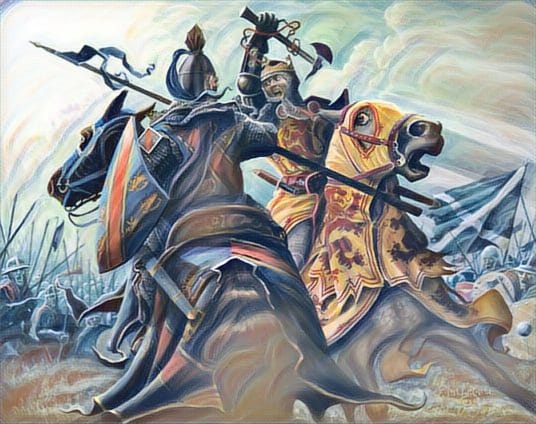

The Battle of Bannockburn
23 & 24 June 1314: An English army under King Edward II of England sent to relieve Stirling Castle was defeated by Scots led by Robert the Bruce, King of Scots at the Battle of Bannockburn. Edward II only narrowly escaped with his life. It was the most notable military victory in Scottish history.
Background
The Wars of Scottish Independence between England and Scotland began in 1296 and initially the English were successful under the command of Edward I, having won victories at the first Battle of Dunbar (1296) and at the Capture of Berwick (1296). The removal of John Balliol from the Scottish throne also contributed to the English success. The Scots under Sir William Wallace, later Guardian of Scotland, and Sir Andrew Moray had been victorious in defeating the English at the Battle of Stirling Bridge in 1297. This was countered, however, by Edward I’s victory at the Battle of Falkirk (1298). By 1304, Scotland had been conquered, but in 1306 Robert the Bruce seized the Scottish throne and the war was reopened.
After the death of Edward I, his son Edward II of England came to the throne in 1307 but was incapable of providing the determined leadership his father had shown, and the English position soon became more difficult.
In 1313, Bruce demanded the allegiance of all remaining Balliol supporters, under threat of losing their lands, as well as the surrender of the English garrison at Stirling Castle. The castle was one of the most important castles held by the English, as it commanded the route north into the Scottish Highlands. It was besieged in 1314 by Robert the Bruce’s younger brother, Edward Bruce, and an agreement was made that if the castle was not relieved by mid-summer it would be surrendered to the Scots.
The English could not ignore this challenge and prepared and equipped a substantial campaign. It is known that Edward II requested 2,000 heavily armoured cavalry and 25,000 infantry, many of whom were likely armed with longbows, from England, Wales and Ireland; it is estimated no more than half the infantry actually arrived, but the English army was still by far the largest ever to invade Scotland. The Scottish army probably numbered around 6,000 men, including no more than 500 mounted forces. Unlike the English, the Scottish cavalry was probably unequipped for charging enemy lines and suitable only for skirmishing and reconnaissance. The Scottish infantry was likely armed with axes, swords and pikes, and included only a few bowmen.
The precise numerical advantage of the English forces relative to the Scottish forces is unknown, but modern researchers estimate that the Scottish faced English forces one-and-a-half to two or three times their size.
Prelude to the Battle of Bannockburn
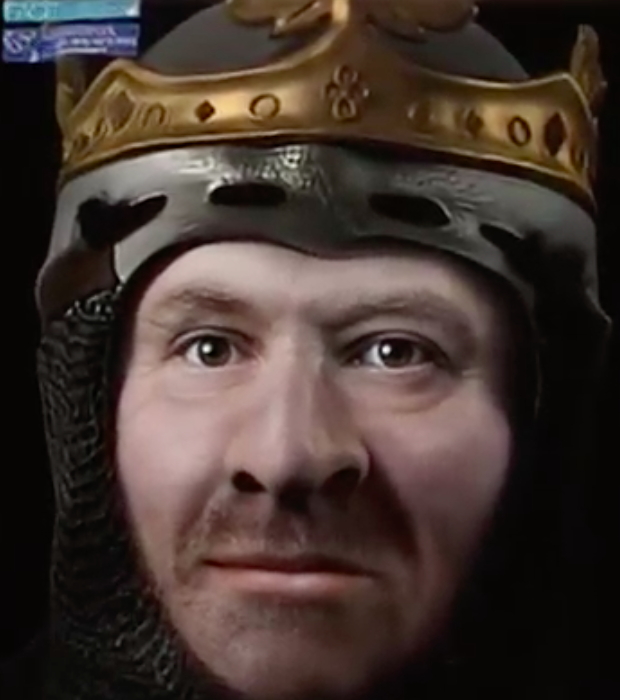
Edward II and his advisors were aware of the places the Scots were likely to challenge them and sent orders for their troops to prepare for an enemy established in boggy ground near the River Forth, near Stirling. The English appear to have advanced in four divisions. The Scots assembled defensive formations known as ‘schiltrons‘, which were strong defensive squares of men with pikes. Thomas Randolph, 1st Earl of Moray, commanded the Scottish vanguard, which was stationed about a mile south of Stirling, near the church of St. Ninian, while the king commanded the rearguard at the entrance to the New Park. His brother Edward led the third division. The fourth division was nominally under the youthful Walter the Steward, but actually under the command of Sir James Douglas. The Scottish archers used yew-stave longbows and, though these were not weaker than or inferior to English longbows, there were fewer Scottish archers, possibly only 500. These archers played little part in the battle. There is first-hand evidence in a poem, written just after the battle by the captured Carmelite friar Robert Baston, that one or both sides employed slingers and crossbowmen.
Location of the Battle of Bannockburn

The exact site of the Battle of Bannockburn has been debated for many years, but most modern historians agree that the traditional site, where a visitor centre and statue have been erected, is not correct.
A large number of alternative locations have been considered but modern researchers believe only two merit serious consideration:
- An area of peaty ground outside the village of Balquhiderock known as the Dryfield, about 0.75 miles (1.21 km) east of the traditional site.
- The Carse of Balquhiderock, about 1.5 miles (2.4 km) northeast of the traditional site. This location is accepted by the National Trust as the most likely site.
23 June 1314: the first day of the Battle of Bannockburn
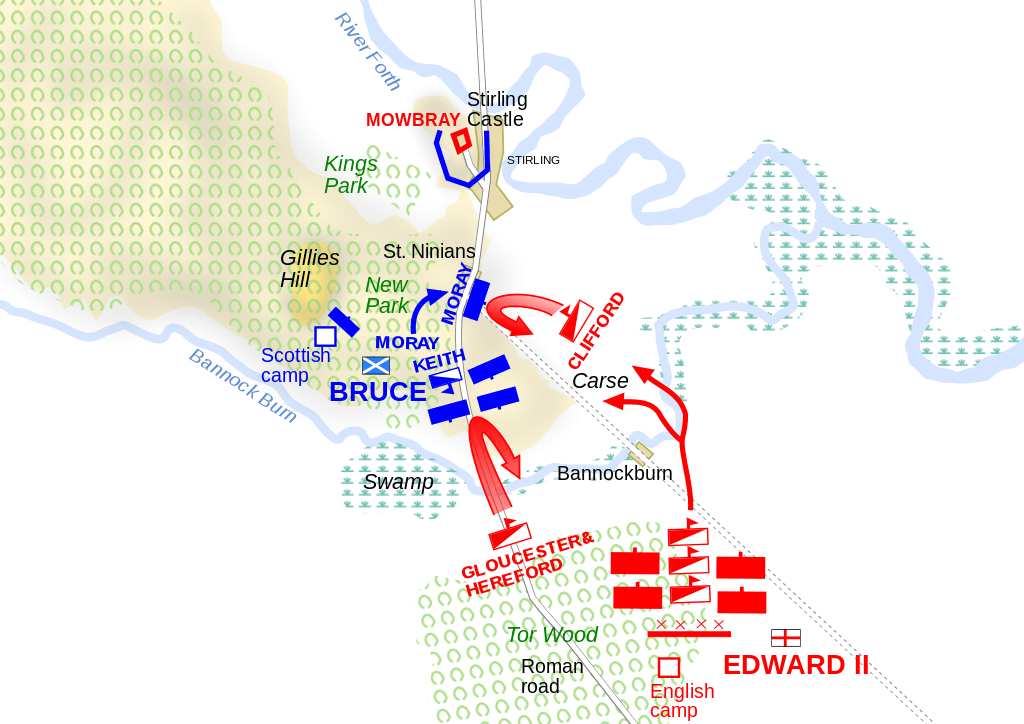
Most medieval battles were short-lived, lasting only a few hours, so the Battle of Bannockburn is unusual in that it lasted two days. On 23 June 1314 two English cavalry formations advanced. The first was commanded by the Earl of Gloucester and by the Earl of Hereford.
They encountered a body of Scots led by Robert the Bruce. Bruce and Henry de Bohun, nephew of the Earl of Hereford, faced off in what became a celebrated instance of single combat. Bohun charged at Bruce and, when the two passed side by side, Bruce split Bohun’s head with his axe. The Scots then rushed the English forces under Gloucester’s and Hereford’s command, who retreated, struggling back over the Bannockburn.
The second English cavalry force was commanded by Robert Clifford and Henry de Beaumont. Their forces included Sir Thomas de Grey of Heaton, father of the chronicler Thomas Grey. The younger Grey described the battle:
Robert Lord de Clifford and Henry de Beaumont, with three hundred men-at-arms, made a circuit upon the other side of the wood towards the castle, keeping the open ground. Thomas Randolph, 1st Earl of Moray, Robert de Brus’s nephew, who was leader of the Scottish advanced guard, hearing that his uncle had repulsed the advanced guard of the English on the other side of the wood, thought that he must have his share, and issuing from the wood with his division marched across the open ground towards the two afore-named lords.
Sir Henry de Beaumont called to his men: “Let us wait a little; let them come on; give them room“.
“Sir,” said Sir Thomas Gray, “I doubt that whatever you give them now, they will have all too soon“.
“Very well” exclaimed the said Henry, “if you are afraid, be off“.
“Sir,” answered the said Thomas, “it is not from fear that I shall fly this day.”
So saying, he spurred in between Beaumont and Sir William Deyncourt and charged into the thick of the enemy. William was killed, Thomas was taken prisoner, his horse being killed on the pikes, and he himself carried off with the Scots on foot when they marched off, having utterly routed the squadron of the said two lords. Some of the English fled to the castle, others to the king’s army, which having already left the road through the wood had debouched upon a plain near the water of Forth beyond Bannockburn, an evil, deep, wet marsh, where the said English army unharnessed and remained all night, having sadly lost confidence and being too much disaffected by the events of the day.— Sir Thomas Grey, Scalacronica, translated by Herbert Maxwell.
23 June 1314: the second day of Battle of Bannockburn

During the night the English forces crossed the stream known as the Bannockburn, establishing their position on the plain beyond it. A Scottish knight, Alexander Seton, who was fighting in the service of Edward II of England, deserted the English camp and told Bruce that English morale was low and encouraged him to attack.
In the morning the Scots advanced from New Park. Not long after daybreak, Edward was surprised to see the Scottish pikemen emerge from the cover of the woods and advance towards his position. As Bruce’s army drew nearer, they paused and knelt in prayer. Edward reportedly said in surprise, “They pray for mercy!” “For mercy, yes,” one of his attendants replied, “but from God, not you. These men will conquer or die.“
The Earl of Gloucester had argued with the Earl of Hereford over who should lead the vanguard into battle. He had also tried to persuade the king that the battle should be postponed. This led the king to accuse him of cowardice. Goaded by the accusation, the Earl of Gloucester advanced to meet the Scots. Few accompanied Gloucester and, when he reached the Scottish lines, he was quickly surrounded and killed.
The English were gradually pushed back and ground down by the Scots’ schiltrons. The English longbowmen attempted to support the advance of the knights but were ordered to stop shooting, as they were causing casualties among their own. The English then attempted to deploy their English and Welsh longbowmen to flank the advancing Scots, but they were dispersed by 500 Scottish cavalry under the Marischal Sir Robert Keith. (Although the Scottish cavalry is sometimes described as light cavalry, this appears to be a misinterpretation of Barbour’s statement that these were men-at-arms on lighter horses than those of their English counterparts.)
The English cavalry was hemmed in against the Bannockburn, making it difficult for them to manoeuvre. Unable to hold their formations, they broke rank. It soon became clear to Aymer de Valence and Giles d’Argentan (reputedly the third-best knight in Europe) that the English had lost the battle and Edward II needed at all costs to be led to safety. Seizing the reins of the king’s horse, they dragged him away, closely followed by 500 knights of the royal bodyguard.
Once they were clear of the battle d’Argentan turned to the king and said: “Sire, your protection was committed to me, but since you are safely on your way, I will bid you farewell for never yet have I fled from a battle, nor will I now.” He turned his horse to charge back into the ranks of Scottish, where he was overborne and slain.
The English Retreat

Edward fled with his personal bodyguard and panic spread among the remaining troops, turning their defeat into a rout. King Edward with about 500 men first fled for Stirling Castle where Sir Philip de Moubray, commander of the castle, turned him away as the castle would shortly be surrendered to the Scots. Then, pursued by James Douglas and a small troop of horsemen, Edward fled to Dunbar Castle, from which he took a ship to Berwick. From the carnage of Bannockburn, the rest of the army tried to escape to the safety of the English border, 90 miles (140 km) south. Many were killed by the pursuing Scottish army or by the inhabitants of the countryside they passed through.
Historian Peter Reese wrote that “only one sizeable group of men – all foot soldiers – made good their escape to England.” These were a force of Welsh spearmen who were kept together by their commander, Sir Maurice de Berkeley. The majority of them reached Carlisle. Weighing the available evidence, Reese concludes that “it seems doubtful if even a third of the foot soldiers returned to England.” If his estimate is accurate, of 16,000 English infantrymen, about 11,000 were killed. The English chronicler Thomas Walsingham gave the number of English men-at-arms who were killed as 700, while 500 more men-at-arms were spared for ransom. The Scottish losses appear to have been comparatively light, with only two knights among those killed.
Aftermath
The immediate aftermath was the surrender of Stirling Castle, one of Scotland’s most important fortresses, to King Robert. He then slighted (razed) it to prevent it from being retaken. Nearly as important was the surrender of Bothwell Castle where a sizeable party of English nobles, including the Earl of Hereford, had taken refuge. In exchange for the captured nobles, Edward II released Robert’s wife Elizabeth de Burgh, sisters Christina Bruce, Mary Bruce and daughter Marjorie Bruce, and Robert Wishart, Bishop of Glasgow, ending their 8-year imprisonment in England.
The defeat of the English opened up the north of England to Scottish raids and allowed the Scottish invasion of Ireland and the installation of King Robert’s younger brother, Edward Bruce, as High King of Ireland. This all finally led, after the failure of the Declaration of Arbroath to secure diplomatic recognition of Scotland’s independence by the Pope, to the Treaty of Edinburgh–Northampton in 1328. Under the treaty the English crown recognised the full independence of the Kingdom of Scotland, and acknowledged Robert the Bruce, and his heirs and successors, as the rightful rulers.
Notable casualties
The following are the notable casualties and captives of the battle.
Deaths
- Gilbert de Clare, 8th Earl of Gloucester
- Sir Giles d’Argentan
- John Lovel, 2nd Baron Lovel
- John Comyn, Lord of Badenoch
- Robert de Clifford, 1st Baron de Clifford
- Sir Henry de Bohun
- William Marshal, Marshal of Ireland
- Edmund de Mauley, King’s Steward
- Sir Robert de Felton of Litcham, 1st Lord
- Malduin (Malcolm) MacGilchrist, 3rd Lord of Arrochar
- William de Vescy of Kildare
- John de Montfort, 2nd Baron Montfort
- Payn Tibetoft, 1st Baron Tibotot
- William de Hastelegh
- Edmund Hastings, 1st Baron Hastings
- Miles de Stapleton
- Simon Ward
- Michael de Poinyng
- Thomas de Ufford
- John de Elsingfelde
- Ralph de Beauchamp
Captives
- Humphrey de Bohun, 4th Earl of Hereford
- John Segrave, 2nd Baron Segrave
- Maurice de Berkeley, 2nd Baron Berkeley
- Thomas de Berkeley
- Sir Marmaduke Tweng
- Ralph de Monthermer, 1st Baron Monthermer
- Robert de Umfraville, Earl of Angus
- Sir Anthony de Luci
- Sir Ingram de Umfraville
- Sir John Maltravers, 1st Baron Maltravers
- Sir Thomas de Grey of Heaton
- William le Latimer
- John Giffard
- Giles de Beauchamp
- Gilbert de Bohun
- Thomas de Ferrers
- Roger Corbet
- John Bluwet
- Bartholomew de Enefeld
- John Cysrewast
- John de Clavering
 Vecchio