

Dunino Den, by Scenic Scotland.

Hidden in a wooded gorge behind a 19th century church in the tiny village of Dunino near Saint Andrews there lies an Iron Age pre-Christian site where what can only be described as a “Druidic Temple” can be found, exactly what went on here over 2,000 years ago can only be speculated at.
The site known locally as Dunino Den consists of a high rock ledge with an intersecting carved rock stairway that leads down to a natural hollow where a small stream flows through, water always played an important part in Celtic mythology and streams such as this one (Dunino Burn) are not uncommon in Celtic pagan sites.
The site has several points of interest, all rock carvings although I would guess that they are not all as early as the Iron Age.

The Den can be reached from a small car park adjacent to the church and as you pass through the Churchyard you will pass by the site of what was once a Bronze Age Stone Circle, there were three remaining stones in 1840 when the site was visited by an Antiquarian but none now remain, and in 1834 a ploughman unearthed a deliberately buried hoard of seven polished bronze axe heads most likely to have been an offering to the gods.
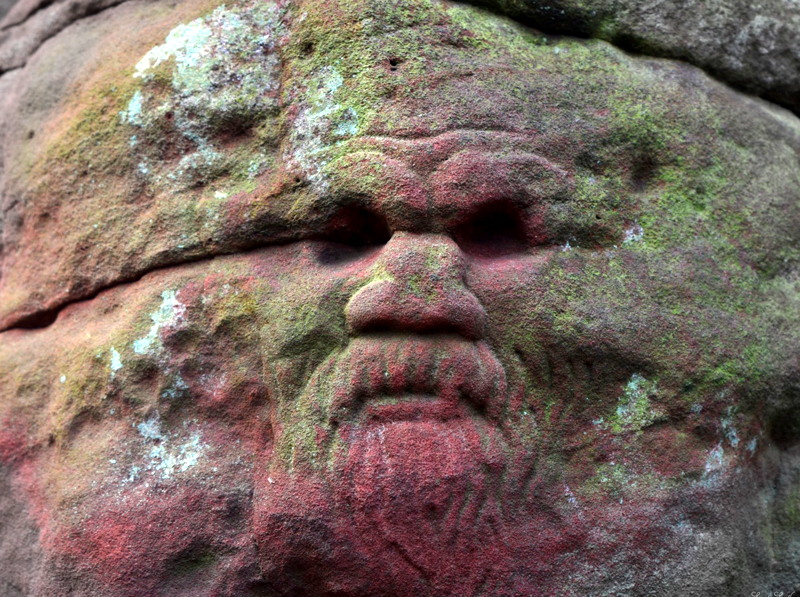
In the churchyard there is a the lower part of an Early Medieval / Pictish Cross Slab, there is the remains of a cross carved in relief on the broad side of the stone, in more recent times the top of the stone has been flattened off and a Sundial had been carved into the stone with a metal style or gnomon still in place to cast the shadow that marks the time, this stone has also become a shrine it is adorned with many coins and other trinkets.
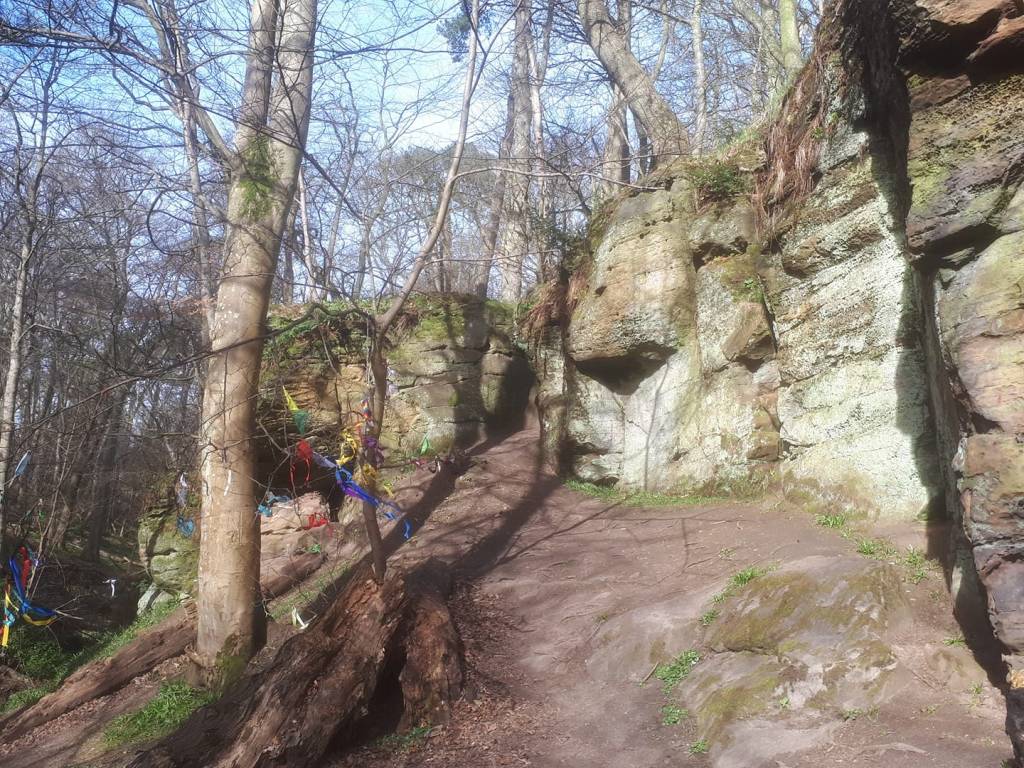
From the Cross Slab head east into the woods being careful as you go as the way ahead is both slippery and steep, at the end of the broad path you will be standing on a high rock precipice that overlooks the Den, there are two rock carvings here near the front of the ledge and both are of particular interest. The first is what would appear to be the carved shape of a footprint upon the rock it is well worn as something of great antiquity would be and generally filled with mud and bits of vegetation, if this is genuine it is one of only two I know of on the Scottish mainland, the other one is at the Fortress of Dunadd on the west coast of Argyll, this was the stronghold of the Irish Celtic warrior King Fergus Mór who crossed from Ireland in about 501AD and took that part of Scotland from the indigenous Epidii tribe and then established his own Scoto-kingdom of Dál Riata, Fergus Mór was the leader of the Scotti tribe and it is from them that we get the expression and name Scots and Scotland.

The second carving is much larger and more defined, it takes the form of a shallow well and is called ‘Pot Hole’ by the local populace, it is about three feet across and two or three feet deep, its purpose can only be speculated on but it may have been used as part of a sacrificial ceremony, perhaps animals were bled into the well by a Druid who was conducting a ritual that would ensure a good harvest or perhaps something far more sinister in the form of a human sacrifice.
The Druids of what is now Scotland where prevalent until the arrival of the Roman Empire in the southern reaches of the country the area we now call the Borders, So little of the Druid culture is known about as they left no written accounts of their everyday lives and religious beliefs, all we really do know is that the Druids were essentially the religious and spiritual leaders of the old Celtic society, it was common place for knowledge and social history in Celtic culture only to be passed by word of mouth, the Celtic culture had a very strong oral tradition.
Julius Caesar the great Roman consul told us much of what we know of these strange and romantic people from a time long gone.
The Druids believed in a place that was very similar to a parallel universe known to them as the Underworld where Daemons Færies and Gods alike would dwell, these otherworldly deities could move freely between their own world Tír na nÓg (land of the youth) and our world the land of mortals, entry into the Underworld for a mortal was either by entering an ancient burial mound (Færie Glen, Skye) or a specific cave (Uamh Tom a’ Mhòr-Fhir, Gleann Mòr, Perthshire) or by a secret entrance under the waters of a hallowed loch, Tír na nÓg could also be reached by crossing the Great Western Sea, (as Oisín and Niamh did on the back of the great white Kelpie). An Otherworldly woman could invite a worthy mortal into the Otherworld by offering him a silver apple or perhaps by leaving a trail of thread for him to follow.
Transmigrate from one body to another and Reincarnation of the soul were other beliefs encouraged by the Druids in Celtic society, these ideals would encourage bravery and fearlessness in battle.
It was also the Druids job to teach the young people of the community everything from the sciences of the stars to the great knowledge passed to them by the Gods.
When the Romans arrived in southern Scotland they already had experienced the Druids from the tribes they had encountered all across Europe so they immediately began to abolished any Druidical orders that they found, forcing them through time over to the north and west of these islands, they knew about the reputation the Druids had for human sacrifice and blood shed when making offerings to their Gods, perhaps it was to ensure a good harvest or maybe safe passage for travellers by land or by sea, but when ever protection or guidance was asked for from the gods there was a good chance that blood was offered in return.
Sacrifices were often brutal and bloody and the victims may very well have been children, placing the victims in wicker baskets over an open fire was one method, reminiscent of the ‘Wicker Man’, or ritualistically mutilating the victims body before throwing it into a peat bog was another.
The ritualistic mutilation method of killing was thought to have been reserved for Royalty or high ranking individuals, there have been Bog-Mummies found that have been mutilated in this manner, their arms were tied behind their back then they were decapitated before having the torso cut from the lower part of the body and then the torso would be thrown into a peat bog where it would remain preserved throughout the ages due to the high pH levels within the bog.
When these mummies have been found they were in such a good state of preservation that even the fingerprints could be taken and on closer examination there were some very interesting details that were noticed, firstly these individuals were not muscular, this would indicate that these victims had never been used to manual work a theory that was supported by the fact that there were no calluses found on the fingers or palms of the victims hands, these facts pointed to someone of high status, Royalty.
Tanistry.
During the Dark Age period the Highlands were broken into several sub-kingdoms (Cait, Fidach, Fortriu, Ce, Fotla Circind and Fib) all of these districts were ruled over by a Mormaer or sub-King, they in turn were ruled over by the ‘Ard-Righ An Alba’ (high King of Scotland) and the Ard-Righ was elected to the rank of King usually by a council made up from the Mormaers. If the High King did not fulfil his Royal duties then he would be deposed of then replaced with a more competent person, this system is known as Tanistry.
There was one more distinctive mutilation that had been found on some of these Bog Mummies, the nipples had deep cuts underneath each of them, were they indicative of torture while the man was alive or perhaps they were put there after death to mark this person as a failed Ard-Righ.
In the second half of the 6th century AD an Irish Monk brought Christianity to the west and north of Scotland, this man was to become Scotland’s patron saint, St Columba. Columba made many trips into the Scottish Highlands from his base on the island of Iona and several of them were to the Dùn (a Celtic castle) of Bridei I, son of Maelchon, King of the Picts (554 to 584). Bridei had his stronghold of Craig Phadrig near the mouth of the River Ness just to the west of the modern city of Inverness, it is said that the Druidical advisors of Bridei disliked this new upstart priest, they created a magical spell that would raise a storm and thwart the coming of the word of this new God into their midst, but by the 8th century nearly all the peoples of Scotland and the Highlands had abandoned the old religions for new one.
Incidentally it was on one of these journeys up the Great Glen along the banks of Loch Ness in 565AD that the first encounter with the Loch Ness Monster was made. While Columba was travelling with his fellow monks along the shore of Loch Ness to the Dùn of Bridei they were stopped by a group of villagers who told them of a water daemon who had killed one of their friends while he was swimming on the loch, Columba decided to send one of the monks Luigne moccu Min into the water to see if the creature would return, no sooner had the monk entered the water than the creature appeared, it started towards the monk but before it could get to him Columba raised his cruciform staff into the air and bellowed at the beastie to “Be-gone” and at that the creature of Loch Ness disappeared back into the dark depths of the loch.
The high alter at Dunino was undoubtedly the scene of many pagan rituals throughout the many centuries that it was in use, a place from where the mortal people could connect with their Gods, make offerings and give praise.
Just to the right of the well and footprint there is a stairway carved into a fisher in the rock face that leads down into the Den proper, the steps are well worn now slippery, muddy and steep but still intact, on the way down on the left side carved into the vertical rock face there is a carving of an interlaced Celtic knotwork design, as stone work is so hard to Radiocarbon date is of an undeterminable date.
From the Den the view back up to the alter area gives you a feeling of how it must have been at the time when this place was in use, the Druid Priest would have been high above his followers preaching the will of which ever God he was communicating with. One group of early Celts called the Tuatha Dé Danann (People of the Gods) were well known for the many deities that they worshiped, Manannan Mac Lir, God of the Sea. Lugh, warrior King and blacksmith God, The Morrígan, Badb and Nemain are the three sister goddesses of sovereignty and war. These are just a few of many dozens of Gods and Demi-gods the Celts worship.

Just a few meters further round the rock escarpment there is another rock carving this one is of an early Christian Cross complete with nimbus and hollow intersections at the junctions of the arms, this cross is of a latter date than those to be found within the Den its-self, this carving is estimated to be from sometime in the Early Medieval period when Christianity was becoming the predominant religion of Scotland, the cross is carved in a slight recess within the cliff face and stands about two meters high, although it shows signs of weathering at the upper parts overall it is in very good condition.
It is not unusual to find a Christian settlement or early chapel built on or near-by an earlier pagan site, it is as if these early Christians were trying to send out a message to the local pagan tribes saying ‘forget the old and embrace the new’, The inhabitants of Dark Age Scotland, the Picts, the Scots and the Brythonic people of the south were all readily converted to the new faith, perhaps they were tired of the old ways of death and sacrifice, traditional religious teachings of Scotland claim that the people of northern Briton were largely converted by Irish missionaries such as Saint. Columba sometime between the fifth to the seventh centuries.
Dunino Den is not the easiest site to visit as the paths are muddy and there are no protective barriers at the cliff edges, therefore it is recommended that only experienced ramblers and walkers visit this place.
Regardless of your beliefs you may encounter people here who have completely different religious conviction than your self, and who knows you may even encounter fairies or other mysterious creatures from Celtic mythology while you are here.
 Vecchio