


17 June 1390: On this day 631 years ago, Alexander Stewart destroyed Elgin Cathedral in reprisal against Bishop Alexander Bur. He was the youngest son of Robert II by his first wife, Elizabeth Mure of Rowallan, younger brother of John, Earl of Carrick (later King Robert III) and Robert, Earl of Fife (later Duke of Albany) and was himself Earl of Buchan in his own right and Earl of Ross by right of his wife. He is better remembered as the “Wolf of Badenoch”.
Alexander Stewart, Earl of Buchan, Alasdair Mór mac an Rígh, and called the Wolf of Badenoch (1343 – 20 June 1405), was the third surviving son of King Robert II of Scotland and youngest by his first wife, Elizabeth Mure of Rowallan. He was the first Earl of Buchan since John Comyn, from 1382 until his death. Alexander married the widowed Euphemia I, Countess of Ross, but they had no children. He did have a large family by his longtime mistress, Mairead inghean Eachainn. Alexander was Justiciar of Scotia for a time, but not an effective one. He held large territories in the north of Scotland before eventually losing a large part of them. Alexander is remembered for his destruction of the royal burgh of Elgin and its cathedral. His nickname was earned due to his notorious cruelty and rapacity, but there is no proof that it was used during his lifetime.

King Robert II died at Dundonald Castle in Ayrshire on 19 April 1390 and the chronicler Wyntoun informs that Robert was not buried at Scone until 13 August 1390, only a day before his son John, Earl of Carrick was crowned King as Robert III. Fife was retained as Guardian of Scotland probably much against Buchan’s hopes as he must have looked at some sort of volte-face on some of Fife’s actions, particularly as Buchan reached his zenith of possessions under Carrick. On top of this, Bishop Bur turned to Thomas Dunbar, Sheriff of Inverness and son of the Earl of Moray to provide his protection. The events of May and June 1390 in the Laich of Moray were perhaps the result of a combination of factors that presented themselves to Buchan. Firstly, John Dunbar, Earl of Moray and his fellow northern landowner Sir David Lindsay of Glenesk both absented themselves from Moray to attend a substantial tourney at Richard II of England‘s court. In addition, Bishop Bur’s involvement with Buchan’s estrangement with his wife and then Bur’s alignment with Moray presented an opportunity for revenge culminating in the destruction of Forres in May and then Elgin with its cathedral in June. His destruction of the church possessions in Elgin was complete—as well as the cathedral, the monastery of the Greyfriars, Saint Giles parish church and the Hospital of Maison Dieu were all put to flame. Church and state now came together to oppose him—excommunicated by Bur, Buchan had to appear at the Church of the Friars Preacher, in Perth in the presence of his brothers, King Robert III of Scotland and the Earl of Fife, and the council-general to plead for forgiveness—absolution was granted by bishop Walter Trail, Bishop of Saint Andrews.
Buchan’s brutal assault on Moray in 1390 was to some extent intended to extricate himself from Fife’s domination but turned out to be unsuccessful—Alexander was to lose his Lordship of Urquhart in 1392 and then his claim on Ross following his wife’s divorce in 1392. Fife’s influence waned during the mid-1390s while that of King Robert and his son David, Earl of Carrick increased—the King took back responsibility for Scottish-English relations and had manoeuvred the Red Douglas Earl of Angus into a dominating position in southeastern Scotland at the expense of Fife’s ally, the Black Douglas. Although Fife’s authority over Scottish affairs had lessened he still exercised considerable power in government. Fife and Carrick both campaigned against Buchan and his sons and other lawless elements in the west and north.
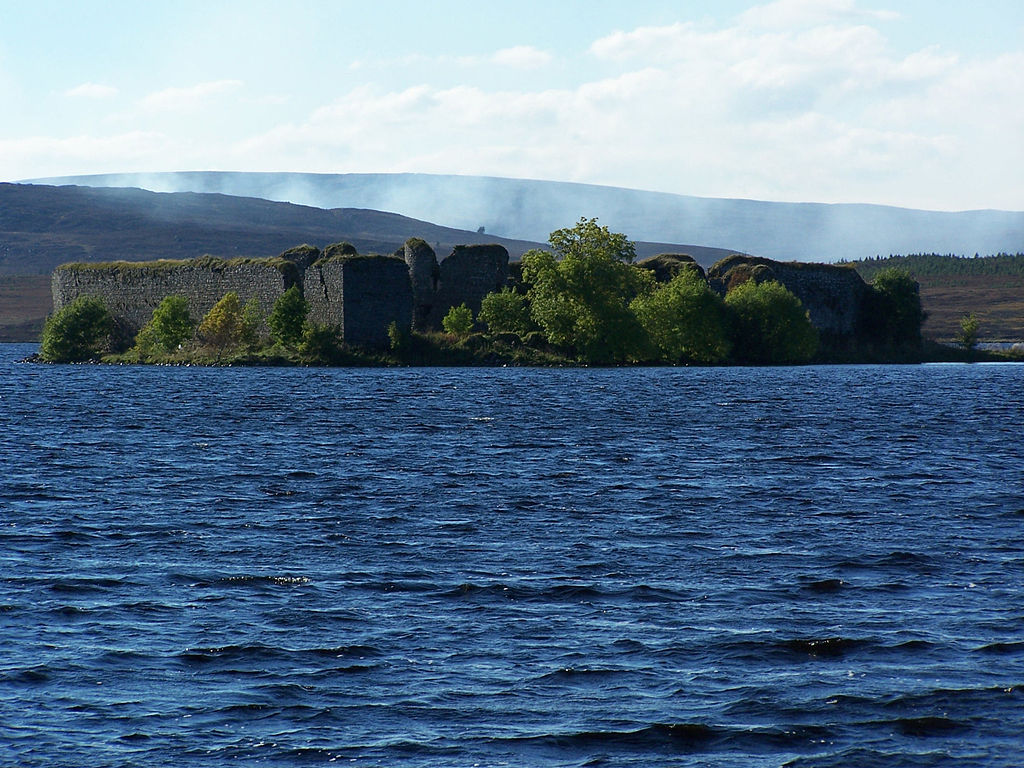
Although, Buchan appeared to have halted his violent traits after this, his sons did not. A fight ensued near Pitlochry involving Duncan and Robert Stewart at the head of a band of caterans, when Sir Walter Ogilvie and Walter de Lychton and followers were killed. Later it is recorded that three sons of Buchan’s were imprisoned in Stirling Castle from 1396 to 1402 and Alexander Grant theorises that Buchan’s low profile during the 1390s might have been because of his sons’ incarceration.
Buchan is again mentioned at Spynie Castle on 3 May 1398 being ordered to deliver it up to William, bishop of Moray by Robert III. Buchan appears to have left the north in his latter years appearing as Baillie of the Earldom of Atholl in 1402 and a mention in 1404 in Perth.
Buchan having acquired vast territories in the north lost a large part of them during his own lifetime (lands of Ross and Urquhart). He held royal appointments only to have them removed (Justiciar of Scotia and Royal Lieutenant north of the Moray Firth.) He was unsuccessful in maintaining law and order and this seen alongside his inability to hold onto his Ross territories demonstrated his ineffectiveness. He died in 1405, and was buried at Cathedral of Dunkeld, Perthshire. His chest tomb, topped by an effigy in armour, is one of the few Scottish royal monuments to have survived from the Middle Ages.
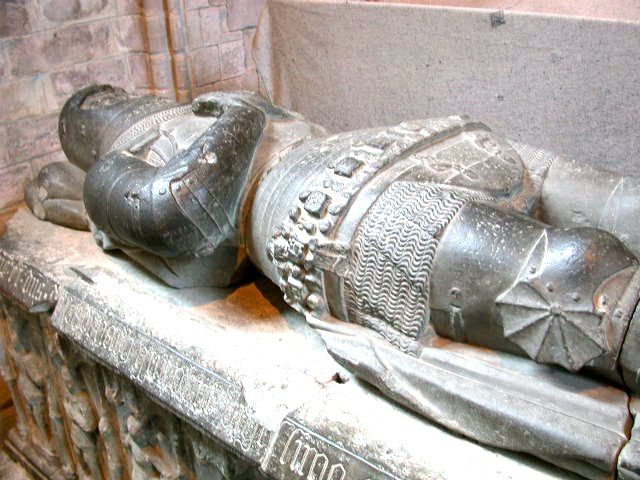
The Wolf of Badenoch in fiction: Lords of Misrule, by Nigel Tranter.
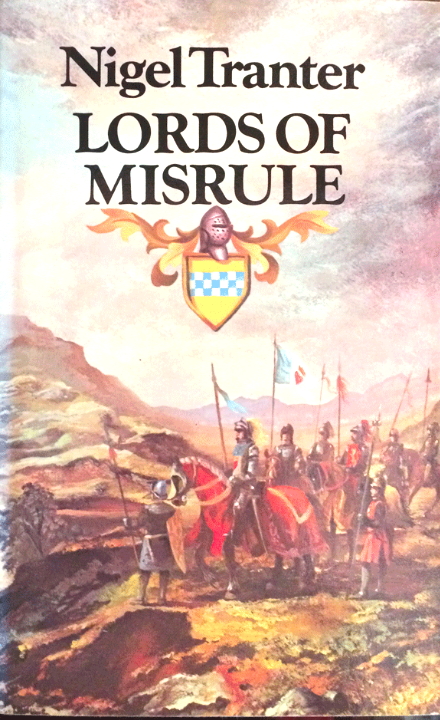
The first (of many) Nigel Tranter books that I read was Lords of Misrule, the first of Nigel Tranter’s Stewart Trilogy, in which Alexander Stewart, the Wolf of Badenoch is a character. The blurb states:
“In turbulent 14th century Scotland, the ruling House of Stewart was a house divided, beset by hatred and jealousy. Descendants of the Bruce’s daughter, they only kept the throne by an astonishing genius for survival – or, as many said, the luck of the Devil.
“Their rivals were the Douglases; and when the second Earl was slain in battle, the Stewarts were suspected of foul play.
“When young Jamie Douglas vowed to avenge his master, he only had his wits, courage and integrity with which to challenge the most eminent and the most unscrupulous men in the kingdom. And while vengeance burned in his heart, he could not prevent his fatal attraction for the beautiful and spirited Stewart women – and one in particular.”
The book was revieved by Whameread:
“Jamie Douglas is a young esquire to the Earl of Douglas, the most powerful man in 14th century Scotland, certainly more powerful than the King, Robert II, a sorry descendent of Robert the Bruce and doddering old man who just wants to be left alone. The King has spawned a clutch of squabbling Stewarts who are waiting to see what happens when he dies. Unfortunately, his oldest son, John, seems unsuited to power, and his second son, Robert, is ambitious and dangerous.
“When Jamie’s lord is foully stabbed in the back by his own armorer during battle, Jamie fears that any of several powerful men may have had enough to gain in the subsequent power vacuum among the Douglasses to have suborned the armorer. But when Robert Stewart, acting as his father’s Governor, appoints his good friend Archie Douglas to take the position of Earl, Jamie’s suspicions point to Robert.
“Jamie and some other men lie in wait outside the armorer’s home after they figure out where he is hiding, in hopes they can capture him and question him about who paid him to murder the Earl. Their plans go awry, however, ultimately sending Jamie Douglas north in pursuit of another man, to the Highland territories of the dreaded Alexander Stewart, Earl of Buchan, known as the Wolf of Badenoch.”
 Vecchio