
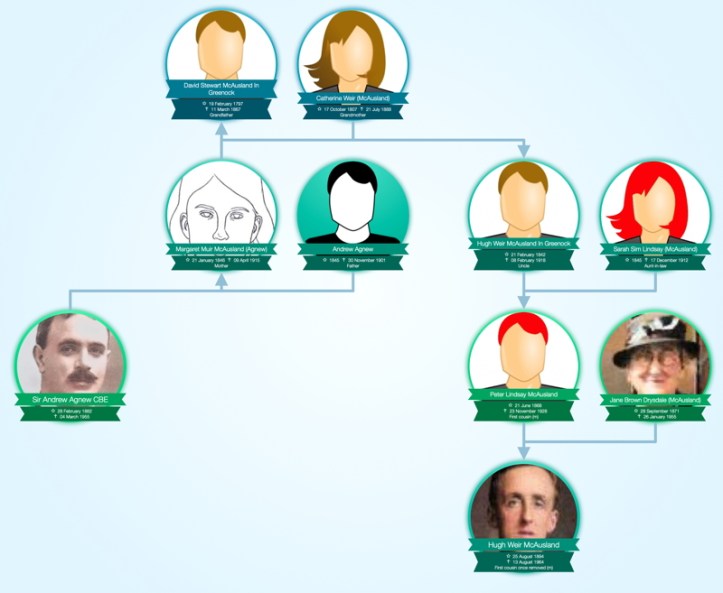
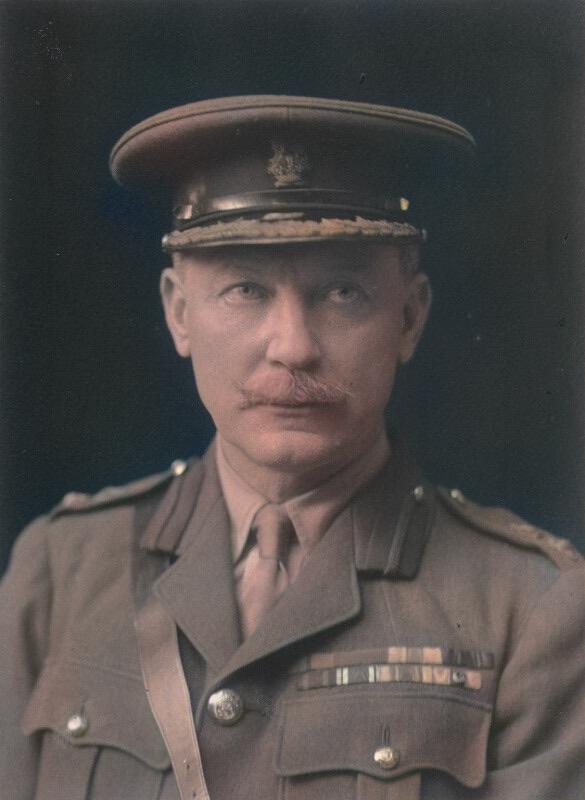
When I downloaded the Statutory Death Register entry for our first cousin three times removed, Andrew Agnew, I initially assumed that I had the wrong person as he was described as “Knight, C.B.E, Company Director and Landed Proprietor.”
However I did indeed have the correct person and discovered that he had served on the board of Shell Transport, Royal Dutch, Anglo-Saxon Petroleum & Asiatic Petroleum spanning over 30 years (1922-1953). He was also Chairman of Elba Tinplate Co (Wales), on the board of the Singapore Harbour and the MLC Straits Settlement (Singapore) and was the Chairman of the Petroleum Board during World War II.
Birth
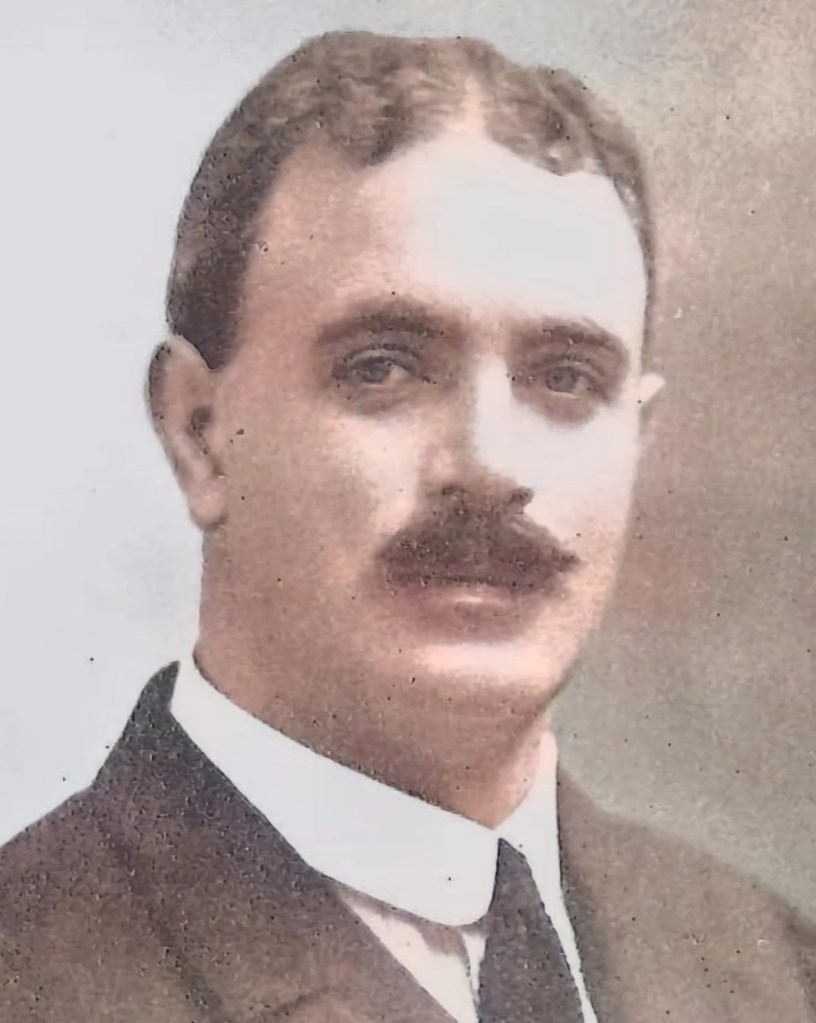
Andrew Agnew was born on 28 January 1882 at 38 Roxburgh Street in Greenock to Andrew Agnew (Rothesay 1845 – after 1901), a Master Grocer and his wife Margaret Muir McAusland (Greenock, 21 January 1846 – Greenock, 09 April 1915).
He had three sisters:
- Catherine Weir Agnew, who was born on 07 June 1875 in Greenock and died there on 09 January 1876, aged 7 months of Intussusception.
- Annie Thomson Agnew, who was born 23 December 1877 in Greenock and died there, unmarried, on 13 March 1949, aged 71, of Arterio-Sclerosis and Cerebral Thrombosis.
- Margaret Muir McAusland Agnew, who was born on 18 October 1879 in Greenock. She married William Shaw on 15 December 1915 in Greenock but the couple do not appear to have had any children. She died on 23 June 1953 at Larkfield Hospital in Greenock, aged 73 of Myocarditis and on 05 September 1953 the beneficiaries of her will were William Shaw, pharmacist and Sir Andrew Agnew CBE, Company Director.
Marriage
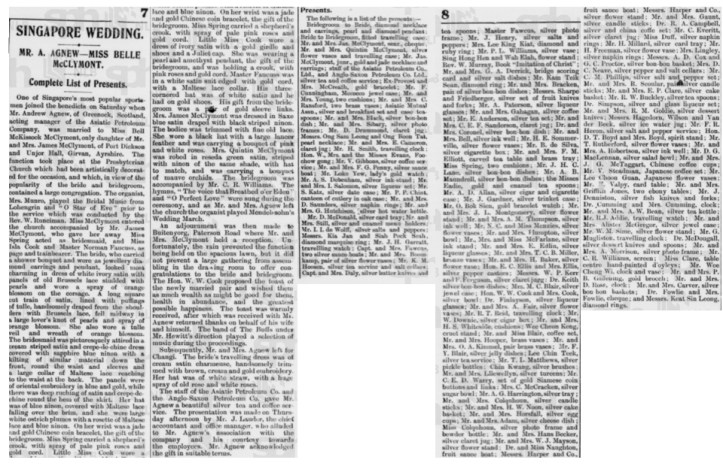
On 20 April 1912 Andrew Agnew married Isabella McKissock McClymont at the Presbyterian Church in Singapore. On 22 April 1912, their marriage was announced in the Straits Times and the list of their numerous wedding presents covered several column inches.
Children
The couple appear to have had at least two children, Andrew Agnew, named after his father, and James Agnew who became a Captain in the Royal Marines.
Death

Sir Andrew died on 04 March 1955 at Glenlee Park in Kells, to the south of Saint John’s Town of Dalry in Kirkcubrightshire. He was aged 73 and described as “Knight, C.B.E, Company Director and Landed Proprietor”. The cause of death was Hypertension and Cerebral Thrombosis as certified by G. N. MacKenzie M.B. Ch.B. The death was registered on 4th March 1955 at New Galloway by his son Andrew who had been present.
Probate
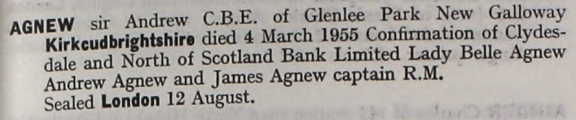
The will of Sir Andrew Agnew was sealed at London on 12 August 1955 with his heirs being confirmed as the Clydesdale and North of Scotland Bank Limited, Lady Belle Agnew, Andrew Agnew and James Agnew, captain, R.M.
Career
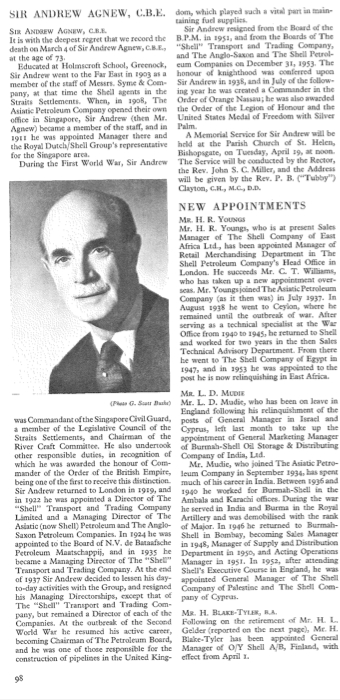
In 1955, Shell’s obituary for Sir Andrew Agnew read:
SIR Andrew AGNEW, C.B.E.,
It is with the greatest regret that we record the death on March 4 of Sir Andrew Agnew, C.B.E., at the age of 73.
Educated at Holmscroft School, Greenock, Sir Andrew went to the Far East in 1903 as a member of staff of Messrs. Syme & Company, at that time Shell Agents in the Straits Settlements. When, in 1908, The Asiatic Petroleum Company opened their own office in Singapore, Sir Andrew (the Mr. Agnew) became a member of the staff, and in 1911 he was appointed Manager there and the Royal Dutch/Shell Group’s representative for the Singapore area.
During the First World War, Sir Andrew was Commandant of the Singapore Civil Guard, a member of the Legislative Council of the Straits Settlements and Chairman of the River Craft Committee. He also undertook other responsible duties in recognition of which he was awarded the honour of Commander of the Order of the British Empire, being one of the first to receive this distinction.
Sir Andrew returned to London in 1919, and in 1922 he was appointed a Director of The “Shell” Transport and Trading Company Limited and a Managing Director of The Asiatic (now Shell) Petroleum and The Anglo-Saxon Petroleum Companies. In 1924, he was appointed to the Board of N.V. de Bataafache Petroleum Maatschappij, and in 1935 he became Managing Director of the “Shell” Transport and Trading Company. At the end of 1937, Sir Andrew decided to lessen his day-to-day activities with the Group, and resigned his Managing Directorships, except that of The “Shell” Transport and Trading Company, but remained a Director of each of the Companies. At the outbreak of the Second World War, he resumed his active career, becoming Chairman of the Petroleum Board and he was one of those responsible for the construction of pipelines in the United Kingdom, which played such a vital part in sustaining fuel supplies
Sir Andrew resigned from the Board of the B.P.M. in 1951, and from the Board of the “Shell” Transport and Trading Company, and The Anglo-Saxon and The Shell Petroleum Companies on December 31 1953.
The honour of knighthood was conferred on Sir Andrew in 1938 and in July of the following year he was created a Commander in the Order of Orange Nassau; he was also awarded the Order of the Legion of Honour and the United States Medal of Freedom with Silver Palm.
A Memorial Service for Sir Andrew will be held at the Parish Church of St. Helen, Bishopsgate, on Tuesday April 19, at noon. The Service will be conducted by the Rector, the Rev. John S. C. Miller and the Address will be given by the Rev. P. B. (“Tubby”) Clayton, C.H., M.C., D.D.
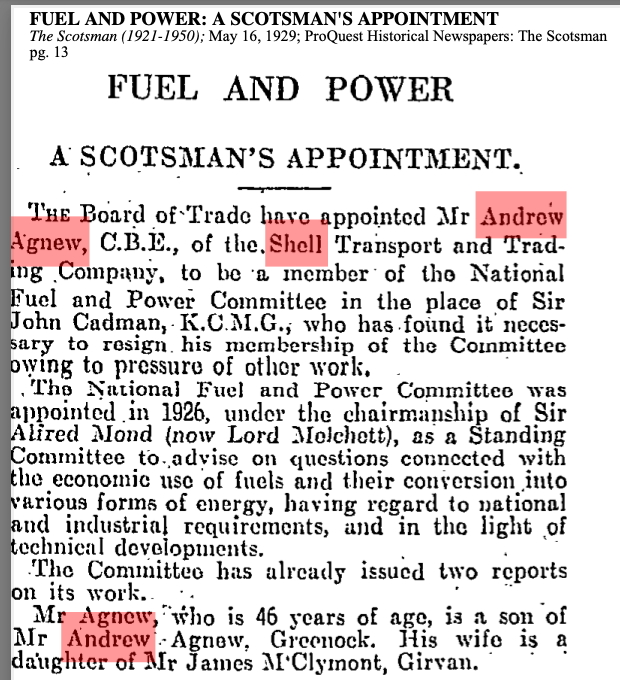
1929 Member of the National Fuel and Power Committee
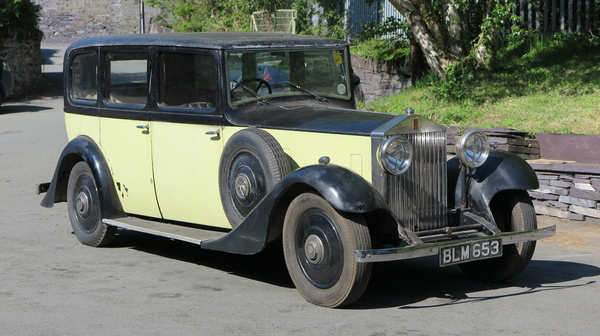
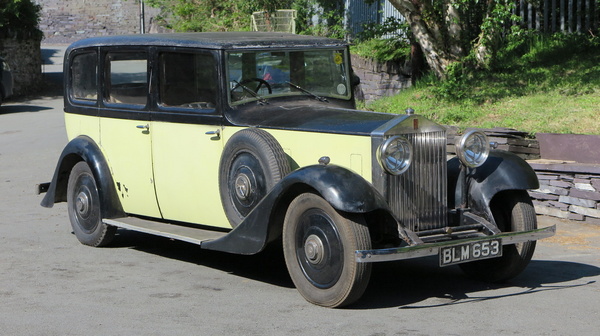
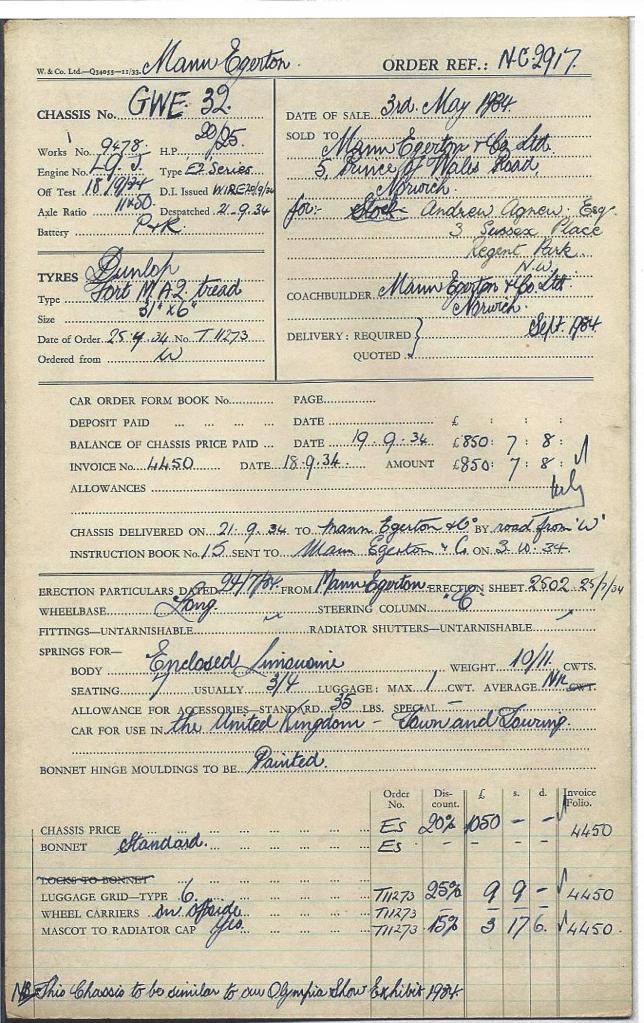
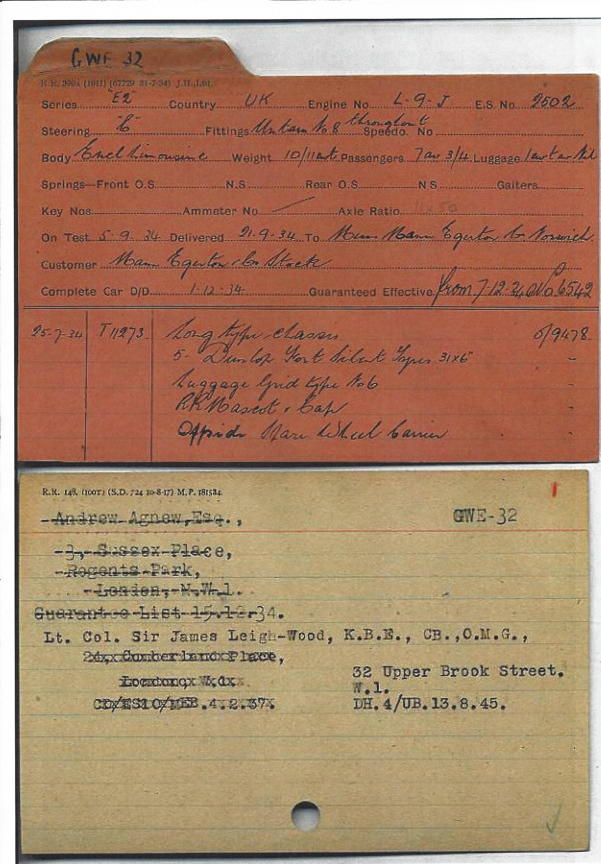
18 September 1934 – The Yellow Rolls Royce
While the Beatles had a Yellow Submarine, Sir Andrew Agnew owned a Yellow Rolls Royce, purchased on 18th September 1934 for £850 7s 6d.
09 June 1938 – Knighthood
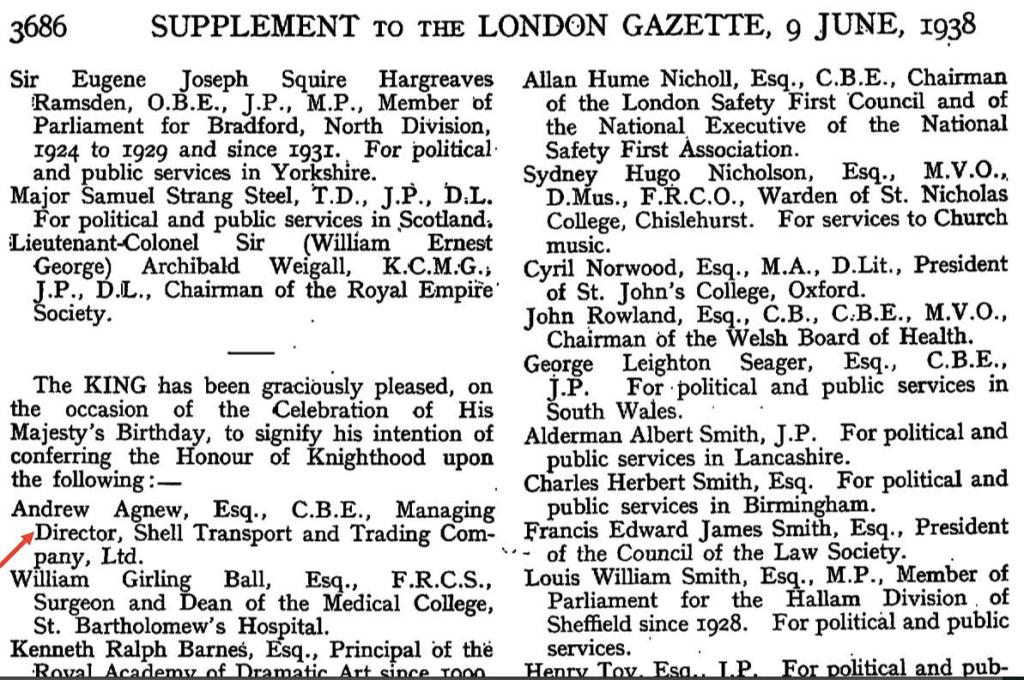
Andrew Agnew’s knighthood was announced in the London Gazette on 9th June 1938 and in the Edinburgh Gazette on 14th June 1938.
September 1939 Chairman of the Petroleum Board
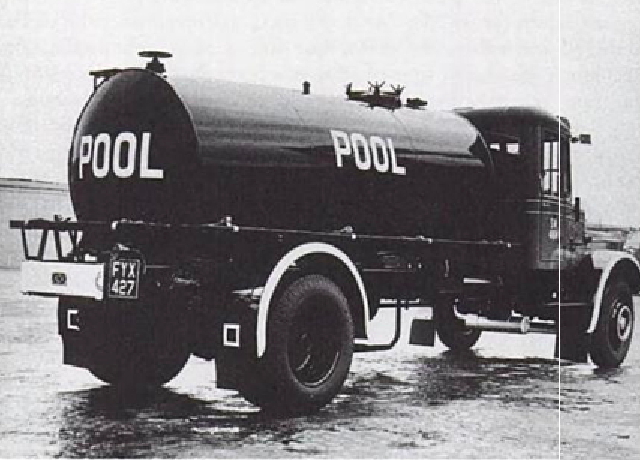
The Petroleum Board was established within a week of the outbreak of the Second World War in September 1939. It was based in Shell-Mex House on the Strand London. The membership comprised the Chairmen or Chief Executives of most of the petroleum and oil companies operating in the UK. The original corporate membership was the Anglo-American Oil Company Limited, the National Benzole Company Limited, Shell-Mex and BP Limited, and Trinidad Leaseholds Limited and their associated companies. Other oil companies joined the Board later. The aim of the Board was to oversee the import, processing, storage, distribution and delivery of all petroleum products in the UK with the exception of oil for the Royal Navy. Supplies of petroleum and petroleum products were no longer branded and competition between the oil companies was suspended.
The Board was acknowledged to have been effective. The success was claimed to be largely due to the Board’s Chairman, Sir Andrew Agnew, who had extensive knowledge of the oil industry and commanded respect within it. Sir Andrew was Managing Director of Shell Transport and Trading. In 1940 with most of the east coast and Channel ports closed by enemy bombing there was congestion of shipping at the west coast ports in Bristol Channel, the Mersey and the Clyde. The amount of petroleum being imported was limited to pre-war levels. The Petroleum Board addressed these logistical issues and achieved a doubling of oil import by the summer of 1941. Also during the fuel crisis during the winter of 1940-41 there were few problems with the distribution of petroleum. The Board made arrangements to use oil barges and ‘block’ trains to transport oil.
In 1941 there were reports in the press concerning rationing of petrol that had incorrectly identified the Petroleum Board as being the authority responsible for rationing. This prompted the chairman of the Petroleum Board, Sir Andrew Agnew, to write to the press to assert that the Board was not responsible for rationing. He pointed out that this was the responsibility of the Petroleum Department of Board of Trade, and the Ministry of War Transport.
Glenlee Park
Sir Andrew Agnew died at his country house of Glenlee Park south of Saint John’s Town of Dalry. In the 1940 Valuation Rolls, Sir Andrew Agnew is listed as the proprietor of thirteen properties at Glenlee (The Mansion House, Offices and Garden; Lodge (South); House, garden; Sawmill; Woodlands; Shootings; House and Bothy; House; House, Black Bank; Byre; House (North Lodge); Fishings in Ken; and Land). He was also listed as the proprietor of Land at Old Glenlee; Land at Glenlee Mains; Farm and House, Old Glenlee; Farm and House, Craigenbay; House, Craigenbay. Finally, at Shiel and Airlie, he is listed as the proprietor of six properties: Farm and House; House; House; House, Airlie; Shootings; and Woodland.
Meanwhile, his son, Andrew Agnew jr. is listed as the proprietor of three properties at Fintloch: Farm and House; House, Marchwell; and Shootings. The Shootings had as their tenant his father, Sir Andrew Agnew.
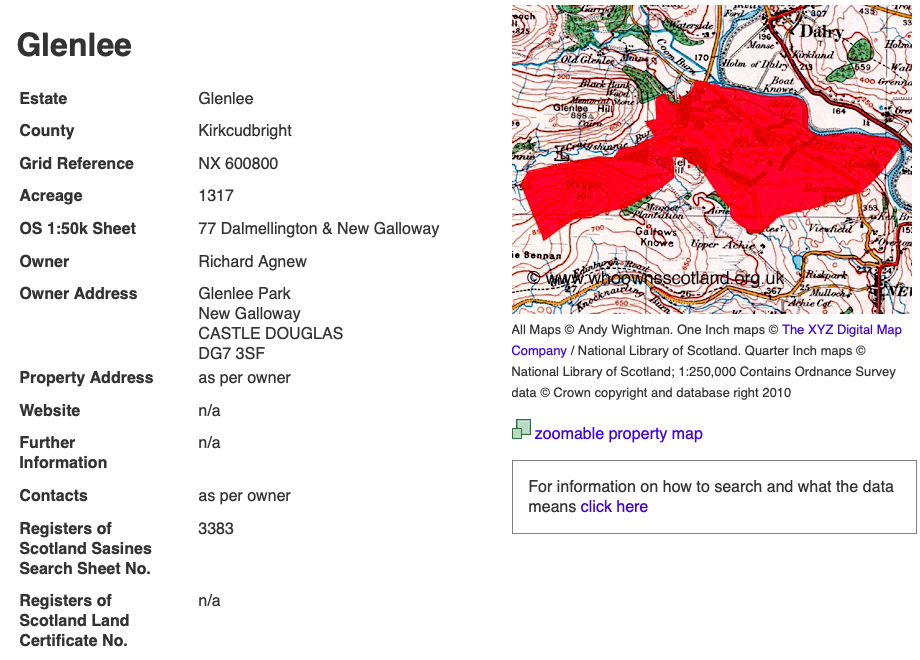
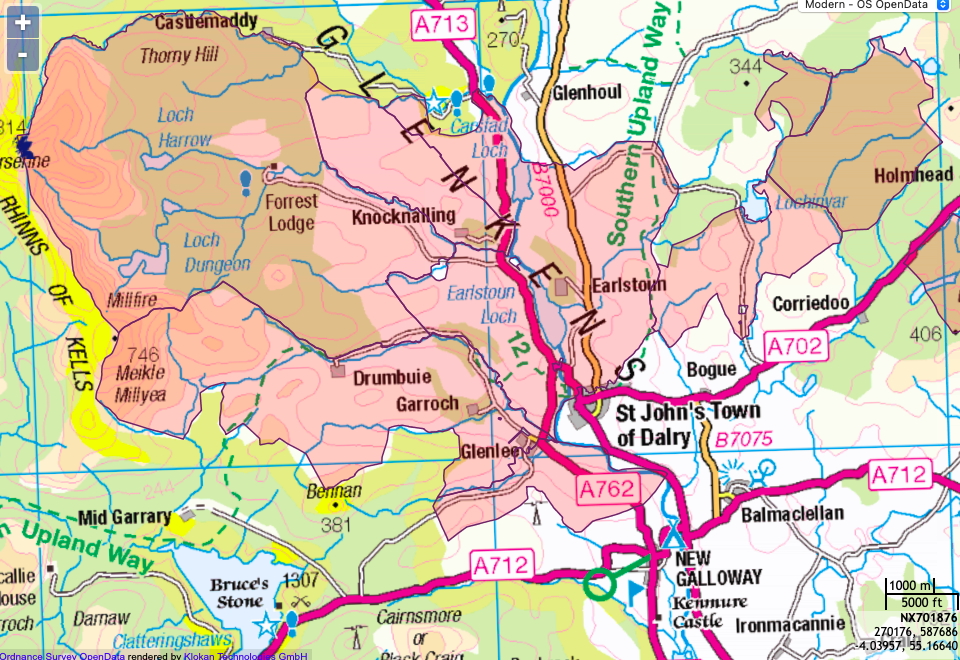
According to Andy Wightman’s excellent Who Owns Scotland? on 10 November 2008, the Glenlee estate was owned by Richard Agnew of Glenlee Park, likely a grandson or great grandson of Sir Andrew, which could potentially make him our third cousin once removed or fourth cousin.
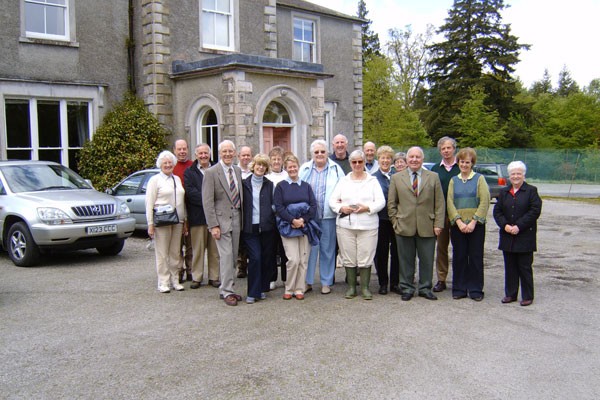
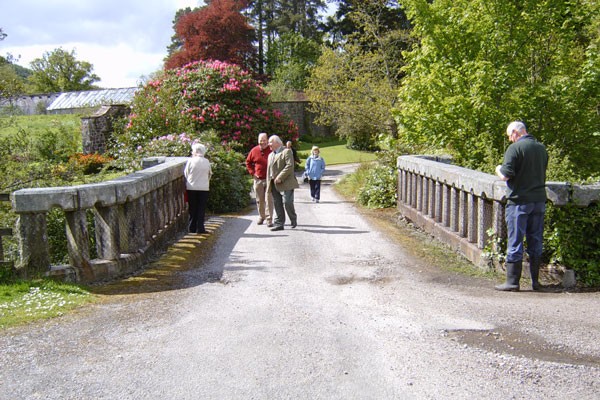
Richard and Cathie Agnew run five holiday cottages which are available to rent. “The five holiday houses at Glenlee are two miles from the villages of New Galloway and St. John’s Town of Dalry. They are in quiet secluded woodland well away from the road. They have been specially converted from the old Home Farm buildings of Glenlee Estate. Set round a central courtyard, each cottage is well equipped and comfortably furnished yet still retains its own individual character.” Once/if covid is over it might be interesting to visit!
The Glenlee Park Ghost
Mysterious Britain and Ireland notes:
In his book ‘Witchcraft and Superstitious Record in the South-Western District of Scotland (1911)’, J Maxwell Wood extracted the following details from the Winter 1900 edition of the Gallovidian, concerning haunt like experiences at Glenlee Park.
“In the north of Kirkcudbrightshire, in the beautiful district of the Glenkens, on the banks of the Ken, nearly opposite to the village of Dalry but on the other side of the river, stands the fine mansion-house of Glenlee Park, at one time the residence of Lord Glenlee, one of the Judges of the Court of Session. Silent and solitary, and untenanted for years now except by a caretaker, this eligible residence has the reputation of being haunted by a lady who walks about dressed in grey silk.
A lady, who is still alive, tells how the grey lady appeared to her one evening as she was sitting in front of her dressing-glass waiting on her maid to come and do up her hair. While looking into the mirror she became aware of someone or something behind her, and then saw a lady enter by the door of her room, pass across the floor, and disappear through a door which communicated with a dressing-room. As the house was full of company at the time she wondered whether some of the strangers had mistaken the way to her room; but she waited in vain for her return, and just as she was thinking of going to explore the mystery it occurred to her that there had been no sound of doors opening or of footfalls on the floor, nor was there any sound in the direction in which the lady had disappeared, and finally it struck her that the lady was not dressed like anyone in the house.
On another occasion the same lady was sitting up with her husband, who was seriously ill, and during the night a kind of rap was heard on the door, or about the door, which roused her to go and see what it was. Upon opening the door a face stared at her, but spoke not, and passed silently along the dimly-lighted corridor out of sight.
A guest at Glenlee, before going off to some entertainment one evening ran up to his bedroom for something or other, and to his surprise there was a lady standing at his dressing-table putting some finishing touches to her toilette. He at once withdrew, thinking that some of the ladies in the hurry of the moment had gone into the wrong bedroom. When he came down again they were all upon the point of departure, and called to him to come along—but before getting into the carriage he said,
‘You have forgotten one of the ladies.’
‘Oh, no!’ they said, ‘everyone is here, and but for your lingering we should have been off.’
One evening at dark the butler was hastening down the avenue on some errand to the lodge-keeper’s, when suddenly a lady hurried past him, and he heard nothing but a faint rustle as of her dress, or the faint flickering of the remaining autumn leaves in the breeze overhead. As it was at a time when all the ladies were supposed to be indoors curiosity piqued him to follow her and watch her movements. She hurried on without once looking round, and finally disappeared through a disused cellar door which he knew to be locked and rusted from want of use. Not till then did it strike the butler that there was anything uncanny about the lady that had hurried past him in the gloom of the evening.
No satisfactory explanation of these unpleasant experiences has ever been established.
Mr Blacklock, in his notes on Twenty Years’ Holidaying in the Glenkens, makes mention of the Glenlee ghost, and adds that Lady Ashburton was said to have poisoned her husband, who was afflicted with morbus pediculus*. ‘Whatsoever a man soweth that shall he also reap’—and there is a further tradition that Lady Ashburton’s butler poisoned her in turn, in order to possess himself of some valuables which he coveted.
The disturbances are chiefly connected with the old part of the house, the bedroom and dressing-room previously mentioned, which seem to be the chief haunts of this yet unlaid ghost.”
Mysterious Britain and Ireland also notes:
The Lady Ashburton mentioned above refers to Anne Selby Cunninghame, styled Baroness Ashburton on 17 September 1805 following her marriage to The Right Hon. Richard Barré Dunning, 2nd Baron Ashburton (Born 20 September 1782 – Died 15 February 1823). The couple had no children and the Barony of Ashburton died with the 2nd Baron.
Following his death in 1823, Lady Ashburton employed Robert Lugar to remodel Glenlee Park. (Lugar also worked for her younger brother and built his house, Hensol, which lies about eight miles away). On 30 June 1826 Lady Ashburton married Ranald George Macdonald, 21st of Clanranald and Moidart and 7th of Benbecula at Glenlee. She was Ranald’s second wife his first dying in 1824. On 18 July 1835 Anne Macdonald (Lady Ashburton), died at Great Stanhope Street, London.
Though there was extensive demolition work carried out at Glenlee in the 1950’s, the core house created by Lugar remains.

Acknowledgements
I am indebted to the following for their invaluable assistance in providing archive material regarding Sir Andrew Agnew:
Rosalie van Egmond, Manager Shell historical Heritage & Archive, Shell International B.V. , Shell Real Estate Services, Carel van Bylandtlaan 5- C05-02B48 PO Box 162, 2501 AN The Hague, The Netherlands.
Jodie Elley, Creative Solutions – Photographic Services at Shell International Ltd, Shell Centre, London, SE1 7NA www.shell.com
 Vecchio