
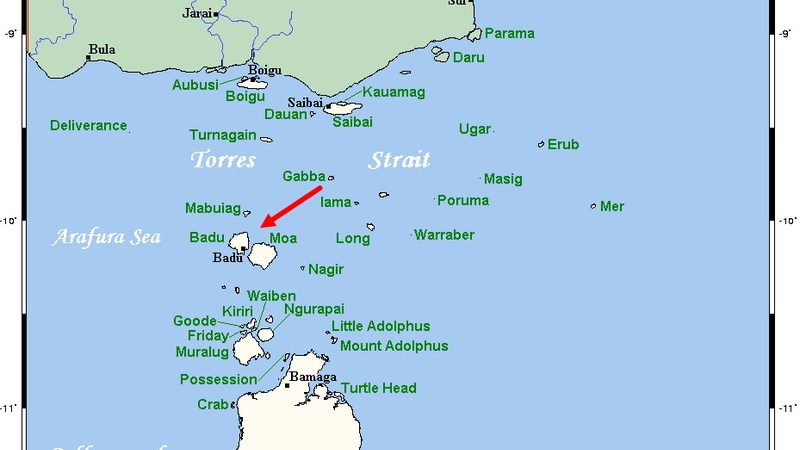
Our first cousin four times removed, Captain Archibald John Bonar McAusland was born at Greenock in Scotland. While an infant, his family emigrated to Australia as part of a scheme organised by his uncle, the Rev. John Dunmore Lang. Their ship, the schooner Minerva was hit by typhus, which claimed many lives. In Australia, Archibald John Bonar McAusland became master of the schooner Melanie, which was involved in pearl diving at Mulgrave Island (Badu) in the Torres Strait between Queensland and Papua New Guinea. The schooner Melanie was involved in a number of incidents including the rescue of survivors of a shipwreck, a number of deaths at sea, the search for the victims of a massacre, the desertion of several crew members and finally a bizarre case of alleged kidnapping, whereby the schooner was seized by Captain John Moresby of HMS Basilisk. Over a year later, the Imperial Government in London, on the recommendation of the Sydney Vice-Admiralty Court, ordered that the Melanie be released. However, by this time Captain Archibald John Bonar McAusland had died in the Police Magistrate’s House at Somerset in Queensland.
1835 Birth and Family in Greenock

Archibald John Bonar McAusland was born on 03 July 1835 in the town of Greenock in Renfrewshire and baptised on 23 August 1835 in the Old or West parish. His parents were George McAusland, shipmaster and Christian Mackie – the sister-in-law of the Rev. John Dunmore Lang. He may have been named “Bonar” after the Rev J.J. Bonar of Greenock.
John had three sisters:
- Mary McAusland who was born on 16 May 1830 in Greenock and baptised on 04 June 1830 in the Old or West parish. She died on 11 January 1903 in Greenock, aged seventy-two and single.
- Margaret Muir McAusland who was born on 24 May 1837 in Greenock and baptised on 18 June 1837 in the Old or West parish. She married William Jackson on 26 February 1861 in Greenock and had at least five children: Christian, Janet, William, Margaret and Helen. The family were living in Camberwell in London in 1871.
- Christian Mackie McAusland who was born in 1840 in Sydney, Cumberland, New South Wales. She married John Symington on 05 August 1862 in Greenock, had eleven children, and died in Ayr on 18 November 1896.
Emigration to Australian on the fever ship Minerva
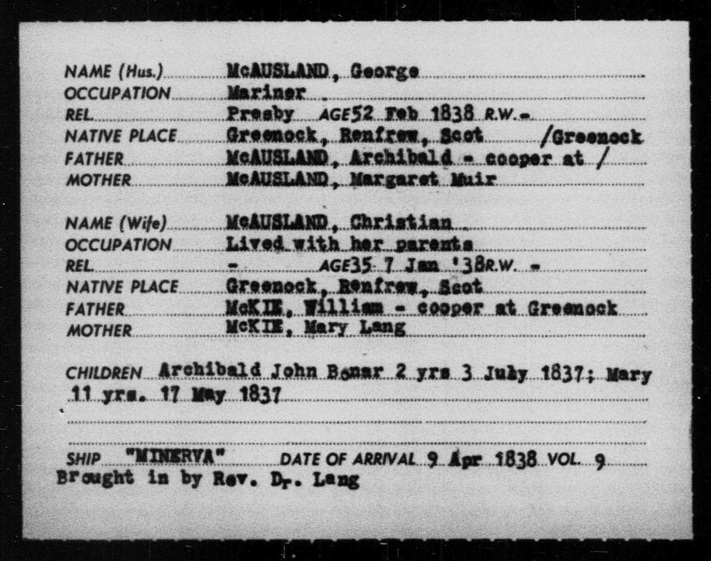
On 13 September 1837, the family embarked in the Minerva heading for Australia as part of an immigration scheme organised by John’s uncle, the Rev. John Dunmore Lang. The voyage was not a happy one as by the time the Minerva arrived on 09 April 1838, several of the passengers had died of typhus and the ship was put into quarantine as detailed in a previous article. The McAuslands travelled on the poop-deck in relative comfort and style, but the overcrowding between decks meant that the other passengers were confined in conditions where disease spread like wildfire.
Master of the Schooner Melanie
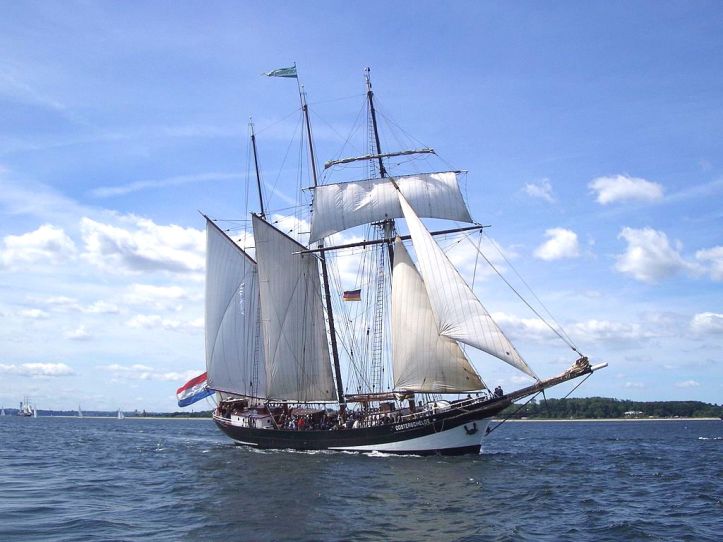
The voyage on the Minerva does not seem to have put John off sailing – perhaps he was too young to really remember it, and he followed his father’s choice of career and became a shipmaster. While his mother and three sisters had returned to Greenock some time between 1851 and 1861. John’s father, Captain George McAusland, died at sea on 27 July 1851, aged 63. John appears to have remained in Australia for the rest of his life, becoming captain of the schooler Melanie a ship of 136 tons.
The Sydney Mail of Saturday 26 September 1863 notes that Melanie, schooner, 180 tons, Captain Longmuir, had arrived from Colombo.
On 19 July 1866, the Cathay, a Barque, of 244 tons, built in 1861, struck an uncharted reef in Torres Strait. The crew were in a boat for five days before meeting up with the schooner Melanie off Stevens Island and taken on to Somerset. [LQ] It is not known whether Archibald John Bonar McAusland was captain at this time.
1868 – 1873 The Melanie’s ships manifests

On 19 February 1868, the schooner Melanie arrived in Sydney from Torres Straits with Archibald McAusland, Master, a mate, second mate, a cook/steward and eight Able Bodied and Ordinary Seamen along with seven passengers. The manifest noted that C. Thomson A.B. (Able-Bodied seaman) had been discharged at Port Albany on 18th January 1868 and that 38 natives, O.S. (ordinary seamen) had been discharged at same in April 1867.

On 03 March 1869, the schooner Melanie arrived in Sydney from the T.S. (Torres Straits) Islands with Archibald McAusland, Master, a mate, second mate, a carpenter, a cook/steward and two Able Bodied and nine Island Seamen along with 46 passengers. The manifest noted that J. Lindeman, A.B. had been discharged at ______ Island on 30 November 1867, that Harry, A.B. had died at ______ Island on 2nd December 1868, and that James Solomon Johnson had been paid off at ___ _______ in January 1869.

On 13 June 1870, the schooner Melanie arrived in Sydney from Western Australia with Archibald McAusland, Master, a mate, second mate, a carpenter, a cook/steward, a cork ____, two Able Bodied and six Island Seamen along with 31 passengers. The manifest listed 17 passengers who had died at sea. An additional 44 individuals has been discharged at the South Sea Islands in May 1870.
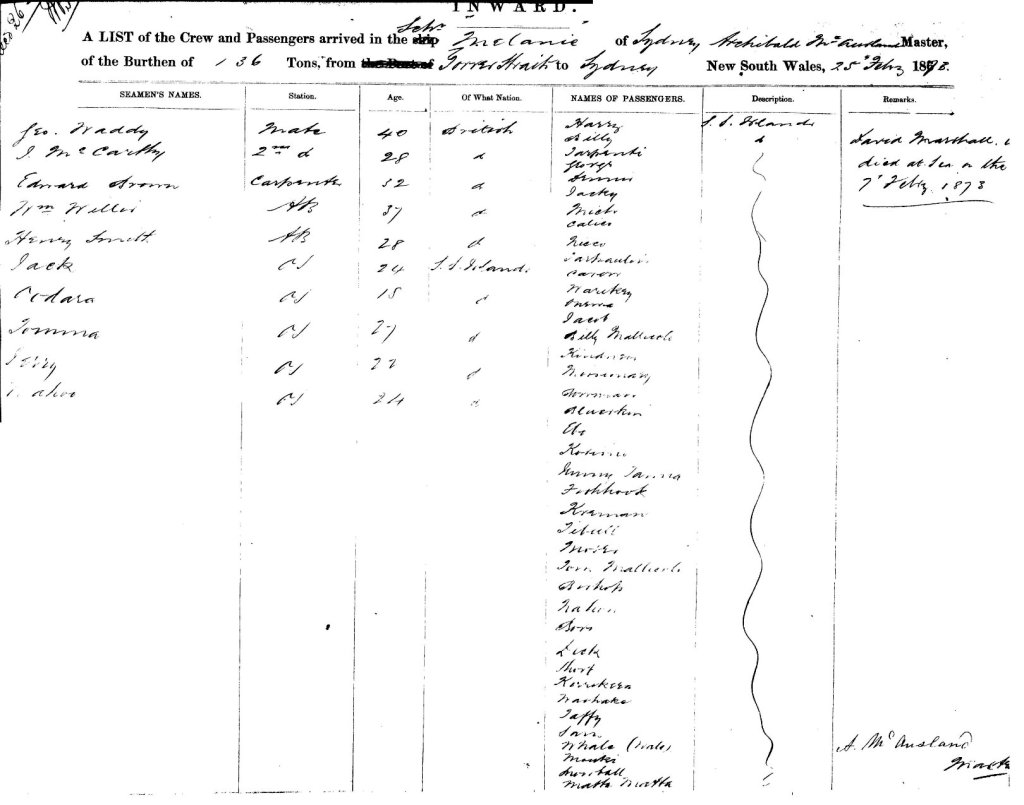
On 25 February 1873, the schooner Melanie arrived in Sydney from Western Australia with Archibald McAusland, Master, a mate, second mate, a carpenter, two Able Bodied and five Island Seamen along with 40 passengers. The manifest noted that David Marshall, the cook, had died at sea on 21st July 1873.
1869 – The Massacre at Prince of Wales Island
Archibald John Bonar McAusland was called upon to assist the Police Magistrate at Cape York in the investigation of a massacre at Prince of Wales Island. The story was reported by the Queensland Times, Saturday 27 November 1869.
THE MASSACRE AT PRINCE OF WALES ISLAND.
The Police Magistrate at Cape York has addressed the following letter to the Colonial Secretary :—Somerset, June 26, 1869.
Sir, — I do myself the honour to report for your information the capture of the cutter Sperwer, and the murder of all hands, by the Prince of Wales Islanders, J. Gascoigne master, bound from Melbourne to New Guinea (so the log states).
As there were too few of us here to divide into three, I requested the use of two boats with their crews from Captain McAusland, of the schooner Melanie, which I got, and went over with four native troopers to the Prince of Wales Island, where we found the camp full of ship’s gear, clothing, &c., and many of the natives dressed in shirts and trousers; but all property was totally destroyed, such articles as watches, revolvers, gun-locks, and a quadrant, having been taken asunder, and portions worn round the neck as ornaments.
The bodies of the murdered men have been put up into trees, near Red Point; but, as the heads and all the clothing have been taken off, they cannot be recognised. The cutter has been run ashore and burned at the same place, and I hear that there is still a large quantity of property lying close to her, but as it would be unsafe to divide our small number into three parties (viz. — one at Somerset., a boat guard, and one to search inland), I am unable to search for it.
The story the natives tell is: That the Sperwer was anchored off Wednesday Spit, trading with the blacks for pearl and tortoise-shell, and that her crew were murdered in two parties at a given signal ; one party on board the vessel, consisting of the captain, his son ,cook, and two seamen; the other onshore while employed cutting wood. The captain’s wife I can hear nothing certain of, but believe she is still alive amongst the natives of Badu.
With the exception of the log, a few papers, and eight silver coins (guilders and half-guilders) I was compelled to leave everything found in the camp, as we had thirty miles to walk home, and of course were unable to carry anything. All the above-mentioned articles I now forward, excepting an epitome and nautical almanac, both of which are very much torn.
I have been informed by the natives of the main-land that another vessel was taken ….Mount Ernest, about five months back; but as this is the first I have heard about it, I cannot believe the report to be true, but all information I can collect on the subject I will forward to you.
If this should reach you in time, will you be good enough to request Captain Bingham, of H.M.S. Virago, to give me assistance, in the shape of a boat and crew, to search the Prince of Wales and other islands lying close to it, for traces of the captain’s wife, &c. — I have the honour, &c.,
FRANK L. JARDINE, P.M. The Hon. the Colonial Secretary, Brisbane.
1870 A stowaway on the Melanie
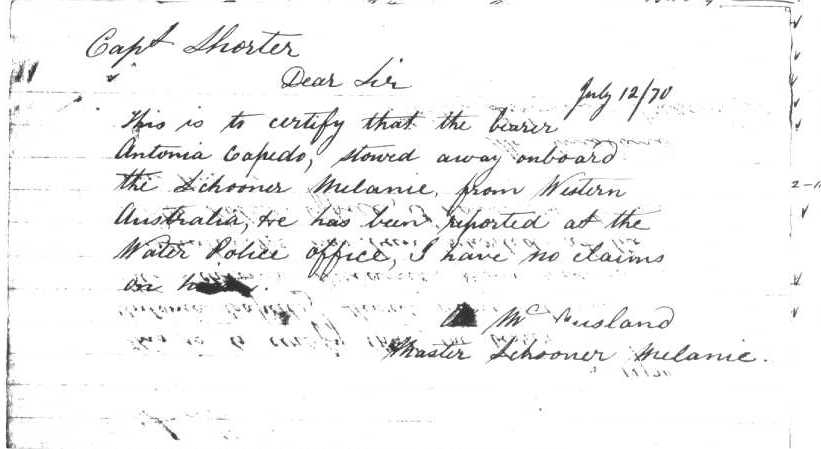
On 12 July 1870, Archibald McAusland wrote a letter to Captain Shorter concerning Antonia Capido, a stow away on the Melanie.
The Melanie and the Pearl Fishing industry in the Torres Straits
The Torres Strait Islands consist of more than 200 small islands located between the island of New Guinea and the Cape York Peninsula, most of which are part of the state of Queensland in Australia. The pearling industry in Torres Strait began in the 1860’s and by the 1890’s, it produced half of the world’s demand for pearl shells and employed 70% of the Torres Strait workforce.

A report in French suggests that the Melanie under Captain McAusland may have been involved in the pearl fishing industry:
“‘Apparatus boats’ for pearl shelling, that is boats equipped with air compressors and ‘hard hat’ diving suits, did not come into general use in Torres Strait until the mid-1870s. Before then most shell was gathered by free divers from what were known as ‘swimming boats’. the boats were from four to eight tons, carvel built with two standing lugs and a jib, and drew about a metre-and-a-half of water. they were partly decked and accommodated between ten and fifteen men with rations for a week. They operated from shore stations or mother vessels, and were sailed to a pearl-shelling ground no deeper than about eight metres to work the weather tide. The divers went overboard and the boat, under jib and mizzen, made a series of short tacks through the divers, who tossed the shell into the boat. At the windward end of the ground the men were picked up and the process repeated until the tide grew too strong to work. Between 700 and 1000 pair of shell made a ton, and twenty pair for one boat was considered a fair day’s work. Larger vessels operating in the early fishery had a few European officers and professional seamen of other nationalities amongst the crew. Aboard Walton’s 256-ton barque Crishna there were men from Mexico, Mauritius, Java, Singapore and Sri Lanka, as well as New Hebrideans and Rotumans. however, most of the actual diving was done by Pacific Islanders. men from Mare, Life, Tana, Eromanga, Aneityum, New Caledonia and the Solomon Islands were aboard the Julia Percy in 1860-61, and in 1869 Banner, by then master of the Pakeha, was still employing crfew drawn from the same islands. Three years later Archibald McAusland had nineteen New Hebrideans and nine Solomon Islanders aboard the Melanie, and Joseph Hastings ten New Hebrideans and eleven Solomon Islanders aboard the Western Star.”

1871 Contributions to the widow of Thomas D. McNab
The Sydney Morning Herald of Saturday 18th November 1871 notes that Agnes McNab, widow of the late Thomas D. McNab, had received, amongst many other sums kindly subscribed for herself and her family, £2 from Captain McAusland of the schooner Melanie and £8 from the officers and crew.
1872 Desertions from the schooner Melanie
According to Jane’s Oceania, it seems that there had been trouble on board the Melanie with six men deserting the schooner.
“By July 1872 boat crews from the Melanie, Western Star and Woodbine were showing obvious signs of dissatisfaction. Eventually six men deserted from the Melanie and joined Colin Thompson’s Enchantress. A short time later the master and mate of the Woodbine were mobbed by their crew and given a severe beating. the officers were powerless to restore order so James Ware, the master of the Woodbine, went to Somerset for help. Jardine made out a summons against two of the Woodbine’s crew for attempted murder and sent the water police to arrest them. When the police arrived at Moa Pass where the incidents were alleged to have taken place the diving boats were out on Warrior Reef – the men were working as usual but refused to be directed by the shelling masters. The police arrested eleven ringleaders, clapped them in irons, and set sail for Somerset. On the return voyage one of the prisoners made a desperate attempt to escape overboard and probably drowned. At Somerset two of the Islanders were sentenced to 28 days and three to 21 days on bread and water for insubordination, and the rest agreed to return to their vessels. the intervention of the Somerset water police had thus restored order, but the masters had been made acutely aware of their vulnerability.“
1872 The Melanie seized by Captain John Moresby of HMS Basilisk for alleged kidnapping
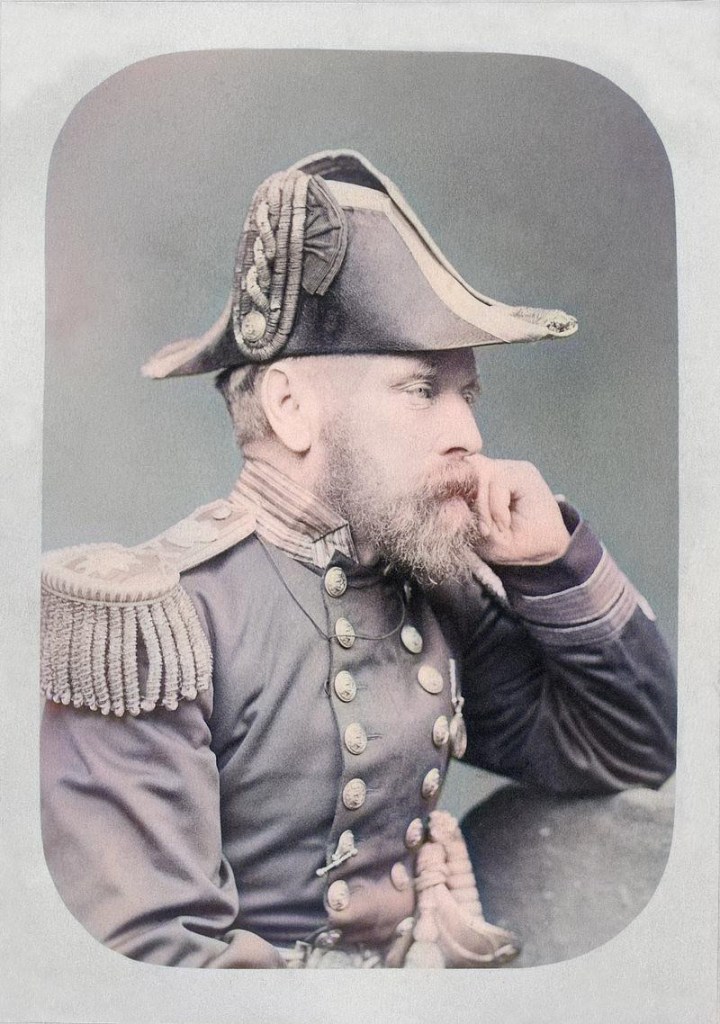

The seizing of the Melanie by Captain John Moresby and HMS Basilisk was reported in the Sydney Morning Herald of 3 July 1872:
CRUISE OF THE BASILISK.[From the Sydney Morning Heraid, July 3.]
H.M.S. Basilisk, Captain Moresby, returned to port yesterday, after a most interesting cruise in Torres Straits and on the coast of New Guinea, extending over six months. She left Sydney on 8th December, 1872, and touched at Brisbane, Bowen, Cardwell, and Fitzroy Island, where the vessels Challenge and Melanie were taken possession of. Thence proceeding north,she made Cape Grafton, where she fell in with the Woodbine and Crishna on the 14th January, both vessels being seized, the particulars of which have already been made public; reached’Somerset on 18th January, and after a stay of six days proceeded to ‘Brothers Island andLewis Island, at the latter place touching on as and patch. On the 31st she continued her cruise, calling at Cornwallis Island, where a surveying party was left with the whaleboat and pinnace. Retracing her course, the Brothers was again reached, and from thence she proceeded to Warrior, Dungeness, Cocoanut, Dalrymple, Damlev, and Bramble Bay Islands, the latter being reached on the 8th February. Herewas picked up a remarkable turtle, or hornback,weighing 480 lbs. The shell was quite soft, and striped black and white. Murray Island was then visited. The natives came on board in great numbers, and proved very friendly. Murray was left on the 11th, and the ship then proceeded to the New Guinea coast, and on the 13th February she arrived in Redscar Bay. The Missionary Station was visited, and Captain Moresby, finding the people very sick, had them brought to the Basilisk for medical treatment, where they remained for some days. The ship’s boats, with the commanderand other officers, proceeded up a river for about ten miles, but it was found to be very shallow, with a strong current running.Meanwhile the proper officers were busily employed in taking soundings inside the Barrier Reef, which appears to form a belt right along the coast. This work brought upthe time to 20th February. Mention may here be made that the natives all evinced a most friendly disposition, although from their manner were unused to the sight of Europeans.The boats that had been dispatched on survey were here picked up, and brought intelligence of a safe passage having been discovered through the Barrier, and through which the ship passed the following day, and led into a splendid bay, which was namedFairfax Harbour, from the head of which a second harbour was reached, which received the name of Moresby Harbour These two places are described by the officers as lovely spots, surrounded by hills rising to some800 fib., with plenty of water for the heaviest draught ships, and no dangers to the navigation. On the shores were several villages, the houses being built on piles, which appears to be the custom among the inhabitants on the New Guinea coast. The natives were most friendlyand would readily barter, but were evidently surprised at the sight of a looking-glass, and could not be induced to go near a sheep. Therewere plenty of wallaby to be sesn, affordingexcellent shooting. On the 26th, the surgeon and Mr, Skelton left in the cutter to examine a bay leading out to Fairfax Harbour, and which was named Idler’s Bay. This charming locality was left on the 27th February, and the ship passed inside the Barrier; again reached Redscar Bay. On March 1 she leftfor Cape York, touching at. Bramble on the3rd, and arriving at Somerset on the 6th.Here a supply of coals and provisions was takenon board. Left on the 20th, and visited Hammond Island, where the future station will be established for the relief of vessels passing through the Straits. Sailed again the followingday, and touched at Double Island and Cornwall.Here a surveying party was left, and the steamerthen proceeded on to the Warrior, Dalrymple,and Bramble, and arrived at Yule Island on the30th March. Here a stay was made of seven days, good anchorage being found at the southend, and good passages through the reefs, which, according to the present charts, was supposed to be filled in. Coasting along, TesterIsland was next reached. This is one of the Louis isles. Here the natives were very shy, but still friendly. Sailed again on the 10th, and examined the coast carefully for the S.E. Cape, as laid down, but which proved to be a group of islands, all inhabited and cultivated. Anchored off O’Neal Island, the natives with much difficulty being induced to come on board the ship. On leaving, passedthrough Fortescue Straits, and on the 14thanchored in Yam Bay. Sailed again on the 21st, and passing through China Straits brought up off Hayter Island, which was taken possession of, together with the adjacent islands, in the name of Her Majesty, with the customary honours. On the 24th arrived at DiscoveryBay, where a very large village was found. There were over 120 canoes belonging to the inhabitants.The natives swarmed on board the steamer, bringing large quantities of trade.Leaving Discovery Bay on the 30th, a group of islands was discovered on the opposite side of Chipa Straits, and on that date found the long sought for S.E. end of New Guinea. The Basilisk left on the 3rd for Tones Straits, via Hayter Island, and arrived at Cape York on 15th May. The voyage has proved most interesting, although perhaps tedious, but the officers have secured a large and valuable collection of curiosities. The cruise has been a great success, and the discoveries made will doubtless be appreciated by the authorities.
The Sydney Morning Herald of Tuesday 4th February 1873 noted:
BRISBANE. Monday.
The barque Woodbine, in charge of a prize crew from H.M.S. Basilisk, arrived at Bowen, yesterday, to provision and refit. She has 20 tons pearlshell on board. Melanie and another vessel are reported to have been seized by the Basilisk.
Heavy rains fell here last week, and considerably damaged the gardens. The floods were never so high in this district.
1873 The Queen verses the Melanie
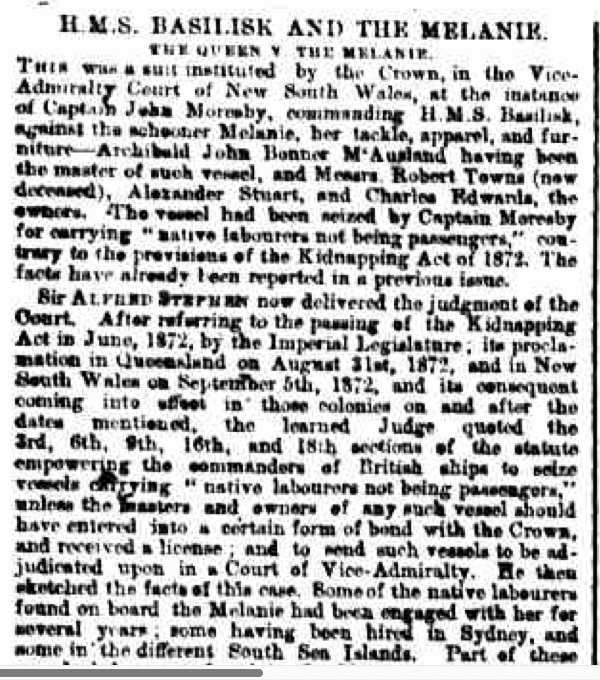
In 1873 there was a trial in the Vice-Admirality Court of New South Wales following the Melanie being seized by Captain John Moresby of HMS Basilisk regarding allegations of kidnapping. The seizure appears to have been the result of confusion, over-zealous policing and possible misinterpretation of a new law. The judgement was reported in the Sydney Morning Herald on Saturday 9th August 1873:
H.M.S. BASILISK AND THE MELANIE.
The Queen V the Melanie.
This was a suit instituted by the Crown, in the Vice-Admirality Court of New South Wales, at the instance of Captain John Moresby, commanding HMS Basilisk, against the schooner Melanie, her tackle, apparel, and furniture – Archibald John Bonnar McAusland having been the master of such vessel, and Messrs Robert Towns (now deceased), Alexander Stuart, and Charles Edwards, the owners. The vessel had been seized by Captain Moresby for carrying “native labourers not being passengers,” contrary to the provisions of the Kidnapping Act of 1872. The facts have already been reported in a previous issue.
Sir Alfred Stephen now delivered the judgment of the Court. After referring to the passing of the Kidnapping Act in June, 1872, by the Imperial Legislature; its proclamation in Queensland on August 5th, 1872, and in New South Wales on September 5th, 1872, and its consequent coming into effect in those colonies on and after the dates mentioned, the learned Judge quoted the 3rd, 6th, 9th, 16th, and 18th sections of the statute empowering the commanders of British ships to seize vessels carrying “native labourers not being passengers,” unless the masters and owners of any such vessel should have entered into a certain form of bond with the Crown, and received a license and to send such vessels to be adjudicated on in a Court of Vice-Admiralty. He then sketched the facts of this case. Some of the native labourers found on board the Melanie had been engaged with her for several years; some having been hired in Sydney, and some in the different South Sea Islands. Part of these men had been employed on the Melanie and another part in tho Western Star; those formerly belonging to the latter vessel having previously been engaged in the Kate Kearney; and they had been employed at the respondent’s pearl fishing station, Mulgrave Island, Torres Straits. The Melanie had been at the fishing-ground between February, 1872 and November, 1872. In the month of July, 1872, the master apparently heard something, about this intended statute, and went to tho town of Somerset where he consulted the Police Magistrate. On the 1st August, an agreement in writing was entered into with these natives, that they should obey all lawful commands of the masters, should receive wages, and at the expiration of five months should be discharged, at their option, in Somerset or Sydney, or, if they wished it, should be returned to the islands to which they belonged. This agreement thus expired on December 31 following. It was suggested that it had been entered into for some other purpose; and there was evidence that there had been a rumour among the natives that they were to he taken fo the West Coast of Australia, which they did not like, and consequently the document was prepared and entered into to reassure them. In September the master of the Melanie was warned by Lord Normansby, the Governor of Queensland, of the statute having been passed. He was unable to leave the station at that time, or until the latter end of November, in consequence of the north-west monsoon which would have rendered the passage unsafe. Desiring certain articles of commerce where with to pay the natives, he availed himself of a vessel proceeding to Normanton to send a telegram to his owners requesting that the stores in question might be forwarded. In the month of November the owners of the Melanie, Messrs Towns and Co, for themselves and the owners of Western Star, placed themselves in communication with the Government of this colony setting forth their case, requesting to be informed whether they were liable under the Act, and expressing their willingness to enter into the requisite bond so that a license might be issued to them. To this, however, they had not received a reply when the Gleaner left Sydney with the stores for which the master of the Melanie had telegraphed. The latter vessel sailed from Mulgrave Island about the beginning of December, proceeded to Somerset, and from thence towards Cardwell. She encountered the Gleaner 400 miles south of Somerset but that vessel not haying brought sufficient articles of trade, it was determined to proceed to Cardwell, where there was a telegraph communicating with Normanton and Sydney, and where the stores might be obtained. But while on their way to that port, on the 5th January last, the Melanie fell in with the Basilisk, and was seized. The judgement of the Court had been reduced to the following heads but; if it were desired for an appeal, the Judges were prepared to give written judgements in which they would discuss the matter in ertmsa (text unclear). The learned Judge Commissary concluded thus –
1 We think that the men were native labourers.
2 And that they were not part of the crew.
3 It is admitted that the vessel had no license and that the master entered into no bond. She was, therefore, liable to forfeiture for carrying these labourers unless neither license nor bond could possibly have been procured entered into.
4 The statute was not intended (primarily, at least) to meet a case of this kind, but only the taking of natives for the purposes of labour from the South Sea Islands. Nevertheless, the carrying of such labourers from any of these colonies back to their own islands, is within the scope and express provisions of the law. It may have been the intention of the Legislature, in preventing vessels from, under any circumstances, carrying Polynesians without a licence, whether to or from the South Sea Islands, to render evasion of the main object of the Act more difficult, if not impossible.
5 The Act also applies equally to Polynesian natives employed in pearl diving or fishing, as to any other species of labour.
6 The Act came into force on the high seas immediately on its passing, but not so as to affect the residents of any colony until after its proclamation in that colony But the Melanie could have procured a license, and her master could have entered into the necessary bond, in Queensland, at any time after the 31st of August, 1872 .
7 The vessel was bound to take the natives buck to Sydney, or their own islands, at their option after the 31st of December. But this she could not do without bond and license. There is nothing to show that she could have given the bond, or obtained a license, at Somerset, or Mulgrave Island, or possibly even at Cardwell, but we think that, however harsh or inconvenient that course, or objectionable on many grounds, she was bound to procure one before proceeding on her voyage, after August, with the labourers, or any of them. They might have been left behind at Somerset, and the master could have proceeded without them, and have telegraphed from Cardwell to Brisbane or Sydney for the approval of a surety, and for the form of bond and for a license.
8 We do not see how the necessary bond could have been entered into, in the absence of the master, at Sydney, or any other place.
9 We are of opinion that after proof of any violation of the Act, the Court has no discretion as to condemnation. The structure of the Act may be open to the criticisms which it was subjected to on the hearing, but we think that this conclusion is inevitable.
10 The Act is not retrospective in any part of it but the omissions to enter into the bond, and obtain a license, were each after the passing of the Act, and after its coming into force in both these colonies. The Melanie sailed from Mulgrave Island, and also from Somerset, on a new, that is to say, her return voyage, the one being in, or after September, and the other in December, 1872 , the Act having come into operation in Queensland on the last August.
11 We do not think (as we have already said) that it was impossible to procure a license, although we decidedly are of opinion that to insist on it, and punish the omission, in a case of this kind, is harsh in the highest degree. Although therefore we are compelled to condemn the Melanie and her cargo, we conceive that on application to the discretion of the Crown, she probably would be (and, so far as the facts before us are concerned, we think that she ought to be) restored.
12 We see on the evidence no reason for suspecting any intention to violate the Act, nor any reason to believe that the natives were not perfectly willing labourers throughout the whole of their employment, both at and before the time of their signing the agreements at Somerset. And even should the fact turn out to be otherwise, the existing ground of seizure would be the same. The vessel is prosecuted, not for any not done, but for an omission, which on her part was, we believe, an unintentional breach of the statute. Judgment was therefore given for the Crown, but with-out costs.



1874 Release of the schooner Melanie
On Saturday, 28th March, 1874, the Armidale Express and New England General Advertiser contained a brief but important announcement. :
BY ELECTRIC TELEGRAPH.
(THROUGH GREVILLE’S TELEGRAPH COMPANY)
Sydney, Friday Night
LONDON.
The Imperial Government has ordered the release of the barque Melanie, seized by the Basilisk, under the Kidnap Act.
This confirmed the recommendation by the Vice-Admirality Court of New South Wales.
1874 Death at Somerset in Queensland
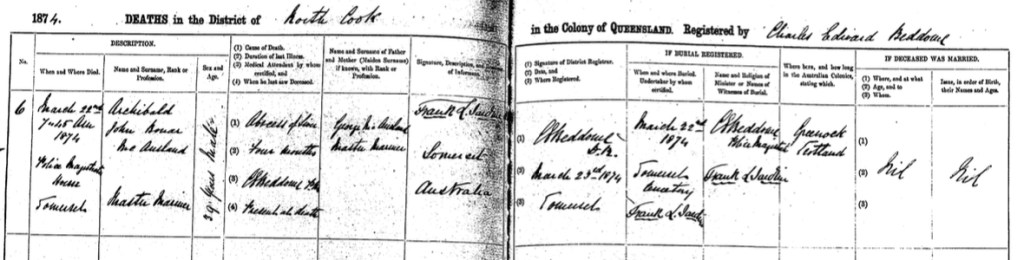
Sadly, Captain Archibald John Bonar McAusland died just six months after the court case, and six days before the release of the Melanie, on 22 March 1874. He was aged 39, unmarried at died at the Police Magistrate’s House at Somerset in Queensland. The cause of death was abces of liver, four months, as certified by C. Sheddow, Police Magistrate, who was present at at the death.
Had the seizure of the Melanie by HMS Basilisk been an error by an overzealous naval commander? The court’s recommendation and Imperial government’s order that the schooner be released would seem to confirm this.
Was Archibald John Bonar McAusland under arrest at the Police Magistrate’s house at the time of his death or was he staying with a friend and colleague? This is unclear.
Had his life been shortened by the stress of his vessel’s seizure, which lasted well over a year? This does seem likely.


Diana Damrau sings an excerpt from Leïla’s Act I aria from Bizet’s “The Pearl Fishers” at the final dress rehearsal. Production: Penny Woolcock. Conductor: Gianandrea Noseda. 2015–16 season. Metropolitan Opera.
 Vecchio