
Birth
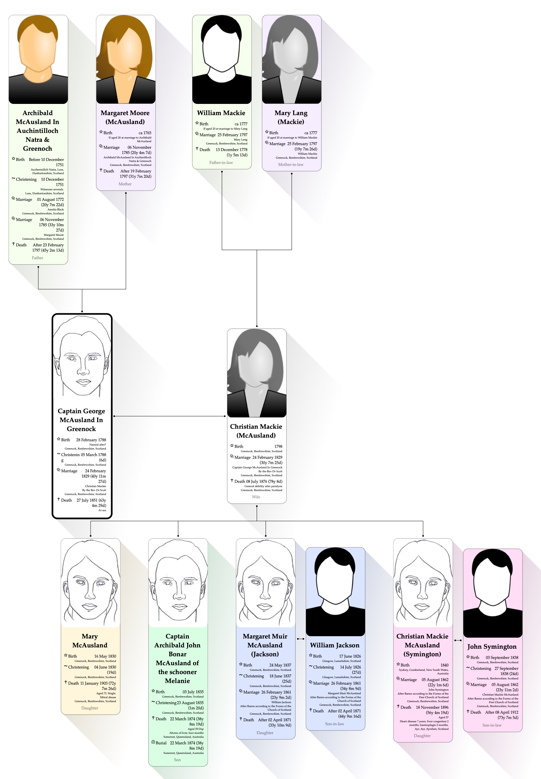
Our great (x4) uncle George McAusand was born in the New or Middle parish of Greenock in Renfrewshire on 28 February 1788 and baptised there on 05 March 1788. He was the son of Archibald McAusland, a cooper and Margaret Moore (aka Muir) his second wife.
He had four siblings:
- James McAusland born 17 October 1786 and baptised 23 October 1786 in Greenock.
- Aemilia McAusland born 05 November 1789 and baptised 10 November 1789 in Greenock.
- Margaret McAusland born 03 May 1794 and baptised 08 May 1794 in Greenock.
- David Stewart McAusland born 19 February 1797 and baptised 23 February 1797 in Greenock.
He also had seven elder half-siblings who were the children of George McAusland’s first marriage to Amelia Black on 01 August 1772:
- Humphrey McAusland born 18 June 1773 and baptised 20 June 1773 in Greenock.
- Mary McAusland (first of that name) born 12 February 1775 and baptised 14 February 1775 in Greenock.
- Archibald McAusland (first of that name) born 20 May 1777 and baptised 24 May 1777 in Greenock.
- Mary McAusland (second of that name) born 13 December 1778 and baptised 14 December 1778 in Greenock.
- Helen McAusland, born 05 May 1780 and baptised 07 May 1780 in Greenock.
- Archibald McAusland (second of that name) born 24 March 1782 and baptised 26 March 1782 in Greenock.
- John McAusland born 10 April 1783 and baptised 13 October 1783 in Greenock.
Marriage

On 20 February 1829, George McAusland, shipmaster and Christina Mackie, both in the Old or West parish of Greenock booked their wedding and they were married on 27 February 1829. The marriage was announced in the Greenock Advertiser on 27 February 1829.
Children
The couple had four children:
- Mary McAusland, born 16 May 1830 and baptised on 04 June 1830 in Greenock.
- Archibald John Bonar McAusland born 03 July 1835 and baptised on 23 August 1835 in Greenock.
- Margaret Muir McAusland, born 24 May 1837 and baptised on 18 June 1837 in Greenock.
- Christian Mackie McAusland, born 1840 in Sydney, New South Wales.
Death
Captain George McAusland is included on the MacKie memorial stone at Inverkip Street Burial Ground, in Greenock, which notes that he died at sea on 27 July 1851, aged 63.
Christian Mackie
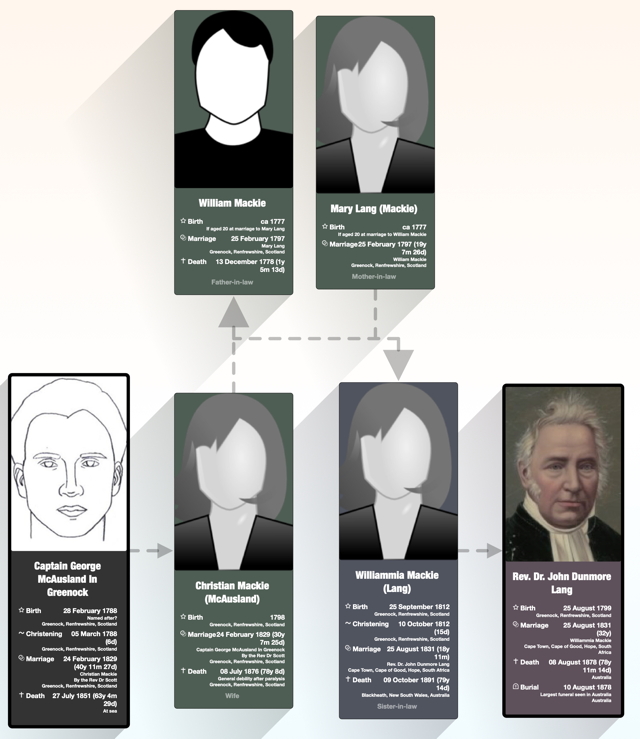
Christian Mackie, wife of George McAusland, was the sister of Williamia Mackie, the wife of radical Presbyterian Minister John Dunmore Lang.
John Dunmore Lang
John Dunmore Lang (25 August 1799 – 8 August 1878) was a Scottish-born Australian Presbyterian minister, writer, historian, politician and activist. He was the first prominent advocate of an independent Australian nation and of Australian republicanism.
Lang was born near Greenock, Renfrewshire (now Inverclyde), Scotland, the eldest son of William Lang and Mary Dunmore. His father was a small landowner and his mother a pious Presbyterian, who dedicated her son to the Church of Scotland ministry from an early age. He grew up in nearby Largs and was educated at the University of Glasgow, where he excelled, winning many prizes and graduating as a Master of Arts in 1820. His brother, George, had found employment in New South Wales and Lang decided to join him. He was ordained by the Presbytery of Irvine on 30 September 1822. Arriving in Sydney Cove on 23 May 1823, he became the first Presbyterian minister in the colony of New South Wales. On the way back from the second of his nine voyages to Britain (1830–31), he married his 18-year-old cousin, Wilhelmina Mackie, in Cape Town. They were married for 47 years and had ten children, only three of whom survived him. There were no grandchildren.
Dr John Dunmore Lang was educated for the ministry at the University of Glasgow and licensed to preach in 1820. Arriving in Sydney in May 1823, he became the first Presbyterian minister there, although there was already one in Hobart Town.
Lang was eager to promote free (non-convict) migration, and in 1831 he was applauded in Sydney for his patriotism and enterprise in bringing about 140 valuable migrants, Scottish tradesmen and their families, as well as schoolmasters and two more Presbyterian ministers, to the colony.
In 1835 Dr Lang commenced a weekly newspaper, the Colonist; or, Journal of Politics, Commerce, Agriculture, Literature, Science and Religion for the Colony of New South Wales. The Colonist ran until 1840, and contains many articles on the subject of immigration.
He visited Britain again in 1836, recruiting clergy and selecting suitable emigrants, many of them from the Scottish highlands and the Western Islands, among them farmers, mechanics or tradesmen, and teachers, thus stimulating Australian immigration. He returned to Sydney in December 1837 on the emigrant ship Portland.
The Minerva set sail from Greenock on 13th September 1837. As well as emigrants from Scotland and Northern Ireland, there was on board a group of German Lutheran missionaries.
The Minerva
Minerva was the Roman goddess of wisdom and strategic warfare, justice, law, victory, and the sponsor of arts, trade, and strategy. Minerva is not a patron of violence such as Mars, but of defensive war only. From the second century BC onward, the Romans equated her with the Greek goddess Athena. Minerva is one of the three Roman deities in the Capitoline Triad, along with Jupiter and Juno. She was the virgin goddess of music, poetry, medicine, wisdom, commerce, weaving, and the crafts. She is often depicted with her sacred creature, an owl usually named as the “owl of Minerva“, which symbolised her association with wisdom and knowledge as well as, less frequently, the snake and the olive tree. Minerva is commonly depicted as tall with an athletic and muscular build, as well as wearing armour and carrying a spear. As the most important Roman goddess, she was highly revered, honored, and respected.
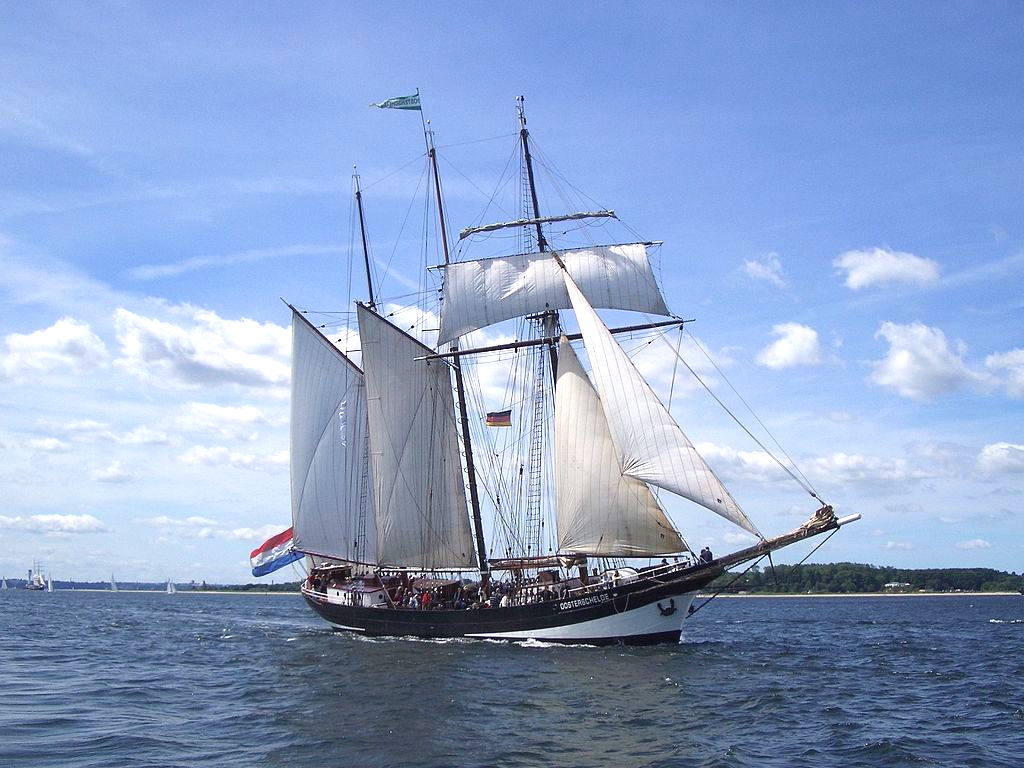
At least 24 ships with the name Minerva have been identified. The Minerva that transported the McAuslands to Australia is believed to have been built in the 1830s and owned by George Elder of Kirkcaldy, Scotland. It was used to transport his son Alexander Lang Elder to South Australia in 1840. The Minerva was a schooner, a type of sailing vessel defined by its rig: fore-and-aft rigged on all of 2 or more masts and, in the case of a 2 masted schooner, the foremast generally being shorter than the mainmast. Schooners were built primarily for cargo, passengers, and fishing.
The Voyage and Quarantine of the Minerva
On 13 September 1837 (or 13 August 1837) Captain George McAusland, his wife Christian Mackie and children embarked from Greenock on the Minerva schooner of 380 tons captained by Thomas Furlong. They were heading from Australia with emigrants from Scotland and Ireland and a number of Lutherian missionaries.
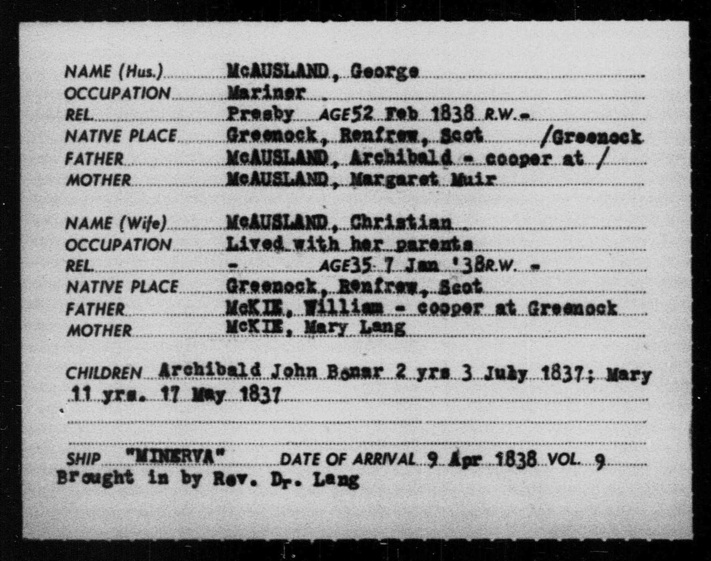
Captain McAusland, his wife and three children were poop cabin passengers. The exact number of passengers and crew varies depending on the source. It can be seen that the immigration card for Captain McAusland’s family has inaccuracies with Mary’s age being recorded as 11 when she is actually seven, while the baby Margaret Muir McAusland is omitted completely.
One source states that there were 234 on board consisting of 213 passengers – 15 on the poop deck and 198 tween deck passengers – along with 21 ship’s crew, while another states there were 151, with the Minerva carrying a total of 121 immigrants (87 adults and 34 children), and 30 crew.
There were 14 deaths (12 adults and 2 children) during the voyage. The Minerva was quarantined for a total of 44 days, during which time a further 18 people (13 adults and 5 children) died. The primary reason for the quarantine was given as typhus fever.
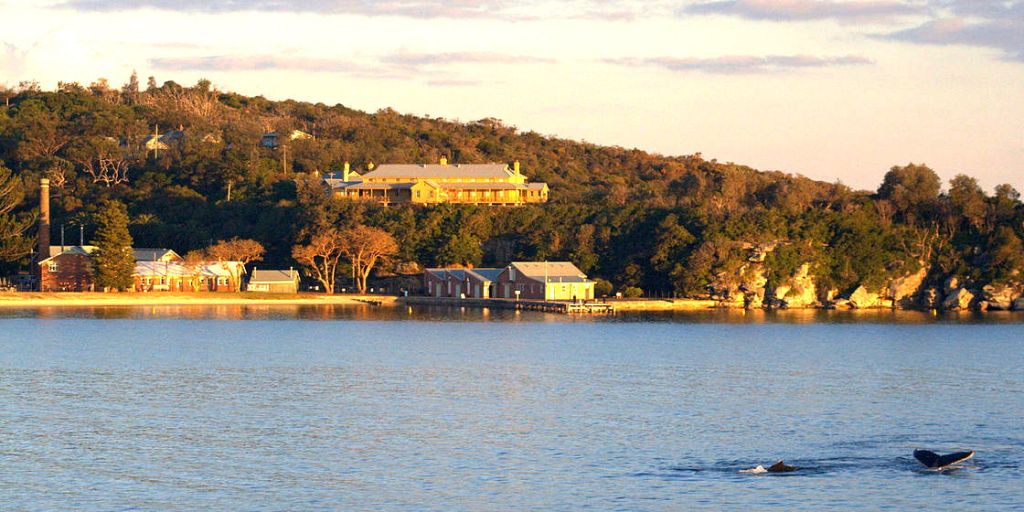
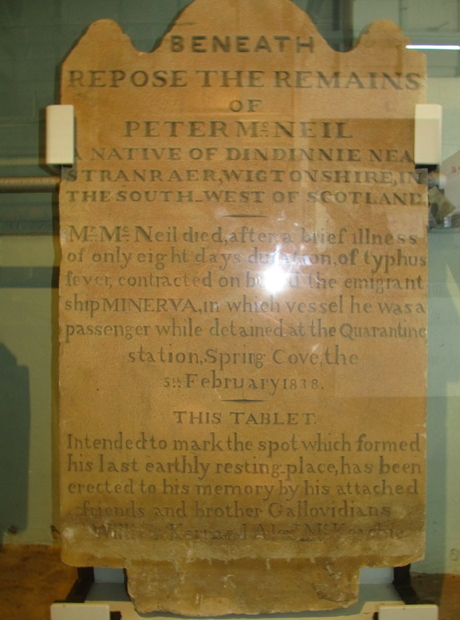
The following report appeared in the Sydney Gazette on Thursday, 25th January 1838:
“The Minerva, from Greenock, with 235 emigrants on board arrived on Tuesday, but in consequence of the existence of typhus fever on board, she has been placed in Quarantine. The emigrants by the Minerva were selected by the Rev. Dr. Land during his recent visit to the mother country, and have come out under the superintendence of Capt. McAusland, the Dr’s brother-in-law.
Among the passengers are thirteen German Missionaries with their families, come out to establish a mission to the wretched aborigines to the northward of this Colony under the superintendence of the Synod of New South Wales. Two of the Missionaries are ordained Clergymen, and the remainder, who come in the capacity of Catechists, have also, in conjunction with their theological studies, been instructed in various mechanical arts with a view to the communication of the arts of civilized life to the aborigines in conjunction with Christian knowledge.
The typhus fever made its appearance among the passengers early in December; on the fifth of that month the first death occurred. Since that time the disease has continued to increase, thirteen in all have fallen victims to its ravages.
On her arrival twenty individuals were ill, ten of them seriously so, and among the latter, we regret to enumerate Dr. Cook the surgeon of the vessel. Hitherto the cabin passengers are free from disease, the fever having confined its ravages entirely to the ‘tween docks’.
Orders have been issued by the Executive Government for the immediate landing of the emigrants, and for the occupation of the buildings recently erected at the Quarantine Station, Spring Cove. Dr. du Moulin of the 50th Regiment and Mr. Assistant Colonial Surgeon Stuart, have been sent to their assistance.
Supplies of all descriptions likely to be useful to the emigrants have been forwarded in compliance with the orders of the local Government. We trust the removal of the emigrants from the confinedatmosphere of a ship’s steerage to the genial breezes of Australia, will have the effect of putting a speedy and an effectual stop to the ravages of this pestilential disease.
Since the above was written, we learn that the passengers were landed at the Quarantine Station yesterday, and divided into three parties who are not allowed to have any communication with each other, viz., the sick are placed in hospital, those who have been exposed to the contagion, and those (the cabin passengers), among whom no disease has yet made its appearance.
Typhus
Typhus, also known as typhus fever, is a group of infectious diseases that include epidemic typhus, scrub typhus, and murine typhus. Common symptoms include fever, headache, and a rash. Typically these begin one to two weeks after exposure.
The diseases are caused by specific types of bacterial infection. Epidemic typhus is due to Rickettsia prowazekii spread by body lice, scrub typhus is due to Orientia tsutsugamushi spread by chiggers, and murine typhus is due to Rickettsia typhi spread by fleas.
Vaccines have been developed, but none are commercially available. Prevention is achieved by reducing exposure to the organisms that spread the disease. Treatment is with the antibiotic doxycycline. Epidemic typhus generally occurs in outbreaks when poor sanitary conditions and crowding are present. While once common, it is now rare. Scrub typhus occurs in Southeast Asia, Japan, and northern Australia. Murine typhus occurs in tropical and subtropical areas of the world.
Typhus has been described since at least 1528 AD. The name comes from the Greek tûphos (τῦφος) meaning fever or delusion, describing the state of mind of those infected. While “typhoid” means “typhus-like“, typhus and typhoid fever are distinct diseases caused by different types of bacteria.
For more information see:
The Ship Minerva in Quarantine, 1838 By Shelagh Champion, B.A. (Lib.Sc.) and George Champion, Dip.Ed.Admin.
Free Settler or Felon The Log Book of the Fever Ship Minerva (actually the diary of a passenger rather than the ship’s log).
North Head Quarantine Station
Sydney Quarantine Station Moveable Heritage Collection
Smallpox in Sydney: North Head Quarantine Station. 2 mins 3 secs.
A short documentary looking at the past, present and future of Manly’s North Head Quarantine Station, now known as QStation. 16 mins 24 secs.
The Q Station is situated on the North Head of Sydney and dates back to the early 1800s. It was built as a way to keep those already residing in Australia safe by containing the spread of disease from immigrants. Many people perished at this place, leading many to claim this Sydney Quarantine Station to be one of the most haunted places in Australia. 38 mins 42 secs.
 Vecchio