

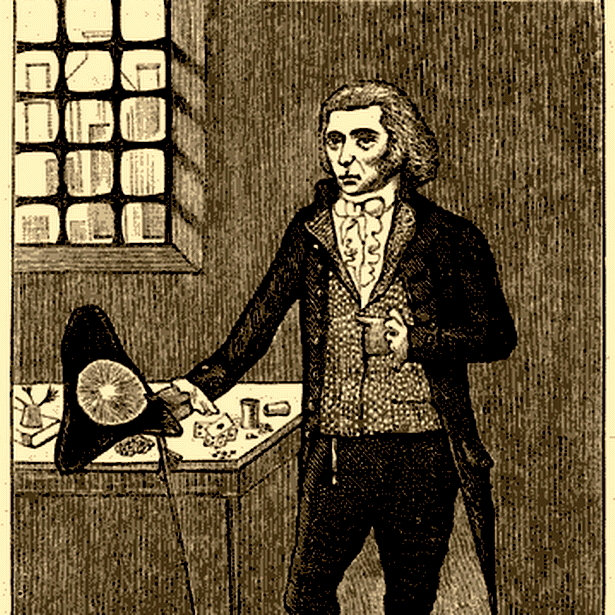
Deacon William Brodie
William Brodie (28 September 1741 – 01 October 1788), often known by his title of Deacon Brodie, was a Scottish cabinet-maker, deacon of a trades guild, and Edinburgh city councillor, who maintained a secret life as a housebreaker, partly for the thrill, and partly to fund his gambling.
Career
In 1774, Brodie’s mother is listed as the head of household in their Edinburgh home on Brodie’s Close on the Lawnmarket. The family (William and his brothers) are listed as “wrights and undertakers” on the Lawnmarket. By 1787 William Brodie is listed alone as a wright living at Brodie’s Close. The house was built towards the foot of the close in 1570, on the south east side of an open court, by Edinburgh magistrate William Little and the close was known as Little’s Close until the 18th century.
With ‘improvements’ being made to Edinburgh, the mansion was demolished around 1835 and is now covered by Victoria Terrace (at a later date, Brodie’s workshops and woodyard, which were situated at the lower extremity of the close, made way for the foundations of the Free Library Central Library on George IV Bridge).
By day, Brodie was a respectable tradesman and deacon (president) of the Incorporation of Wrights, which locally controlled the craft of cabinetmaking; this made him a member of the town council. Part of his work as a cabinetmaker was to install and repair locks and other security mechanisms. He socialised with the gentry of Edinburgh and met the poet Robert Burns and the painter Henry Raeburn. He was a member of the Edinburgh Cape Club and was known by the pseudonym “Sir Llyud“.
At night, however, Brodie became a housebreaker and thief. He used his daytime work as a way to gain knowledge about the security mechanisms of his customers and to copy their keys using wax impressions. As the foremost locksmith of the city, Brodie was asked to work in the houses of many of the richest members of Edinburgh society. He used the money he made dishonestly to maintain his second life, which included a gambling habit and five children by two mistresses, who did not know of each other and were unknown in the city.
He reputedly began his criminal career around 1768, when he copied keys to a bank door and stole £800, then enough to maintain a household for several years. In 1786 he recruited a gang of three thieves, John Brown, a thief on the run from a seven-year sentence of transportation, George Smith, a locksmith who ran a grocer’s shop in the Cowgate, and Andrew Ainslie, a shoemaker.
Capture and Trial
The case that led to Brodie’s downfall began later in 1788 when he organised an armed raid on an excise office in Chessel’s Court on the Canongate. Brodie’s plan failed. On the same night, Brown approached the authorities to claim a King’s Pardon, which had been offered after a previous robbery, and gave up the names of Smith and Ainslie (initially saying nothing of Brodie’s involvement). Smith and Ainslie were arrested, and the next day Brodie attempted to visit them in prison, but was refused. Realising that he had to leave Edinburgh, Brodie escaped to London and then to the Netherlands, intending to flee to the United States, but was arrested in Amsterdam and shipped back to Edinburgh for trial.
The trial of Brodie and Smith started on 27 August 1788. At first there was no hard evidence against Brodie, although the tools of his criminal trade (copied keys, a disguise and pistols) were found in his house and workshops. But with Brown’s evidence and Ainslie being persuaded to turn King’s Evidence, added to the self-incriminating lines in the letters he had written while on the run, the jury found Brodie and Smith guilty.
Brodie and Smith were hanged at the Old Tolbooth in the High Street on 1 October 1788 before a crowd of 40,000. According to one tale, Brodie wore a steel collar and silver tube to prevent the hanging from being fatal. It was said that he had bribed the hangman to ignore it and arranged for his body to be removed quickly in the hope that he could later be revived. If so, the plan failed. Brodie was buried in an unmarked grave at St. Cuthbert’s Chapel of Ease in Chapel Street. However, rumours of his being seen in Paris circulated later and gave the story of his scheme to evade death further publicity.

Deacon Brodie in Fiction
Dr Jeckyll & Mr Hyde by Robert Louis Stevenson

Robert Louis Stevenson, whose father owned furniture that had been made by Brodie, wrote a play (with W. E. Henley) entitled Deacon Brodie, or The Double Life, which was unsuccessful.
However, Stevenson remained fascinated by the dichotomy between Brodie’s respectable façade and his real nature, and this paradox inspired him to write the novel The Strange Case Of Dr. Jekyll And Mr. Hyde, which he published in 1886.
Billy Connolly as Deacon Brodie (1997)

The “Deacon Brodie” episode of the BBC One television drama anthology Screen One starred Billy Connolly as Brodie, aired on 8 March 1997, and was made in Edinburgh.
Billy Connolly stared in the title role of Deacon Brodie. In 1788 the city of Edinburgh was rocked by the revelation that Deacon Brodie, master carpenter and Town Councillor, had been found guilty of a string of extraordinary crimes – the last of which was a bungled attempt to steal a fortune from the city’s Customs and Excise Office.
After a widely published trial, Deacon Brodie and his two fellow cronies are sentenced to death – to be hung on the same gallows the Deacon designed, and had previously failed to sell to the Town Council. Driven by his desire to seek revenge on those who betrayed him and the wish to protect the lives of his loved ones, the Deacon started planning his escape from an almost certain death.
The Prime of Miss Jean Brodie
Christina Kay (11 June 1878 – 23 May 1951), who was born in Edinburgh and died in Midhope, West Lothian, was a Scottish school teacher and served as an inspiration for Miss Jean Brodie, the leading character in the novel The Prime of Miss Jean Brodie by Muriel Spark. The occupation of Christina Kay’s father, a cabinet maker, is also neatly inserted into Jean Brodie’s own ancestry, as she reminds us:
Jean Brodie: “I am a descendant, do not forget, of Willie Brodie, a man of substance, a cabinet maker and designer of gibbets, a member of the Town Council of Edinburgh and a keeper of two mistresses who bore him five children between them. Blood tells. He played much dice and fighting cocks. Eventually he was a wanted man for having robbed the Excise Office – not that he needed the money, he was a night burglar only for the sake of the danger in it. Of course, he was arrested abroad and was brought back to the Tolbooth prison, but there was mere chance. He died cheerfully on a gibbet of his own devising in seventeen-eighty-eight. However all this may be, it is the stuff I am made of.“
Deacon Brodies Tavern
Deacon Brodie is commemorated by a pub of that name on Edinburgh‘s Royal Mile, on the corner of the Lawnmarket and Bank Street which leads down to the Mound.
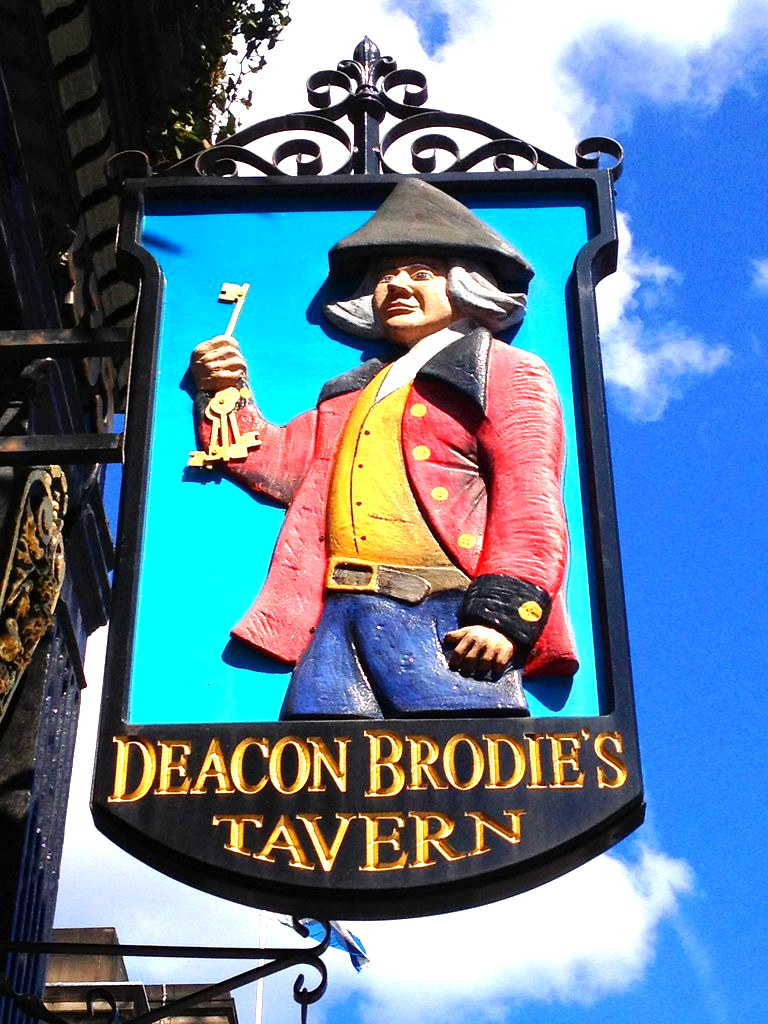
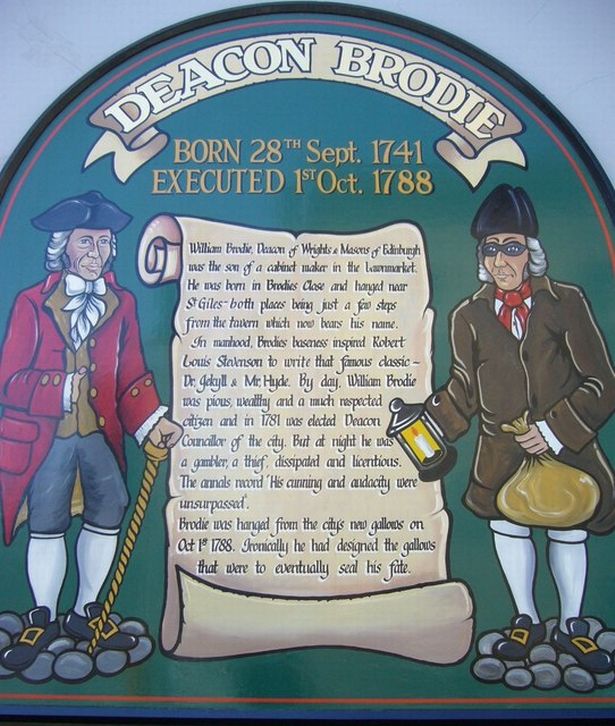
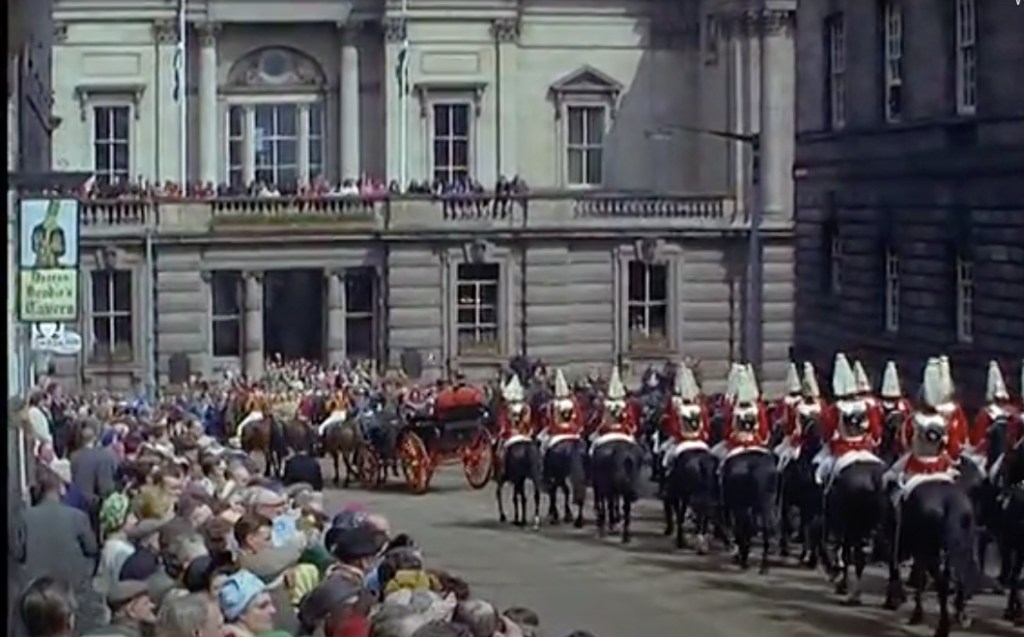
Deacon Brodie’s Tavern has featured on TV shows such as The Hairy Bikers. From 1999, it was used as a watering hole before the opening of the new Scottish Parliament at Holyrood when MSPs were based at the Church of Scotland Assembly rooms on the Mound. Those frequenting Deacon Brodie’s Tavern included the late Margo MacDonald (SNP), the late Alex Johnstone (Conservative), Keith Harding (Conservative), Frank McAveety (Labour), Tricia Marwick (SNP), Bill Aitken (Conservative) and many others including journalists such as Robbie Dinwoodie (The Herald) whose laugh would often reverberate throughout the bar.
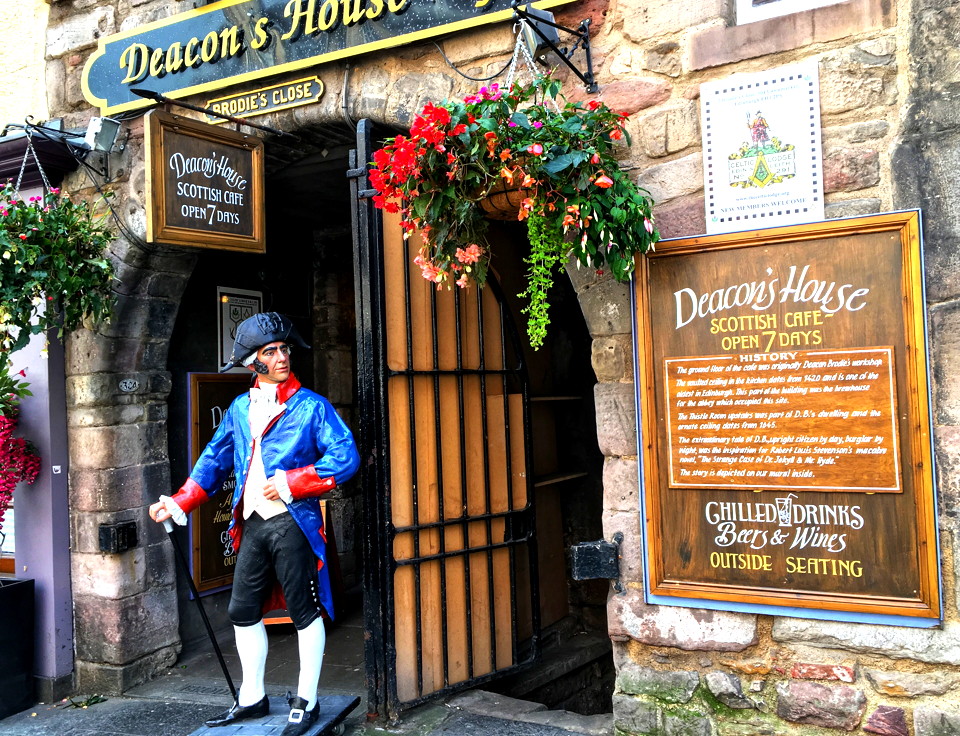
Deacon’s House Cafe
Deacon Brodie is also commemorated by a close off the Royal Mile, which contained his family residence and workshops, and bears the name “Brodie’s Close”. Here the Deacon’s House Scottish Cafe can also be found.
 Vecchio