
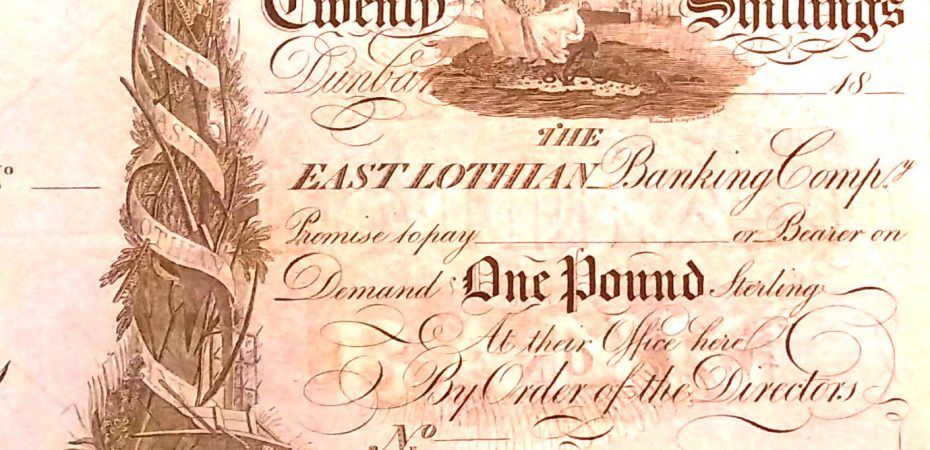
The East Lothian Banking Company was founded in Dunbar in 1810. The £28,000 of the £80,000 capital paid up at the outset was subscribed by 56 people, mainly tenant farmers. The prime mover in the formation of the co-partnery was Christopher Middlemass [Middlemiss], merchant in Dunbar, who became chairman. Branches were established in Selkirk and Haddington and business was conducted via correspondents in Berwick, North Berwick, Edinburgh, London, Carlisle, Belfast and Glasgow. The Carlisle connection was especially important as it was used to circulate the company’s notes in the North of England. The cashier (manager) of the concern was William Borthwick. So much was he trusted that the supervisory responsibilities of the directors were often neglected and Borthwick was given a free hand in the administration of the bank. He abused this position by giving large loans to business ventures run by his brother and in which he was a secret partner. This led to his eventually decamping to America in 1822, following which the bank was wound up under a trust deed.
National Records of Scotland Ref. GD304.

The East Lothian Banking Company was established two hundred and twenty one years ago today on 1st June 1810 when it opened for business in Dunbar. The main mover in establishing this bank is thought to have been Christopher Middlemass (1761 – 1850) who was not only a well respected local dignitary but was also an experienced banker, having been employed in the town as agent of the British Linen Company in 1808, when he was dismissed for negligence following a robbery of the British Linen Company office. Christopher Middlemass first became Provost of Dunbar in October 1793 in succession to his business partner Charles Hay and held the office, on and off, until October 1847.
The initial contract of co-partnery for the Company was for 21 years; the capital £80,000, in 400 shares of 200 each. There were 27 Partners, chiefly small landed proprietors or tenant farmers; 9 ordinary Directors and 3 extra ordinary Directors.
The bank issued its own notes and these reflected the County’s strong ties with agriculture and fishing.

The 5 note above depicts images of agricultural produce and Dunbar harbour. Note the spelling of ‘Lothian’ as “Lothan” around the wheat!
The Cashier was William Borthwick, who was recruited at the outset of the business from the Falkirk Union Banking Company, when he was aged about 20 – 22. His youth for such a position is thought to be reflective of the general lack of experienced Scottish bankers as a consequence many having been recruited by other Scottish, UK and International banks.
At first, the Bank flourished and soon further staff were employed and branches opened in Haddington and Selkirk. They also had various agents in London, Belfast and Edinburgh conducting business on behalf of the Bank.
However, due to recession and the mistakes and mismanagement of some of its untrained staff, the bank soon foundered. By 1816 only the Haddington branch remained.
The final nail in the coffin came six years later on 10th April 1822, when William Borthwick ran off to America with a large number of the bank’s bills, resulting in the closure of the bank.
It has been suggested that the economic climate of the time was causing other businesses in which Borthwick had an interest (with his brother, Bruce) financial difficulty and that he was propping up these businesses using the Bank’s funds and that when he could support this no longer he fled.
There is some debate as to whether he ever stood trial for the offence although it is known that he was arrested in either South America or Savannah but released and history is unclear as to whether he ever stood trial for his crime.
Although the Bank closed, the Edinburgh agents – Sir William Forbes, James Hunter & Co. – assisted the directors in their difficulty and provided credit of £100,000, on ample security over the Partners’ estates, until the assets could be realised.
Mr William Paul, Accountant, Edinburgh was appointed to assist a committee of Partners in the winding up of the Bank. This took many years (actions still seen in the 1840s) although all Creditors were paid in full.
For example, on 22 August 1828 at Haddington Sheriff Court we note the case of “William Paul, trustee and manager for the East Lothian Banking Company, against Robert Cossar (of the Saint George Hotel), vintner in Dunbar, Peter Cockburn, flesher in Dunbar, and Andrew Murray, vintner in Dunbar; Summons for payment of mails and duties for lands and property which had previously been owned by John Burnet and, as the result of an adjudication, were now owned by the pursuer.” (NRS SC40/20/137/6).
The East Lothian Bank by the John Gray Centre.
The East Lothian Bank was begun on 1 June 1810 in Dunbar. It raised capital by issuing 400 shares of £200 each, which were snapped up by the then cash rich merchants and farmers of East Lothian (who were greatly profiting from good prices and exceptional sales on the back of the wars with Napoleon’s France!). The Board of Directors recruited William Borthwick from a similar regional bank in Falkirk as Cashier – essentially the chief operating officer of the business. Agents and tellers were appointed in Haddington, Selkirk and elsewhere as the bank got into its stride.
For a while all went well. The Bank circulated £1 and £5 notes – the collections have examples of both – as well as their own cheques and other documents. The quantities of documents that have survived both in the archive and museum collections (as well as in the hands of collectors) suggest that a considerable amount of business passed through the Bank. But signs that the Bank was overreaching did begin to appear, although these may have been hidden from the Board.
Borthwick and his brother began to develop other interests in Belhaven and one suggestion was that they may have diverted funds without authorisation from the Bank to support these concerns. However it happened, Borthwick disappeared on 10 April 1822 and a gaping hole in the Bank’s finances was quickly apparent. The Bank closed immediately. The Board and partners (shareholders) rallied round and obtained a credit line of £100, 000 secured over their own property and an Edinburgh accountant was appointed to wind up the Bank. This took over twenty years to unravel all the strands but by the 1840s all the creditors were paid – in full!
There’s more about the bank in this interesting off-site link (no longer active) but there remains much to be uncovered within the archives held within the John Gray Centre and in the Museums Service collections.
 Vecchio