
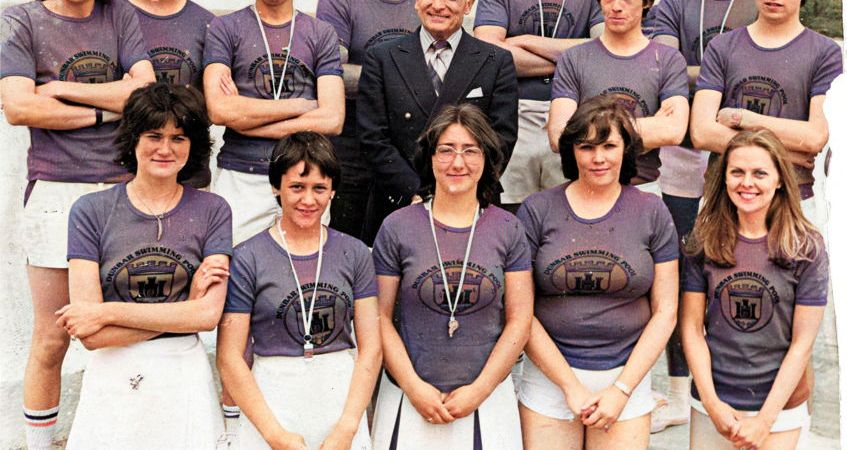
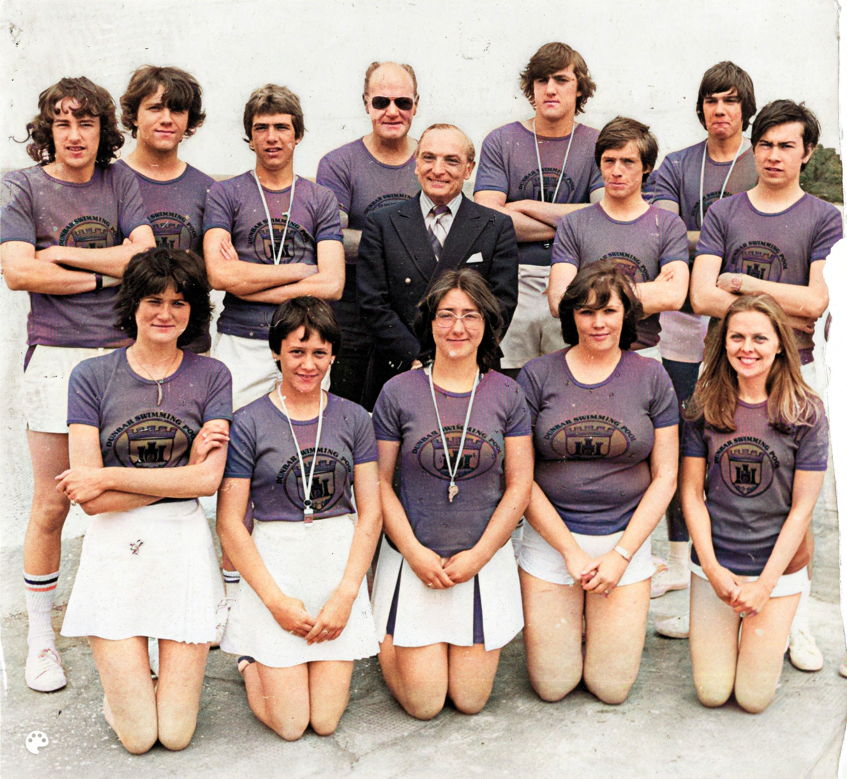
Front row, left to right: Phyllis, Susan Jamieson, Elaine Gray, ?, Elaine Kerr.
Colourised version of an old black and white photo in the author’s possession – the T shirts were actually red.
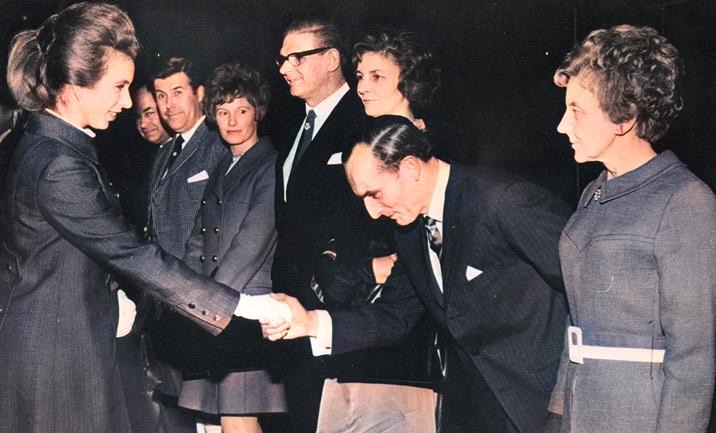
Dunbar Open Air Swimming Pool was set to close after the season of 1978. However in 1979, the running of the pool was taken over from the Council by the local Trader’s Association under the leadership of the late Mike O’Donnell who passed away in 2017, aged 97. Commonwealth gold medal-winning diver, Peter (later Sir Peter) Heatly, who was then the Chairman of the Scottish Sports Council, was invited to perform the official opening ceremony.
Also pictured above, to the right of Peter Heatly, is Christopher Antony Gray (born 11 July 1960 in Haddington, East Lothian) who went on to become a dentist and a Scottish international rugby player. He gained 22 caps for the Scotland national rugby union team including five appearances at the 1991 Rugby World Cup.
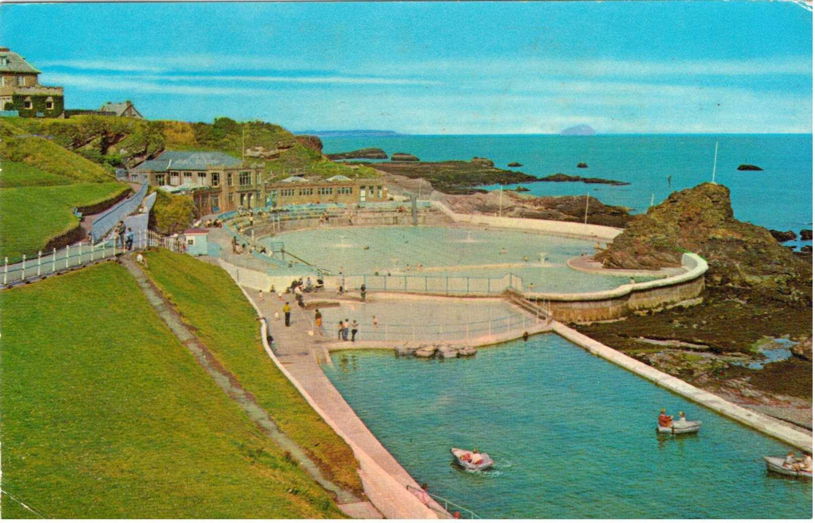
My only claim to fame – or rather shame – was when I was way ahead in the rowing competition at the Wednesday Gala night, but was disqualified due to forgetting to touch one of the fountains – see photo above.
Or perhaps when Radio Forth did an outside broadcast from the pool and set up outside the Pondmaster’s Office. When I appeared from the office, the DJ called me over and chatted to me during the adverts, only to segue into a live broadcast, much to my consternation.
Sir Peter Heatley
Sir Peter Heatly, CBEDL (09 June 1924 – 17 September 2015) was a Scottish diver and Chairman of the Commonwealth Games Federation. He competed in the 3 metre springboard and 10 metre platform at the 1948 and 1952 Olympics, at the 1950, 1954 and 1958 British Empire Games, and at the 1954 European Championships. He won five British Empire Games medals and one European medal, while his best Olympic result was fifth place in 1948. Heatly was knighted in 1990, before being inducted into the Scottish Sports Hall of Fame in 2002, the Scottish Swimming Hall of Fame in 2010 and the International Swimming Hall of Fame in 2016.
Early life
Born in Leith on Coburg Street, Heatly was educated at Leith Academy and began his diving career with Portobello Amateur Swimming Club (PASC). He was inspired to become a diver after watching Pete Desjardins dive at Port Seton. Heatly was eleven years old, and Desjardins asked to see him dive and gave him tips.
By the age of thirteen Heatly had become the East of Scotland Champion (1937), and he held this title until the outbreak of World War II in 1939. The outbreak of war put things on hold; however, Heatly became a record holder in the 440-yards and 880-yards during this time. Heatly studied engineering at the University of Edinburgh and continued to train with PASC.
Heatly wanted to enlist; however, as he was doing well with his studies at University, he was advised to join the Officers’ Training Corps instead. When he graduated from University, he was commissioned into the Royal Engineers, but before he could be posted, the war ended. Healty became an apprentice at Rosyth’s Naval Dockyard; however, he kept up his training at the sports facilities nearby and became a Scottish Freestyle Champion in 1946, a title he kept until 1958.
Heatly married Jean Hermiston in 1948; he ran the family business of heating and ventilation, and a building and construction company while competing internationally and raising his four children.
International competitions
At the 1948 Olympics, Heatly placed fifth in the platform and 13th in the springboard. At the 1950 British Empire Games in Auckland, New Zealand, he won a gold medal in the platform and a silver in the springboard. Heatly had been unable to practise for most of the five-week journey by ship to Auckland, except for one training session which took place in a U.S. base in Panama.
At the 1952 Olympics, Heatly placed 12th in the platform and 16th in the springboard. At the 1954 Commonwealth Games in Vancouver, Canada, he won a gold in the springboard and a bronze in the platform. The same year he won a bronze in the platform at the European championships.
At the 1958 Commonwealth Games in Cardiff, Wales, Heatley was appointed as captain and flagbearer for the Scotland Team. He won a gold medal in the platform, and retired from competitions after that.
Later life
Heatly became the Chairman of Commonwealth Games Council for Scotland (now Commonwealth Games Scotland), in 1967–1971, Chairman of the Scottish Sports Council, (now sportscotland), in 1975–87, and Chairman of the Commonwealth Games Federation, in 1982–90. Heatly has a unique connection with the Commonwealth Games as he has consecutively attended seventeen games, from 1950 to 2014, in an official capacity as a competitor, organiser, Chairman of the Federation, as the Life Vice President of the Federation, team manager and Chef de Mission.
Healty was also the President of Scottish Swimming on two separate occasions, Chairman of the British Swimming Federation, was a Councillor for the City of Edinburgh and was an integral part of the planning of the Royal Commonwealth Pool. He also served in many roles on both the European (LEN) and World (FINA) Technical Diving Committees from 1966 to 1988.
Honours
Heatly was awarded a CBE in 1971 and was knighted in 1990, before being inducted into the Scottish Sports Hall of Fame in 2002, the Scottish Swimming Hall of Fame in 2010 and the International Swimming Hall of Fame in 2016. He was made Deputy Lieutenant of the City of Edinburgh in 1984, and held honorary degrees from the University of Edinburgh (1992) and Saint Margaret’s College (1994).
Personal life
Heatly had four children by his first wife Jean, who was also known as Bertha; she died in 1979. He re-married to Mae Cochrane; she was also a widower with four children of her own. Together Peter and Mae had twenty grandchildren; Mae died in 2003.
Heatly was diagnosed with prostate cancer in the 1980s but lived with the disease for nearly thirty years before he died. His grandson James Heatly won a bronze medal in the 1 m springboard at the 2018 Commonwealth Games.
Rikki Fulton & Jack Milroy
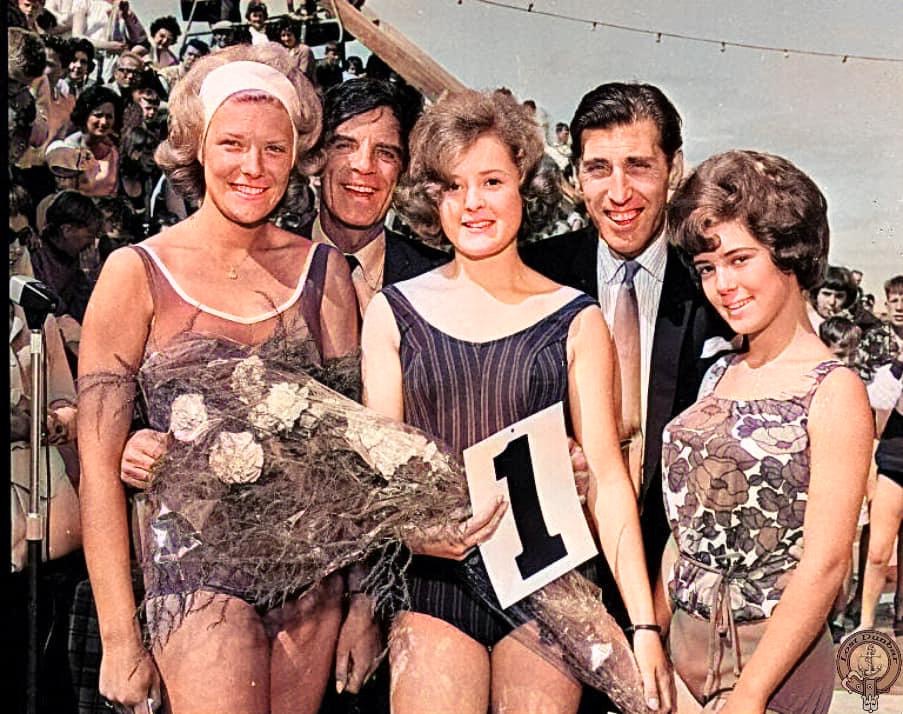
The old pool at Dunbar no longer exists, but in the days before foreign holidays became widely available, Dunbar open air pool was a real visitor attraction with events hosted by big Scottish stars such as Francie and Josie (Jack Milroy and Rikki Fulton).
Ally McLeod
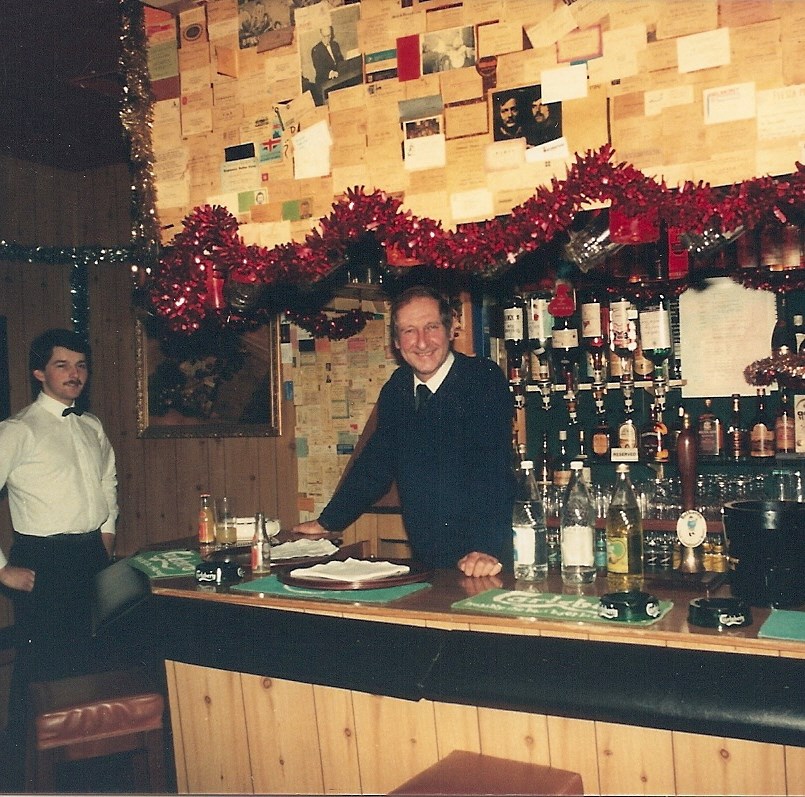
Well-kent faces have been seen in Dunbar for many years. At the town’s renowned Battleblent Hotel, run by Jim and Faye Ferguson and their sons Martin and Kevin (pictured on left) visitors might have been served a pint by Scotland Football Manager, Ally McLeod.
Kylie Minogue
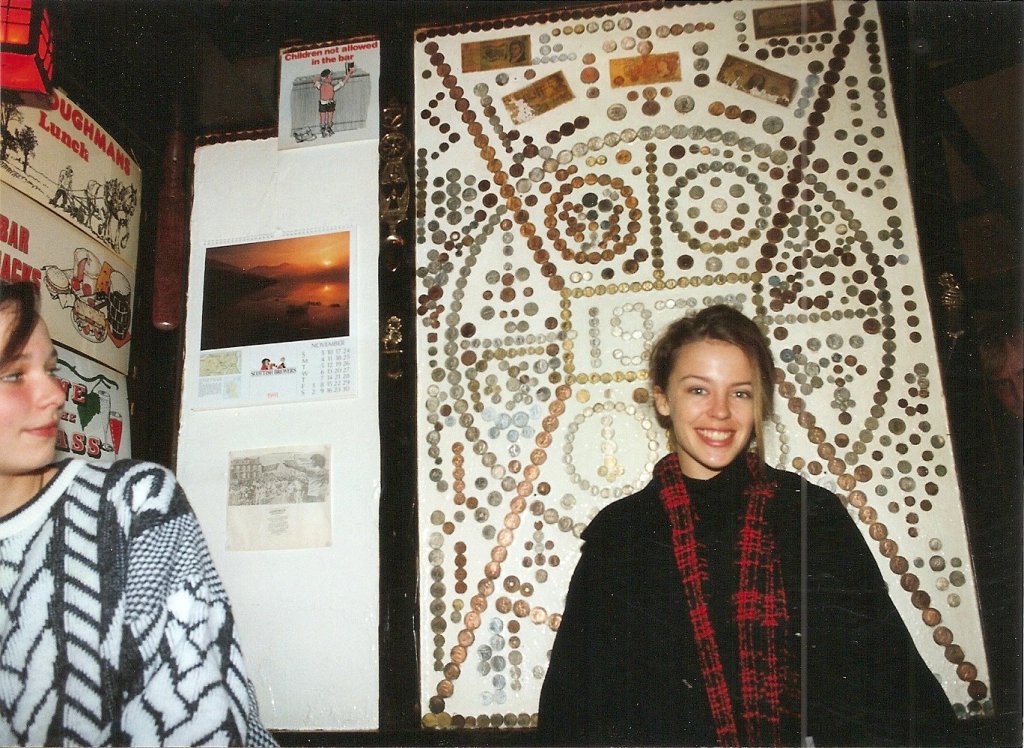
Some like Caroline Smith (now Williams) may have been surprised to encounter Neighbours star and singer Kylie Minogue at the Battleblent.
David Hayman
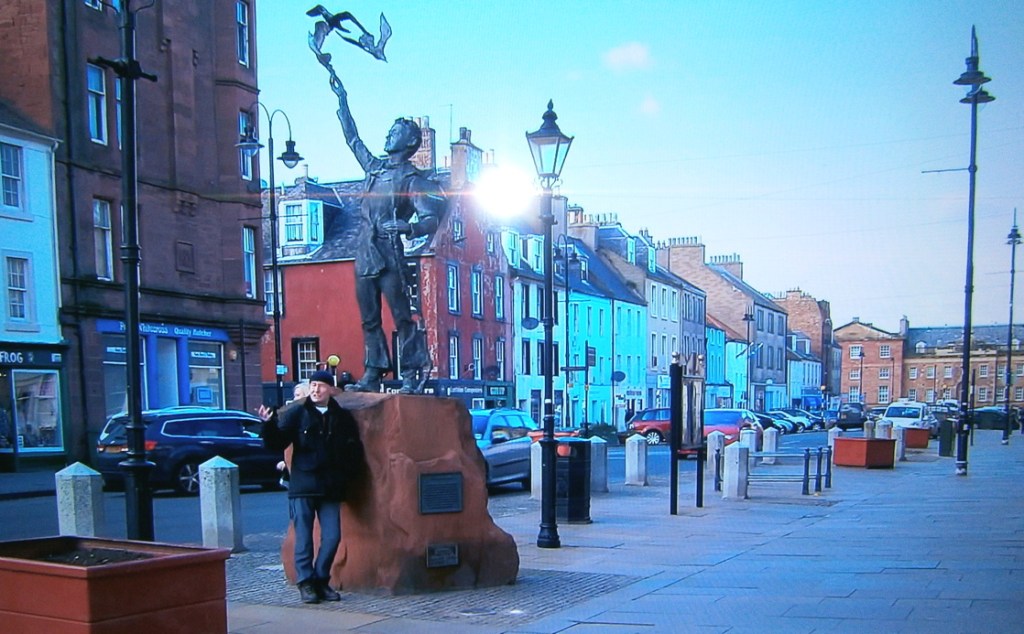
Famous faces can still be seen visiting Dunbar: David Hayman was in the High Street by John Muir’s Statue for an episode of Hayman’s Way, his tribute to Weir’s Way, in 2015.
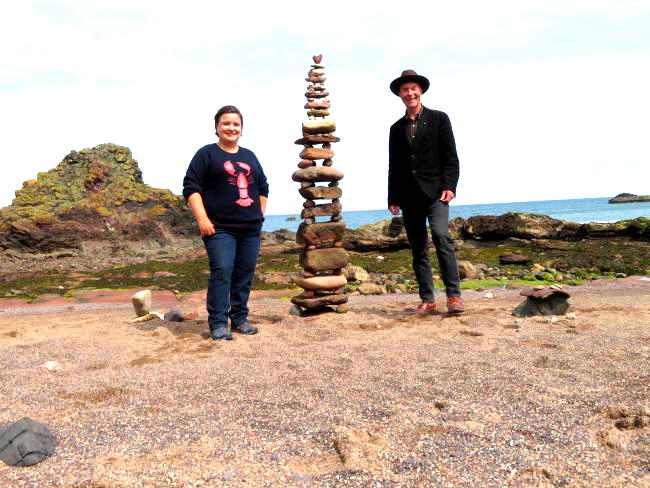
Meanwhile, the site of the old swimming pool continued to be frequented even when lockdown caused the cancellation of the annual stone stacking competition.
The Duke of Kent
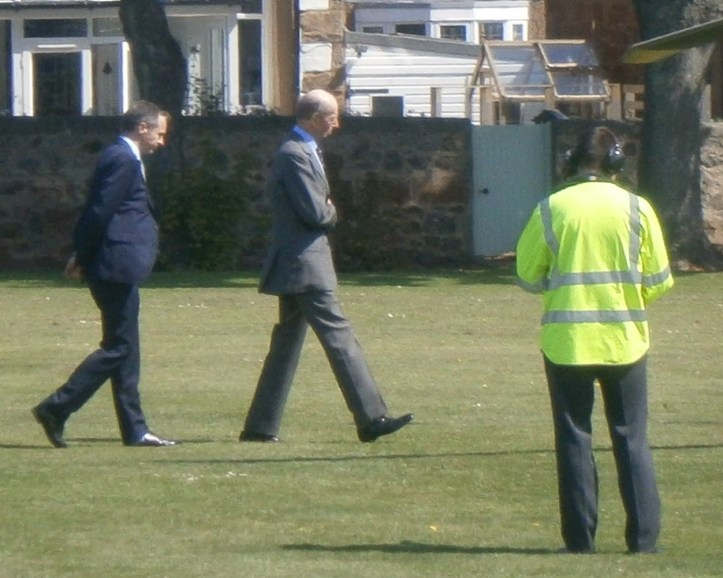
Walkers in Winterfield Park might have bumped into the Queen’s cousin, the Duke of Kent in 2019.
Susan Calman
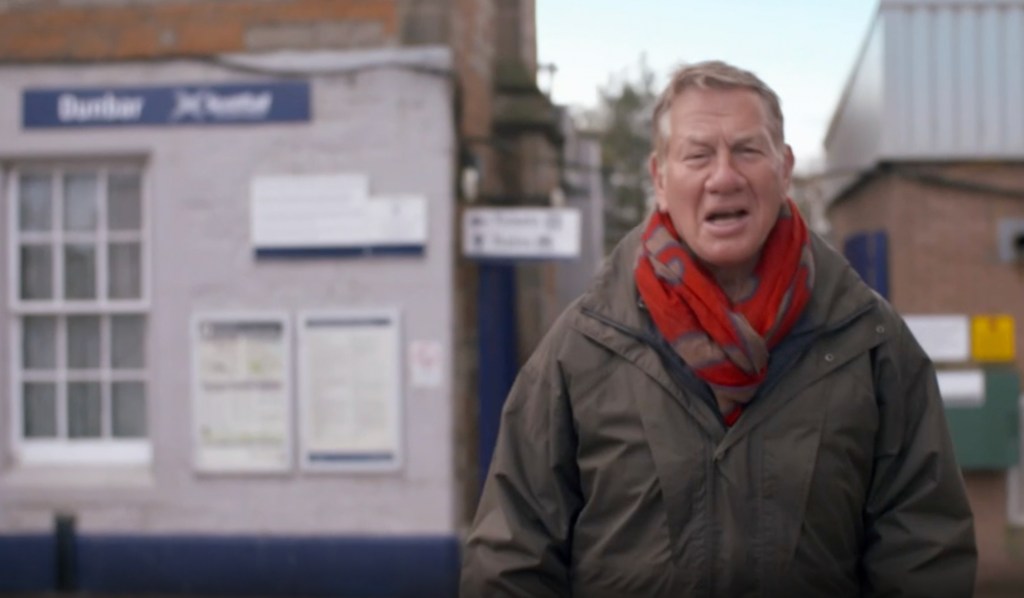
Michael Portillo
And most recently Michael Portillo alighted at Dunbar station before visiting Siccar Point in Berwickshire, famous in the history of geology for Hutton’s Unconformity, found in 1788, which James Hutton regarded as conclusive proof of his uniformitarian theory of geological development.
Notable people with Dunbar Connections
Although no longer the massively popular holiday destination that it once was, with its excellent transport links to Edinburgh and coastal location, Dunbar is one of Scotland’s fastest growing towns. New, and old residents however might be surprised at some of the famous past resident of the town which include:
- Joan Beaufort, Queen of Scots, wife of King James I of Scotland, who served as the Regent of Scotland in the immediate aftermath of his death and during the minority of her son James II of Scotland, before being engulfed in a power struggle with members of the nobility. In desperation she took refuge in Dunbar Castle where she was subsequently besieged by her opponents, in which place and circumstances she died in the year 1445.
- Alexander Stewart, Duke of Albany, second son of King James II of Scotland and Mary of Guelders, was Duke of Albany, Earl of March, Lord of Annandale and Isle of Man and the Warden of the Marches, which altogether gave him an impressive power base in the east and west borders, centred on Dunbar Castle which he owned and lived in. He attempted to seize control of Scotland from his brother King James III of Scotland, but was ultimately unsuccessful.
- John Stewart, Duke of Albany, de facto ruler of Scotland and important soldier, diplomat and politician in a Scottish and continental European context, was the only son of the above Duke of Albany, and managed where his father had failed and became Regent of Scotland, while he also became Count of Auvergne and Lauraguais in France and, lastly, inherited from his father the position of Earl of March, which allowed him to likewise use Dunbar Castle as his centre of power in Scotland.
- Alexander Dow, influential Orientalist, author and British East India Company army officer and resident and educated in Dunbar for part of his boyhood.
- William Alexander Bain pharmacologist.
- Dr James Wyllie Gregor FRSE botanist, born in Dunbar.
- Sir Anthony Home, VC KCB, British soldier who was notable as a recipient of the Victoria Cross and the eventual achievement of the rank of Surgeon-General of the British Armed Forces, born and bred in Dunbar from a local family.
- John Muir, important conservationist, geologist, environmental philosopher and pacifist; one of the founders of the United States system of National Parks and Sierra Club.
- General Sir Reginald Wingate, 1st Baronet, GCB, GCVO, GBE, KCMG, DSO, TD, army officer and colonial governor, ‘the maker of the Anglo-Egyptian Sudan‘, Governor-General of the Sudan (1899–1916), British High Commissioner in Egypt (1917–1919), commander of military operations in the Hedjaz (1916–1919), for many years the senior general of the British army, long-time resident in Dunbar.
- Robert Wilson (engineer), one of the inventors of the ship’s propeller, born and bred in Dunbar from a local family.
- Black Agnes, Countess of Dunbar and heroine of local folklore.
- James Hepburn, 4th Earl of Bothwell, notorious third and last husband of Mary, Queen of Scots, and owner of Dunbar Castle.
- Hugh Trevor-Roper, renowned English historian who boarded at Belhaven Hill School
- Walter Runciman, 1st Baron Runciman, major shipowner and maverick Liberal politician, born in Dunbar to parents from Dunbar.
- Saint Wilfrid, 7th to early 8th century English bishop and saint was imprisoned for a time in Dunbar.
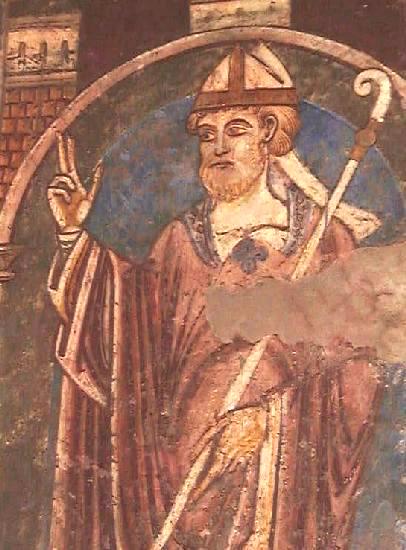
- Saint Cuthbert, early saint and evangelist of the Northumbrian church, Bishop of Lindisfarne, at a time when Northumbria was a leader in promoting and spreading the message of Christianity in a British and wider European context and, he was, according to some authors, born in and initially brought up in Dunbar to a local noble family, before being fostered in the Melrose area with a related or allied family as per the traditions of his class and time.
- Maria Lyle, Para-sprinter, won medals at both the Commonwealth and Olympic Games.
- Jack Hobens (1880 – 1944) was a Scottish-American professional golfer.
- Sergeant John Penn (1820–86), a survivor of the Charge of the Light Brigade.
Archive Film
Some old films recapture the days when Dunbar and its pool were major tourist attractions.
Dunbar Pool 1965. The Gibson family and Donald Walker at Dunbar Outdoor Pool in 1965, also Mary Walker and Grandma Gibson.
Miss Dunbar 1972? @ Dunbar Swimming pool.
Dunbar A1 Resort. 1970’s tourist film.
Dunbar Tourist Board 1970’s. Archive film of Dunbar in the 1970’s.
Dunbar August 1966.
 Vecchio