
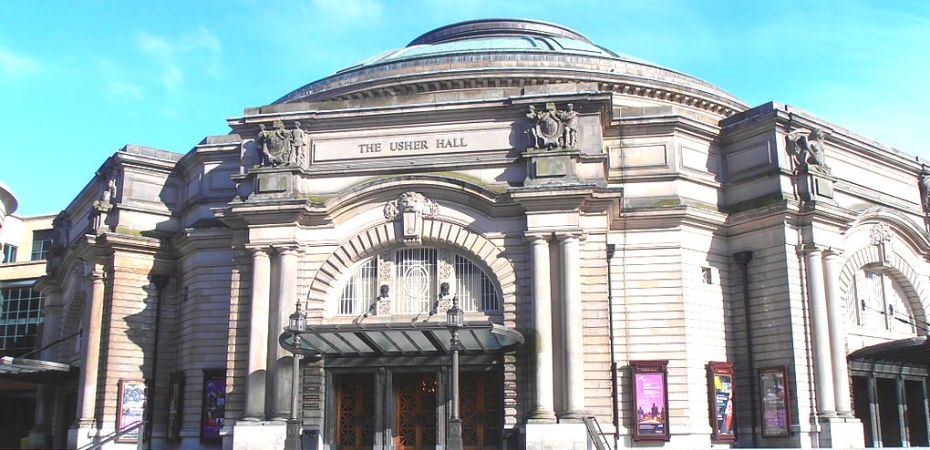
The Usher Hall
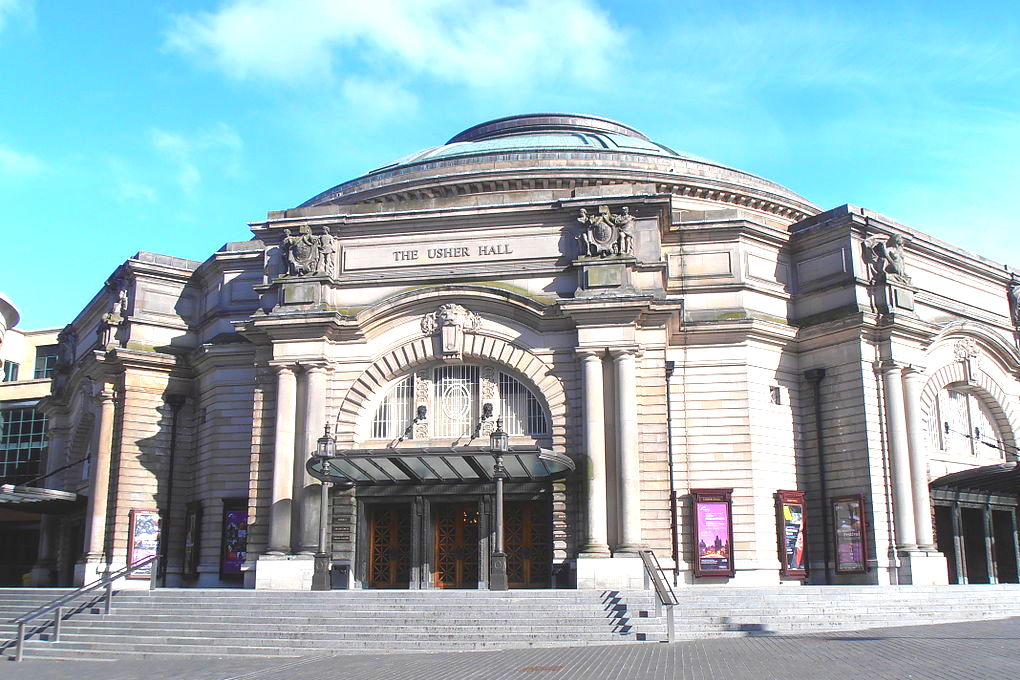
The Usher Hall is a concert hall, situated on Lothian Road, in the west end of Edinburgh, Scotland. It has hosted concerts and events since its construction in 1914 and can hold approximately 2,200 people in its recently restored auditorium, which is well loved by performers due to its acoustics. The Hall is flanked by The Royal Lyceum Theatre on the right and The Traverse Theatre on the left. Historic Scotland has registered the Hall with Category A listed building status.
The construction of the hall was funded by Andrew Usher, a whisky distiller and blender, who donated £100,000 to the city specifically to fund a new concert hall. The choice of site caused early delays but in 1910 an architectural competition was announced with the requirement that the hall be simple but dignified. The winning bid (one of 130 entries) came from Stockdale Harrison & Howard H Thomson of Leicester. The design was partly a backlash against Victorian Gothic, with a return to classical features owing much to the Beaux-Arts style. On 19 July 1911, George V and Queen Mary laid two memorial stones, an event attended by over a thousand people.‘Municipal Benificence’- one of the sculpted figures on the facade of the Hall
Its curved walls, unusual for the time, were made possible by developments in reinforced concrete. The dome was designed to reflect the curvature of the walls, not to give a domed interior (which would have been acoustically disastrous).
The interior of the hall is adorned with decorative plaster panels by the Edinburgh sculptor Harry Gamley. The figures depicted in these panels show figures from the world of music, as well as famous Scots. These include: Sir Walter Scott, Robert Burns, Allan Ramsay, R L Stevenson, Johann Sebastian Bach, George Frideric Handel, Wolfgang Amadeus Mozart, Johannes Brahms, Edvard Grieg and Anton Rubinstein. Harry Gamley’s work also features on the outside of the building with two large figures representing Inspiration and Achievement, as well as another three figures by Crossland McClure depicting the Soul of Music, Music of the Sea and Music of the Woods.
The finished building was officially opened on 16 March 1914 with a concert featuring music by Handel, Bach, Wagner, Beethoven and the Scottish composer Hamish MacCunn.
The final cost of building the Usher Hall was £134,000. Andrew Usher died before building work was started.
Andrew Usher and his descendants
Andrew Usher II (05 January 1826 – 01 November 1898)

Andrew Usher II (05 January 1826 – 01 November 1898) was a Scottish whisky distiller and blender.
Usher’s father, whose name he shared, Andrew Usher (1782 – 1855), was a prominent Scottish brewer who had experimented with the blending of whisky in the 1840s. He had two sons, Andrew II and John. Andrew Usher II was made a partner of Andrew Usher & Co of Edinburgh in the late 1840s. Andrew Usher II perfected the eventual blending of whisky and as such is sometimes called the ‘father of Scottish whisky’. The subsequent blending and mass distillation enabled whisky to grow from a drink rarely consumed outside the United Kingdom, to be one of mass export.
Andrew Usher II was one of the three founders of the North British Distillery; the other two were John Crabbie of Crabbie’s Green Ginger and William Sanderson, whisky blender of Vat 69, who both served as directors of the NB distillery. Andrew Usher II was the first Chairman of the NB Distillery, serving from its start in 1885 until shortly before his death on 1 November 1898. Andrew Usher II and his brother John Usher, as partners in Andrew Usher & Co, were also the proprietors of the Edinburgh Distillery.
Among his many bequests to Edinburgh and Scotland was Usher Hall, which became Scotland’s premier concert hall. It is recorded that he donated £100,000 to the city specifically to fund the new concert hall on 23 June 1896. A bust of Usher is located in the hall at the entrance to the Grand Circle. He died before the hall was completed and it was later opened by his widow.
Usher also played a major role in improving the fishing village and harbour of St Abbs in Berwickshire. He purchased the Northfield estate on the edge of the village, enlarging and finishing the building of a countryside manor by the coastal shore in 1892. He considered the local public hall inadequate and subsequently funded a new village hall and school, which was constructed in 1887 and is now occupied by the St Abbs visitor centre. Usher also gave funds for the building of the local church in 1892 and the extension of the outer harbour wall in 1890.
Elizabeth Stewart Usher (12 November 1862-30 March 1951) and St Clair Cunningham (10 August 1857-19 April 1906).


Andrew Usher’s daughter, Elizabeth Stewart Usher married St Clair Cunningham, a businessman from Leith who purchased Hedderwick Hill. He re-established horse racing at Hedderwick where he created a nine hole golf course that was later extended to eighteen holes. In May 1896 St Clair Cunningham bought Bielside estate, which included most of West Barns and in 1901 he gifted a village hall to West Barns. In March 1905 St Clair Cunningham bought the lands of Winterfield where Saint Margaret’s, intended to be the first of several villas, was built. St Margaret’s is now the clubhouse of Winterfield Golf Club.


St Clair Cunningham and Elizabeth Stewart Usher were the grandparents of Jean Cunningham, who married popular local farmer and rugby enthusiast, Douglas Vernon Rennie of South Belton.
The Agriculture section for the Fourth Statistical Account of East Lothian for the parish of Dunbar notes that:
“West Barns Mains farmhouse (on the south side of the A1) is now called Myreside and this was part of Lochend estate. By 1950 West Barns Mains was owned by Alex Tweedie, farmer at Eweford.
“South Belton was leased by Ian Rennie’s grandfather in 1929. It was bought by Douglas Rennie in 1955; at that time James and Douglas were farming West Barns, but Douglas sold it to James to enable him to buy South Belton. West Barns Farm was bought by Mrs Douglas Rennie in 1965 when James died. Latterly West Barns farmhouse was the home of Mr and Mrs Douglas Rennie. Part of the West Barns Farm steading is used for storage and by the Belhaven Trout Company. (They moved out to a new building at Beltonford by 2003; the steading is to be developed).
“Hedderwickhill farm is mostly arable, rented in 1945 by the Cunningham family from the Tyninghame estate. The farm became empty in 1950s. It was taken over by Alan Dewar in November 1956 who farmed it until November 1984. He had five workers. The next farmer was A. P. Dale who now works the farm with two.“

The story of Belton House and the Hay Barons of Belton will feature in a future post.
 Vecchio
