

Hallelujah Chorus from Handel’s Messiah. Edinburgh Schools Choir including Leith Academy and Broughton perform the Hallelujah Chorus from Handel’s Messiah at the Usher Hall in Edinburgh in 1952. Recovered from an old and cracked 78rpm record by Alan Young – recommended playback speed is 1.25.
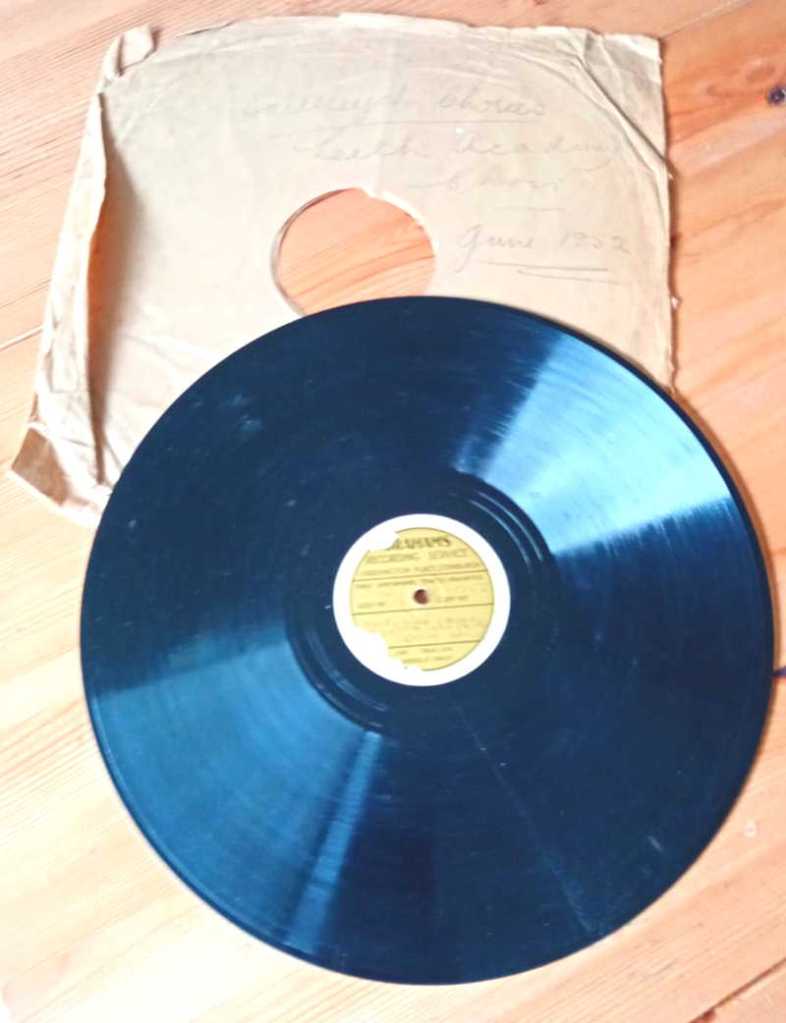
My mother, Alice May McAusland and the Leith Academy choir were part of the Edinburgh Schools Choir ensemble that performed the Hallelujah Chorus from Handel’s Messiah at the Usher Hall in Edinburgh in June 1952.
The old crackly recording reminded me a little of Enrico Caruso’s Mi par d’udir ancora from the opera I Pescatori Di Perle (The Pearl Fishers) by Georges Bizet (1838-1875) as used in Woody Allen’s 2005 film Match Point.

In the same year (1952) Alice May McAusland and the Leith Academy Girls Choir sang “Caller Herring” for BBC Radio.

Georg Friederic Händel

George Frideric (or Frederick) Handel (baptised Georg Friederich Händel, 23 February 1685 – 14 April 1759) was a German-born Baroque composer becoming well known for his operas, oratorios, anthems, concerti grossi and organ concertos. Handel received his training in Halle and worked as a composer in Hamburg and Italy before settling in London in 1712, where he spent the bulk of his career and became a naturalised British subject in 1727. He was strongly influenced both by the middle-German polyphonic choral tradition and by composers of the Italian Baroque.
Handel started three commercial opera companies to supply the English nobility with Italian opera. In 1737 he had a physical breakdown, changed direction creatively, and addressed the middle class and made a transition to English choral works. After his success with Messiah (1742), he never composed an Italian opera again. His orchestral Water Music and Music for the Royal Fireworks remain steadfastly popular. Almost blind, he died in 1759, a respected and rich man, and was given a state funeral at Westminster Abbey.
Handel composed more than forty opera serias over a period of more than thirty years. Since the late 1960s, interest in Handel’s music has grown. The musicologist Winton Dean wrote that “Handel was not only a great composer; he was a dramatic genius of the first order.” His music exerted a strong influence on Classical-era composers, including Mozart and Beethoven.
Slow, steady and deliberate tempi were the order of the baroque day and clarity of contrapuntal line was paramount, which itself dictated a slow and deliberate rendition. John Elliot Gardiner, once said: What I set out to recapture is that “danciness” and lightness of foot which Handel demands and which all Baroque music requires to some extent. Differences in interpretation and tempo can be heard in these four renditions of Morgana’s aria Tornami a vagheggiar, (sometimes sung by Alcina) from the end of Act 1 of Haendel’s Alcina. My first live experience of Alcina was at the Lausanne Opera in Switzerland in 2012 with Olga Peretyatko – in the first of her many appearances there – as Alcina and Sophie Graf as Morgana.
My first Tornami a vagheggiar from Alcina by Sophie Graf at Opéra Lausanne.
Karina Gavin sings Tornami a vagheggiar from Haendel’s Alcina – slower tempo.
Amanda Forsyth sings Tornami a vagheggiar from Haendel’s Alcina – faster tempo.
Nathalie Dessay sings Tornami a vagheggiar from Haendel’s Alcina – fastest tempo. Can be viewed on Youtube.
Handel’s Messiah
Messiah (HWV 56) is an English-language oratorio composed in 1741 by George Frideric Handel, with a scriptural text compiled by Charles Jennens from the King James Bible, and from the Coverdale Psalter, the version of the Psalms included with the Book of Common Prayer. It was first performed in Dublin on 13 April 1742 and received its London premiere nearly a year later. After an initially modest public reception, the oratorio gained in popularity, eventually becoming one of the best-known and most frequently performed choral works in Western music.
Handel’s reputation in England, where he had lived since 1712, had been established through his compositions of Italian opera. He turned to English oratorio in the 1730s in response to changes in public taste; Messiah was his sixth work in this genre. Although its structure resembles that of opera, it is not in dramatic form; there are no impersonations of characters and no direct speech. Instead, Jennens’s text is an extended reflection on Jesus as the Messiah called Christ. The text begins in Part I with prophecies by Isaiah and others, and moves to the annunciation to the shepherds, the only “scene” taken from the Gospels. In Part II, Handel concentrates on the Passion and ends with the “Hallelujah” chorus. In Part III he covers the resurrection of the dead and Christ’s glorification in heaven.
Handel wrote Messiah for modest vocal and instrumental forces, with optional settings for many of the individual numbers. In the years after his death, the work was adapted for performance on a much larger scale, with giant orchestras and choirs. In other efforts to update it, its orchestration was revised and amplified by, among others, Mozart (Der Messias). In the late 20th and early 21st centuries the trend has been towards reproducing a greater fidelity to Handel’s original intentions, although “big Messiah” productions continue to be mounted. A near-complete version was issued on 78 rpm discs in 1928; since then the work has been recorded many times.
Hallelujah
Part II closes with the chorus Hallelujah, in the key of D major with trumpets and timpani. The choir introduces in homophony a characteristic simple motif on the word, playing with the interval of a second, which re-appears throughout the piece. Several lines from the Book of Revelation (Revelation 19:6,16, Revelation 11:15) are treated differently, as in a motet, but unified by “Hallelujah” as a conclusion or as a countersubject in a fugal section. The line “for the Lord God omnipotent reigneth” is sung by all voices, first in unison, then in imitation with Hallelujah-exclamations interspersed. The second line “The kingdom of this world is become” is sung in a four-part setting like a chorale. The third idea “and he shall reign for ever and ever” starts as a fugue on a theme with bold leaps, reminiscent in sequence of Philipp Nicolai‘s Lutheran chorale “Wachet auf“. As a countersubject, the words “for ever – and ever” assume the rhythm of the Hallelujah-motif. The final acclamation “King of Kings…and Lord of Lords” is sung on one note, energized by repeated calls “Hallelujah” and “for ever – and ever”, raised higher and higher (the sopranos and the trumpets part), up to a rest full of tension and a final solemn “Hallelujah“.
Handel’s Messiah features in Face/Off, a 1997 American action film directed by John Woo, written by Mike Werb and Michael Colleary, and starring John Travolta and Nicolas Cage.
 Vecchio