
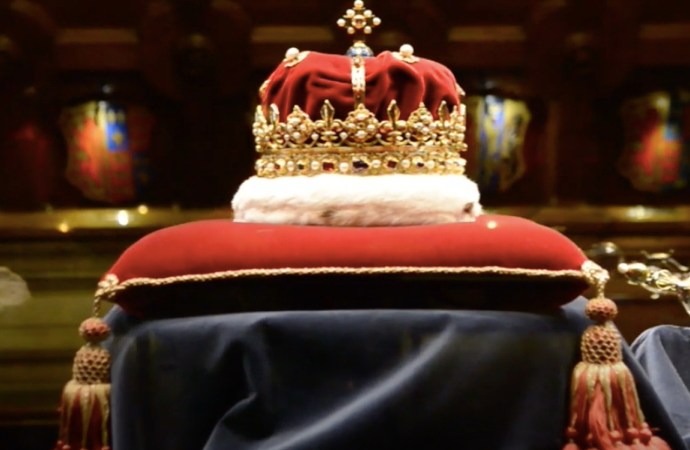
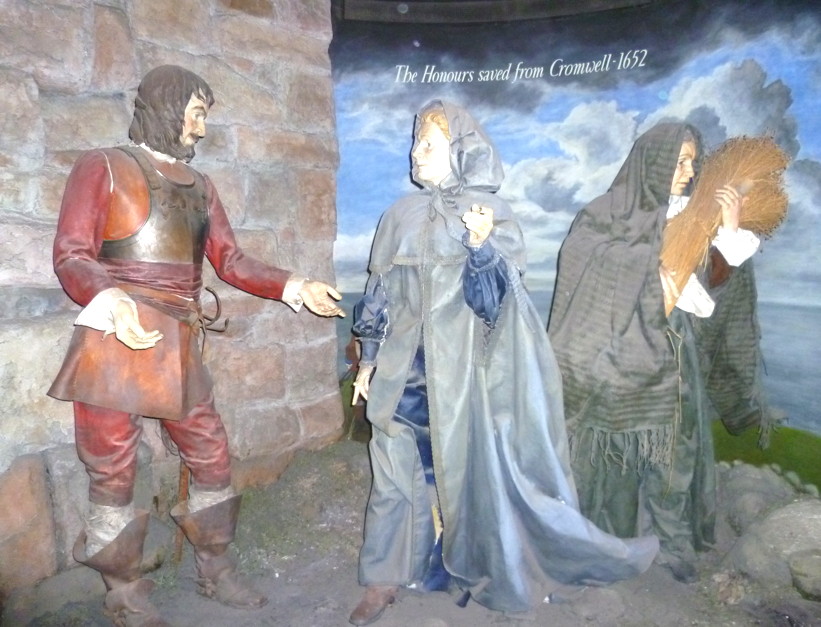
26 May 1652: On this day, three hundred and seventy years ago, the last Royalist stronghold anywhere on the eastern side of Scotland, Dunnottar Castle near Stonehaven, surrendered after an eight month siege, though not before the Scottish crown jewels had been smuggled out to safety in Kinneff Old Church.
In 1651, during Cromwell’s occupation of Scotland after his victory at Dunbar in 1650, the regalia were quietly removed from the Castle to be used for the coronation at Scone of Charles II as King of Scots. From there they were taken for safekeeping to Dunnottar Castle, south of Aberdeen, smuggled out during a siege of that castle in 1652 and buried under the floor of a local church at Kinneff until the Restoration in 1660. The account of Christian Fletcher, wife of Mr. Granger, the minister of Kinneff, reveals how easily they might have been lost for all time, “…whereupon I went to Dunnottar, five miles distant from my house, and after a little conference with the said Elizabeth Douglas [the Governor’s wife], she showed me the Honours, desiring me to take upon me the keeping of them, and to carry them along with me, which I by the Lord’s assistance did willingly undertake, whereupon she delivered unto me the Crown and Sceptre*, which I brought with me on horseback, riding always near the sea along the tops of the high craigs, resolving rather to lose my life and throw them in the sea than that they should have taken them from me, being at that time in fear of the enemy always.” [* the Sword blade and hilt came out in a sack of flax carried by her servant].
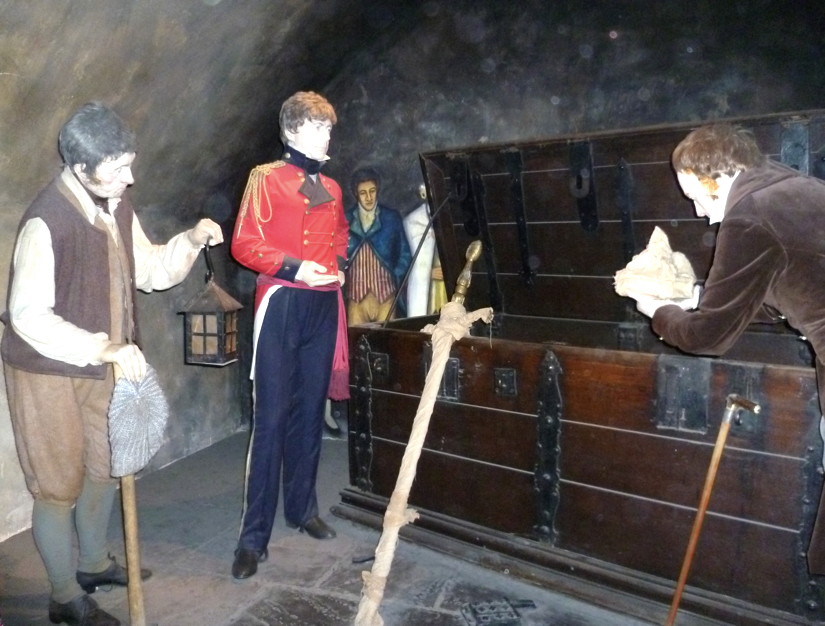
26 May 1819: On this day, two hundred and two years ago, The Honours of Scotland, the crown jewels, were put on display in Edinburgh Castle after being disinterred by Sir Walter Scott from the bowels of the castle where they had been placed in 1707.
“The extreme solemnity of opening sealed doors of oak and iron, and finally breaking open a chest which had been shut since 7th March 1707, about a hundred and eleven years, gave a sort of interest to our researches, which I can hardly express to you, and it would be very difficult to describe the intense eagerness with which we watched the rising of the lid of the chest, and the progress of the workmen in breaking it open, which was neither an easy nor a speedy task. (…) The discovery of the Regalia has interested people’s minds much more strongly than I expected, and is certainly calculated to make a pleasant and favourable impression upon them in respect to the kingly part of the constitution. It would be of the utmost consequence that they should be occasionally shown to them, under proper regulations, and for a small fee.“
Sir Walter Scott, letter to J. W. Croker M.P., 5th February, 1818.
The Honours of Scotland
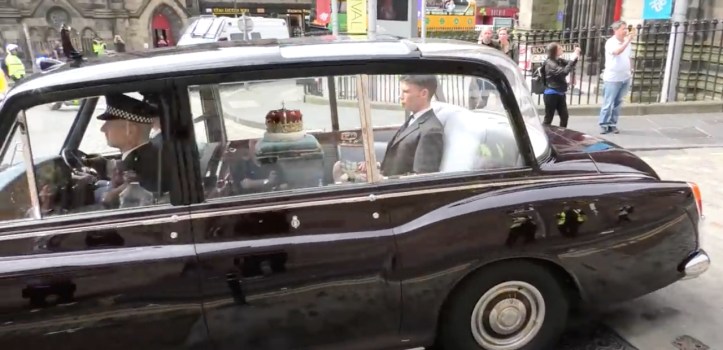
The Honours of Scotland, informally known as the Scottish Crown Jewels, dating from the fifteenth and sixteenth centuries, are the oldest surviving set of crown jewels in the British Isles.
The regalia were used together for the coronation of Scottish monarchs from Mary I in 1543 until Charles II in 1651. They were used to represent Royal Assent to legislation in the Estates of Parliament before England and Scotland were unified under one parliament in 1707, at which time the Honours were locked away in a chest and the English Crown Jewels were adopted by British monarchs. They were rediscovered in 1818 and have been on public display at Edinburgh Castle ever since. The Honours have been used at state occasions including the first official visit to Scotland as monarch by George IV in 1822 and the first such visit by Elizabeth II in 1953. The Scottish Parliament was founded in 1999 and the Honours are used there once again to represent Royal Assent.
There are three primary elements of the Honours of Scotland: the crown, the sceptre, and the Sword of State. The gold crown, decorated with gems and pearls, is Scottish, and the sceptre and sword were gifts from the pope made in Italy. They also appear on the crest of the royal coat of arms of Scotland and on the Scottish version of the royal coat of arms of the United Kingdom, where the red lion of the King of Scots is depicted holding the sword and sceptre and wearing the crown. Robes, a pair of spurs and a ring also had been part of the Scottish regalia, and queens consort had their own consort crown, none of which survives today.
The secondary Honours comprise a silver-gilt wand, three items of insignia and a ring once owned by James VII added in 1830, and a necklace with a locket and pendant bequeathed to Scotland by the Duchess of Argyll in 1939.
History
Early history
Use of regalia by monarchs in Scotland can be traced back to when Britain was converted to Christianity in the Middle Ages. In the earliest known depiction of a Scottish king wearing his symbols of sovereignty, King Edgar wears a crown and bears a sword and a sceptre on his Great Seal; he reigned from 1097 until 1107. His son, Alexander I, is shown holding an orb – a pictorial emblem of divine kingship that was not actually part of the Scottish Honours. By the reign of John Balliol, the regalia consisted of a crown, sceptre, sword and ring. After the English invasion in 1296, the regalia and Stone of Scone, upon which monarchs of Scotland were invested and crowned, were captured by the English army and taken south to London.

New items were made for subsequent coronations, and these were gradually replaced during the 16th century with the current set of Honours, consisting of a crown made in Scotland by John Mosman and a sword and a sceptre both made in Italy and given to Scotland as papal gifts. A consort crown was made for Mary of Guise, wife of James V, in 1539; it does not survive among the Honours. The monarch’s regalia were first used together by Mary, Queen of Scots in 1543. By the second half of the century, they represented royal authority in the Scottish Parliament, and Acts of Parliament were given royal assent when the monarch or one of his or her commissioners touched it with the royal sceptre.
17th century
Spurs – emblems of knighthood and chivalry – were presented to Charles I at his Scottish coronation in 1633; the spurs and coronation robes also have been lost. The Honours were last used at coronation in 1651 by Charles II. His father Charles I had been overthrown and executed by order of the Parliament of England, which ordered almost all of the English Crown Jewels to be melted down and struck into coins. However, the Honours of Scotland were hidden, firstly in Dunnottar Castle, which was later besieged by the New Model Army, and from where the Honours were smuggled out; secondly under the floor of Kinneff Parish Church, to be recovered after the Restoration of the monarchy in 1660. Although they had been found, the Honours were no longer used to crown Scottish sovereigns after Charles II.
Until the Acts of Union 1707, which united the Kingdom of Scotland and the Kingdom of England to form the Kingdom of Great Britain, the Honours of Scotland were taken to sittings of the Parliament of Scotland to represent the monarch, who lived in England since the Union of the Crowns in 1603. After the Act of Union, the two parliaments having been dissolved, the Parliament of Great Britain sat in London; the Honours of Scotland, having no symbolic role in the unified British Parliament, were locked away in a chest at Edinburgh Castle.
19th century
There they remained, almost forgotten, until 1818 when the future George IV, acting as Prince Regent, issued a royal warrant authorising the historian Walter Scott and a group of officials to break down the wall of the ancient Crown Room on 4 February. Half expecting to find the oak chest empty, they were relieved to open it and discover the crown, sceptre and sword exactly as they had been left 111 years earlier. The Royal Standard was hoisted above Edinburgh Castle in celebration of the historic moment. Cheers of excitement rippled through the castle, and members of the public gathered outside to hear the news. On 26 May 1819, the Honours went on public display in the Crown Room. They were guarded by two veterans of the Battle of Waterloo dressed in a Tudor-style Yeoman’s outfit.
George IV was crowned king in 1821 and his visit to Scotland the following year was the first by a monarch since 1651. On 12 August 1822, the Honours were escorted in procession to the Palace of Holyroodhouse. There was a carnival atmosphere, with people lining the streets and observing from windows. Three days later, the king arrived at the palace and symbolically touched the regalia. Before leaving the country a week later, he took part in a return procession to the Castle, where the Honours would remain until the 20th century.
20th century to present day
In 1911 the sword was carried before George V at the official opening of the Thistle Chapel in St Giles’ Cathedral, Edinburgh – the first time any of the regalia had left Edinburgh Castle since 1822. During the Second World War, the Honours were hidden at the Castle owing to fears they might be lost if the UK fell to Germany. The crown and Stewart Jewels were buried under the floor of a water closet, while the sceptre, sword and wand were hidden inside a wall. The only officials who knew of the hiding places were George VI, the Scottish Secretary of State, the King’s Remembrancer, and the Governor General of Canada. In 1953, they were presented to the newly crowned Elizabeth II at a National Service of Thanksgiving in St Giles’ Cathedral. Keen to avoid the service being interpreted as a Scottish coronation, Winston Churchill, the then Prime Minister, advised the Queen to dress informally, which was interpreted by many as a disrespectful attitude to Scotland by the new monarch.
From 1971 until 1987 the sword was used at the installation of a Knight of the Order of the Thistle, Scotland’s highest Order of Chivalry. When the Stone of Scone was returned to Scotland in 1996 it also was placed in the Crown Room alongside the Honours. During renovations in the 1990s, the Honours were temporarily stored at an anonymous bank in Edinburgh.
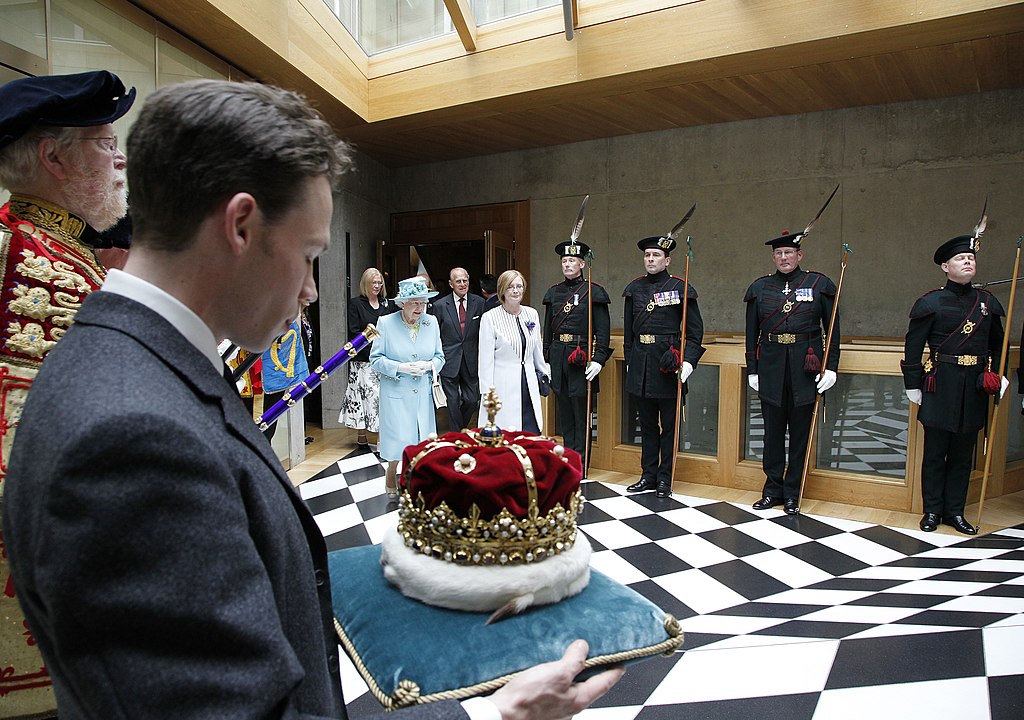
The Crown of Scotland was present in May 1999 at the first sitting of the devolved Scottish Parliament. It was carried on a cushion, the official reason being that it was too fragile for the Queen to wear. The crown was present again in October 2004 at the opening of the new Scottish Parliament Building and at the opening ceremonies of each new session of the Scottish Parliament.
In 2018 plans were announced to renovate the “past its sell-by date” Honours exhibition and improve accessibility.
Regalia
Crown

It is not known exactly when the original Crown of Scotland was made, but it can be seen in its pre-1540 form in a portrait of James IV in the Book of Hours that was created for his marriage to Margaret Tudor in 1503. Arches were added to the crown by James V in 1532, making it an imperial crown, symbolising the king’s pretensions of being an emperor of his own domain, subservient to no one but God. Arches first appeared as pictorial emblems on coins under James III, who in 1469 claimed “ful jurisdictione and free impire within his realm“.
In 1540 the base was melted down and recast by the Edinburgh goldsmith John Mosman with the addition of 22 gemstones to the original 20 and an extra 1.2 kilograms (41 oz) of gold. James V first wore it to his wife’s coronation in the same year at Holyrood Abbey. It weighs 1.6 kilograms (3 lb 10 oz) and the base is decorated with alternating fleurs-de-lis and crosses fleury. Two gold arches, preserved from the original, are surmounted by a gold monde enamelled blue with stars representing the night sky. On top of the monde is a cross decorated with black enamel, pearls, and a large amethyst. A purple velvet cap was manufactured by Thomas Arthur of Edinburgh; this was changed to a red cap by James VII (1685–88), and the present cap dates from 1993. Four gold ornaments with a large pearl in the centre are attached to the cap between the crown’s arches.
Sceptre
The Sceptre of Scotland was a gift made in Italy from Pope Alexander VI to James IV in either 1491 or 1494 and was remodelled and lengthened in 1536. It is made of silver gilt and topped by a finial of polished rock. The sceptre includes grotesques and Christian symbols: stylised dolphins – symbols of the Church – appear on the head of the rod, as do images of the Virgin Mary holding a baby Christ, of Saint James the Great, and of Saint Andrew holding a saltire.
Sword of State

The Sword of State of Scotland was also a papal gift: Pope Julius II presented it to James IV in 1507 (see blessed sword and hat). It was made by Domenico da Sutri and replaced a native sword that had been made in 1502. The etched blade, measuring 99 centimetres (3.25 ft) in length, includes figures of Saint Peter and Saint Paul, as well as the etched name of Julius II. The 38.7-centimetre-long (1.27 ft) silver-gilt handle bears figures of oak leaves and acorns, with a crossguard in the form of dolphins. It is accompanied by a wooden scabbard which is bound in crimson velvet with silver-gilt repoussé work and hung from a woven silk and thread-of-gold belt that has a silver-gilt buckle.
Other jewels in the Crown Room
Since 1818 the coronation regalia have been supplemented in the Crown Room with other pieces of ceremonial jewellery.
Wand
Alongside the crown, sceptre and sword, Walter Scott found a silver-gilt wand. It measures 1 metre (3.3 ft) in length and is topped with a faceted crystal monde surmounted by a cross. The wand has a wooden core and the unknown maker’s initials F.G. The object’s intended role – if it had one at all – has been forgotten, and its presence among the regalia is still a mystery. Walter Scott thought it may have been carried before the Lord High Treasurer of Scotland. Although the Treasurer did have a mace it was a different shape.
Stewart Jewels
Four objects taken into exile by James VII after the Glorious Revolution in 1688 are also displayed: a locket, a Great George and collar, and a ruby ring. They all returned to Britain 119 years later and were given to Edinburgh Castle on permanent loan by William IV in 1830.
The St Andrew Jewel of the Order of the Thistle is a gold and silver locket suspended from a ribbon that contains an oval piece of chalcedony into which is carved a cameo figure of Saint Andrew. The cameo is bordered with 12 diamonds. Inscribed on the back is the Order’s Latin motto: NEMO ME IMPUNE LACESSIT, meaning “no one attacks me with impunity“. Inside is a miniature portrait of Princess Louise of Stolberg-Gedern, wife of Prince Charles Edward Stuart, the elder son of James VII. The object is variously of English, French, Italian and Dutch origin, was altered several times, and measures 6.5 cm (2.6 in) by 4 cm (1.6 in).
The Collar and the Great George of the Order of the Garter consist of an enamelled gold figure of Saint George, the patron saint of England, slaying a dragon made for Charles II in 1661 suspended from a gold collar made in 1685. The George is set with 122 diamonds and measures 7.2 cm (2.8 in) by 6.4 cm (2.5 in). The saint’s cloak and a large suspension loop are both missing. The collar is 1.57 metres (5.2 ft) long and has 26 alternating knots and enamelled badges, each with a tudor rose in the centre.
The Ruby Ring was probably used at the English coronations of Charles I and Charles II, and certainly that of James (known in England as James II). It has a large ruby etched with a St George’s Cross and bordered by 26 diamonds applied in the 19th century.
Lorne Jewels
Queen Victoria‘s fourth daughter Princess Louise, Duchess of Argyll, died in 1939 and left a necklace, locket, and pendant to the nation of Scotland. The London-made jewellery was a gift to Louise from her husband the Marquis of Lorne (later the Duke of Argyll) in 1871. The necklace contains 190 diamonds and 13 pearls; it suspends the locket, consisting of a large pearl surrounded by 30 diamonds; from which hangs the pear-shaped pendant, set with diamonds, emeralds and sapphires, having a relief depiction of the Galley of Lorne and the motto of Dukes of Argyll: NE OBLIVISCARIS, meaning “do not forget“.
Commissioners for the Keeping of the Regalia
Under the terms of a Royal Warrant of 1818, the holders of four of the Great Offices of State in Scotland, the Lord Justice Clerk, the Lord Advocate, the Keeper of the Great Seal of Scotland (the First Minister of Scotland), and the Lord Clerk Register, are ex-officio Commissioners for the Keeping of the Regalia. The warrant gave the keepers the power to appoint a deputy-keeper and Yeoman-keepers. Accordingly on 8 December 1818 Captain Adam Ferguson was appointed. Since 1996, the commissioners have also been empowered by another Royal Warrant for the safekeeping of the Stone of Scone and for the arrangement of its return to Westminster Abbey for the next British coronation.
 Vecchio