
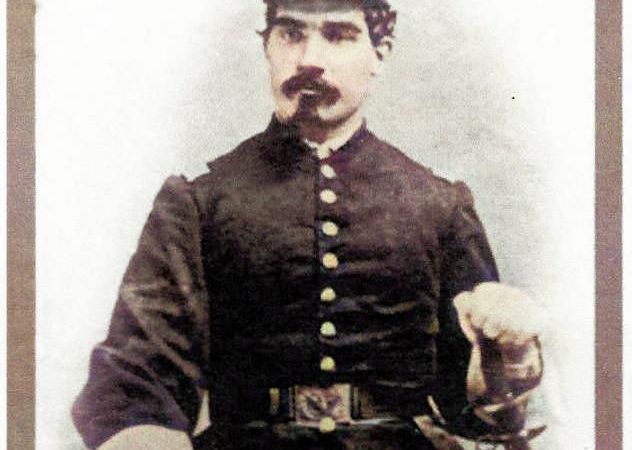
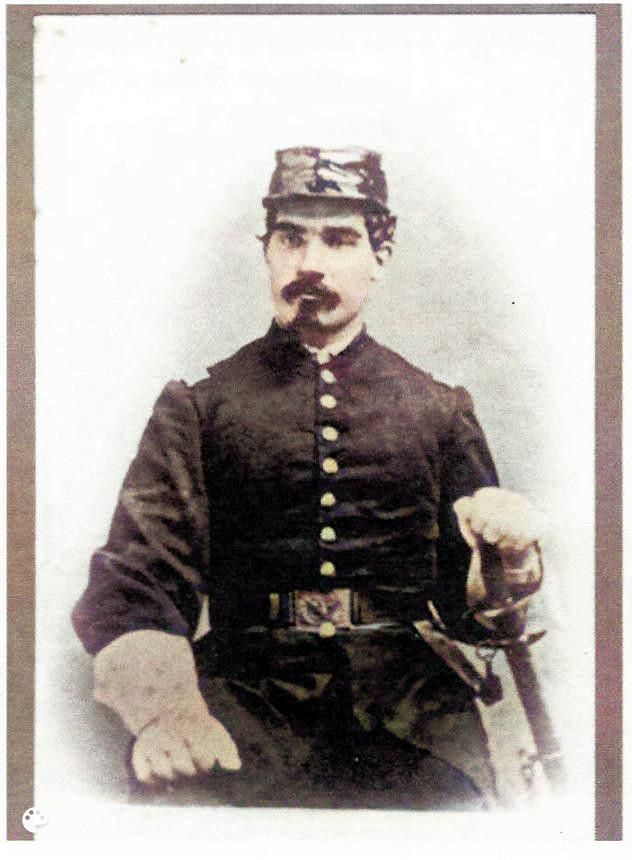
For a long time it was believed that the male lines of the Scottish Philps were extinct until it was discovered that several members of the family had emigrated to the USA in the 1850s and that there is a thriving community of Philps in Iowa.
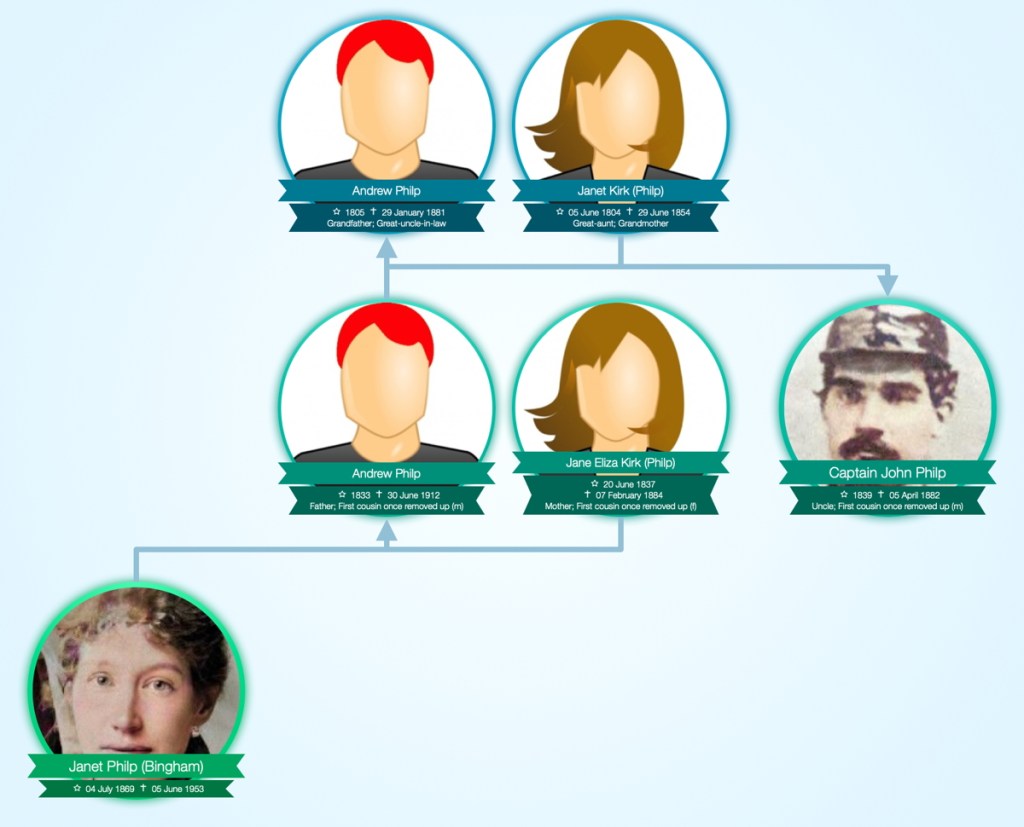
The birth and baptism of John Philp do not appear to have been recorded, but he appears to have been born in 1839 in Cupar parish in Fife. He was the fifth of the seven children of Andrew Philp, a baker, and his wife Janet Kirk.
He had one sister:
- Janet Philp (born 28 June 1835)
and five brothers:
- William Philp (born 1831)
- Andrew Philp (born 1839)
- Robert Philp (born 1837)
- Colour Sergeant James Philp of the Black Watch (born ca 18 January 1842) &
- Thomas Philp (born 1844).
He does not appear in the census of 06 June 1841, but is assumed to have been living in Cupar – the 1841 census records for Cupar and several other Fife parishes are missing.
John Philp first appears in the census of 30 March 1851 where he is described as aged 12 and a scholar living at 53 Bonnygate in the town of Cupar in the parish of Cupar in the county of Fife in Scotland.
On 14 August 1858, along with his sister Janet, his uncle John Philp (senior) and his extended family, John Philp (junior) left Glasgow on the “S.S. Edinburgh” for New York, arriving there on 28 August 1858. John’s elder brother William later joined them in the USA.
At the US census of 01 June 1860, he appears to have been recorded as John “Philip”, aged 28 (rather than 20) and working as a day labourer at Guntersville, Marshall county, Alabama, USA. This would be coherent with his statement that he was residing in Alabama at the start of the US Civil War on 12 April 1861.
After the war ended, on 16 January 1866, John Philp bought a farm in section 23 of Montrose Township, Lee county, Iowa, USA from Hiram Barney and his wife.
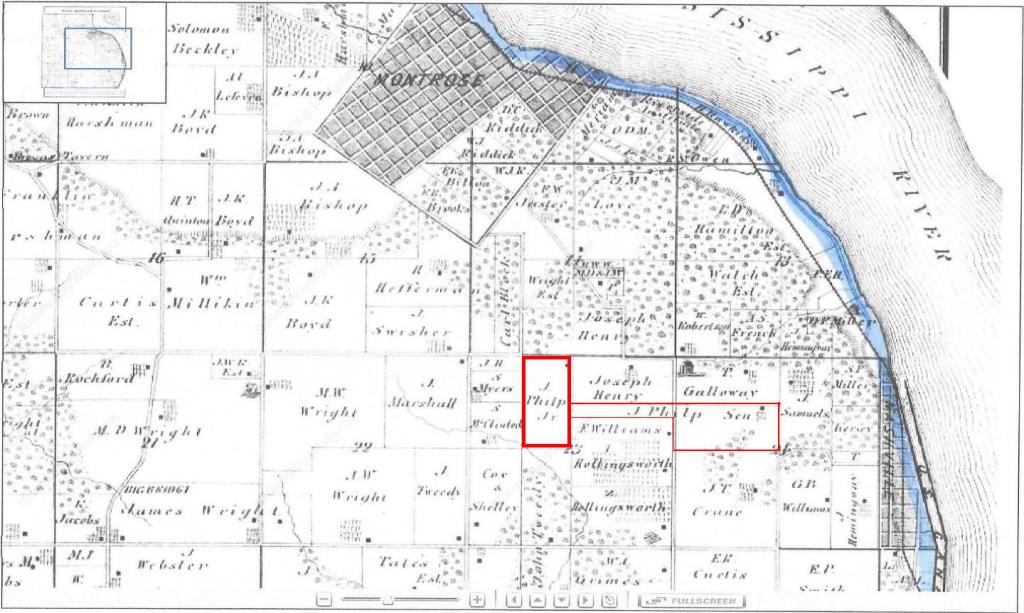
On 05 October 1867, he married Margaret Galloway, daughter of Alexander Galloway and Helen McIntyre. Margaret’s elder sister, Helen Pringle Galloway had married John’s uncle, John Philp senior on 05 June 1847 back in Scotland.
He had six children with Margaret Lawson Galloway:
- Helen Philp (16 August 1868)
- Robert K(irk?) Philp (18 July 1870)
- Allan J. Philp (16 September 1872)
- John Edward Philp (30 May 1875)
- Kathrine Louisa Philp (17 November 1877) &
- Ralph Garfield Philp (18 September 1880).
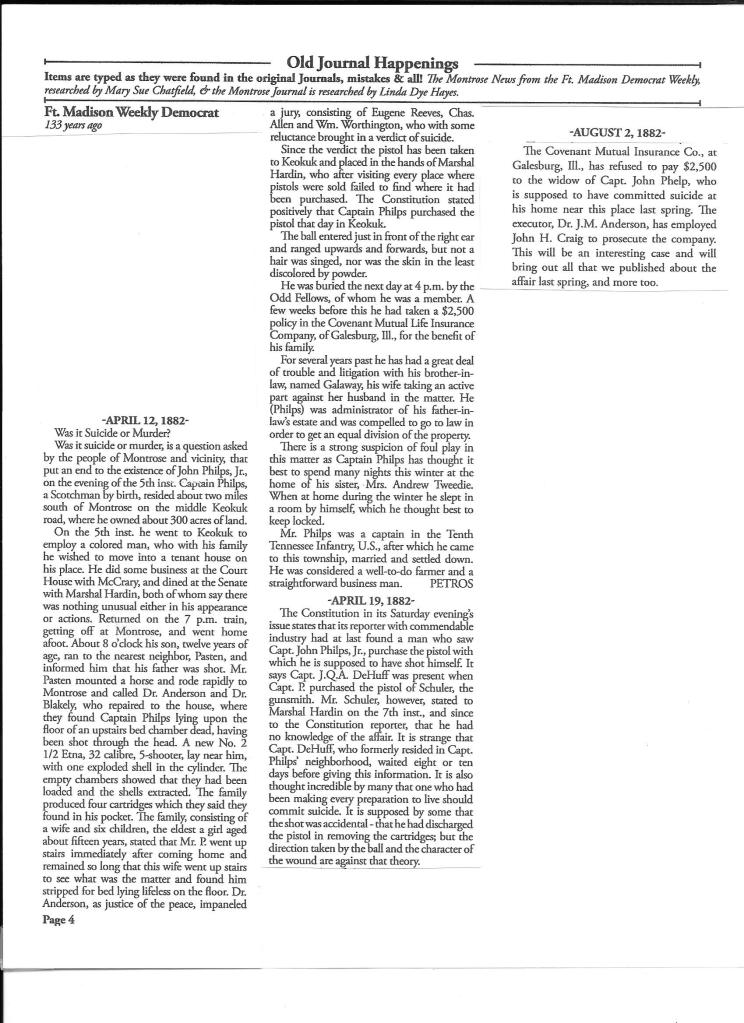
On 05 April 1882, Captain John Phiilp died as the result of a tragic accident in Montrose, Lee, Iowa, United States of America when he was 42 years old.
His wife Margaret Lawson Galloway died on 30 June 1929, 47 years after him.
The military stone on his grave and all of his military records including his own signature spell his name as “Phillips”.
Captain John Philp in the American Civil War
On 29 April 1862, John Philp joined Company C of the 10th Tennessee Infantry (originally 1st Regiment, Middle Tennessee Infantry) as a 3rd Sargent at Nashville, Davidson county, Tennessee, USA. He obtained a number of promotions and was promoted to Captain on 10 September 1863.
From Philp Family History by John Douglas Philp 2017:
“As previously mentioned, there was a second John Philp who accompanied the family group from Scotland to Lee County, Iowa in 1858 and he was a nephew to the elder John. While serving in the Union Army during the Civil War he achieved the rank of Captain so I will refer to him as “Captain” John. According to Scottish census records he was the fifth son of Andrew Philp and he and his older sister Janet (a.k.a. Jessie) also settled in Lee County. Captain John served in Company C of the 10th Tennessee Infantry during the Civil War. The military stone on his grave and all of his military records including his own signature spell his name as “Phillips”. Jessie also served during the War as a nurse. She ministered to the sick and wounded at Estes House in Keokuk, Iowa which had been converted to a hospital during the War.
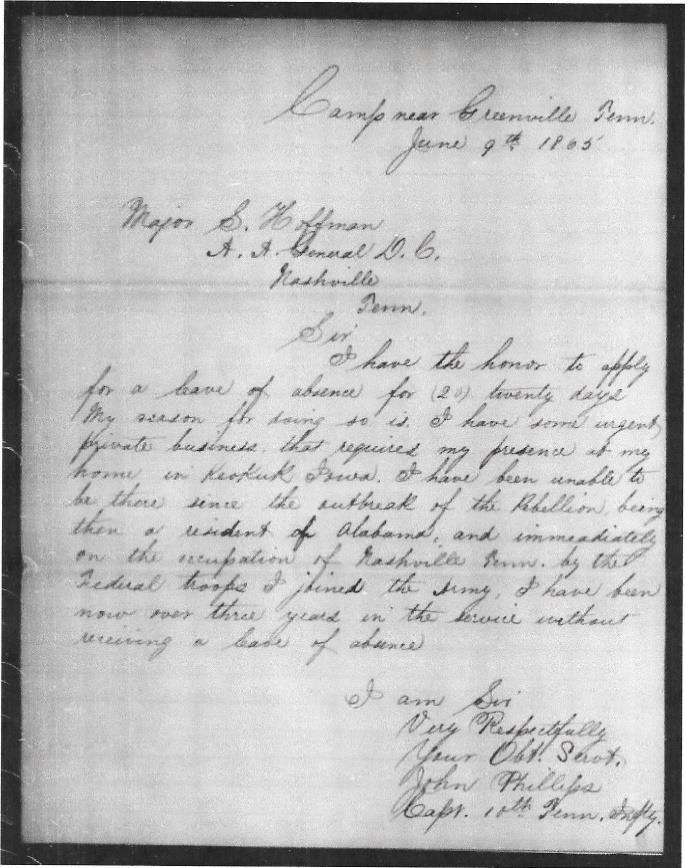
“Included in Captain John’s Civil War service records are 2 separate letters written by him to his commanding officer requesting a 20 day leave of absence. The first letter was dated Nov 21, 1864 and he states his purpose is to visit his sister who is dangerously ill and also to visit other relatives he had not seen in a number of years. This request was apparently not granted as the 2nd letter dated June 9, 1865 states he had urgent private business at his home in Keokuk, Iowa. He goes on to say that he was residing in Alabama at the outset of the rebellion, joined the Army in Nashville, Tennessee and had been in service over 3 years without leave. It is unknown why he was living in Alabama but it does explain why in April of 1862 he join the Union Army in Nashville, Tennessee rather than in Iowa. Even though Tennessee was a Confederate State the Union Army had occupied Nashville early on and held it throughout the entire War. He enter the Army as a 3rd Sargent in Company C, 10th Regiment of the Tennessee Infantry. This unit was originally known as the 1st Regiment, Middle Tennessee Infantry. He received numerous promotions in 1862 and 1863 and was appointed as Captain on September 10, 1863. Captain John was mustered out of service on June 24, 1865 in Knoxville, Tennessee just 15 days after his final request for leave.
Among Captain John’s military records is an interesting account of an incident that took place in late Dec of 1864, just a short time before the end of the War. John wrote the following letter to his commanding officer detailing the events that occurred.
Fort Gillem, Tennessee December 14, 1864
Col. J W Scully Commanding 10th Tenn. Inf.
Col,
I have the honor to submit the following report and respectfully requestthat the matter be investigated. Having been detailed on duty this morning and said duty being to guard prisoners of war at this post. On relieving Lt. Thomas Halleck, 10th Tenn. Infantry I received instruction to allow no citizens to talk to or come near the prisoners. While in the execution of my duty a carriage drove near towhere I was standing and stopped. There were several ladies and one gentleman in it. The ladies were crying. The gentleman stepped out and I ask him what was the matter. He replied the ladies want to see one of the prisoners. I told one of the sentinels to call him over so that I could inform him what the gentleman told me. Providing it was not inconsistent with the interest of the U.S. service. At that moment a Captain Goodwin rode up to the aforesaid sentinel and ask him what he was doing. He replied that he was obeying the orders of this Captain. I being pointed out to the Capt. He assumed the authority of Cmd. Officer and said to me in a very passionate and ungentlemanly manner. Shaking his head at me “Captain consider yourself in arrest by order of Maj. Gen. Thomas and report to my office immediately.” And ordered my sword to be taken from me and then as I was informed by an Officer present he allowed the aforesaid ladies to talk with the prisoner and passed some articles to him. Therefore, feeling aggrieved I desire this to have immediate attention if possible.
I am Col,
Very Respectfully
Your Obedient Servant (signed) John Phillips
Captain Co. “C” 10th Tenn. Inf.
There was also an account written by Captain Goodwin who made the arrest and ultimately two formal charges were filed against Capt. John Phillips and a general Court Marshal was convened in Nashville. Charge 1: Disobedience of orders. Charge 2: Causing the violation of paragraph 416 Revised Army Regulations 1863. Fortunately however, in February of 1865 the Military Court found Capt. John not guilty and acquitted him of both charges and restored him to duty. This whole matter seems to have been blown way out of proportion by an overzealous Capt. Goodwin.
The Mysterious death of Captain John Philp
From Philp Family History by John Douglas Philp 2017:
“After the War Captain John returned to Lee County, IA and on Jan 16, 1866 he bought a farm in section 23 of Montrose Township from Hiram Barney and wife. On Oct. 5, 1867 he married Margaret Lawson Galloway. My mother had written that he returned to Scotland and married Margaret but I can find no records that indicate this. In fact there is a listing of early Iowa Marriages which include John Philip Jr. and Maggie L. Galloway so considering most of the Galloway family was living in Iowa at the time it is most likely that John and Margaret married here. They had six children and lived on a farm just south of Montrose, IA on Middle Road. This is where on the evening of Apr. 5, 1882 Captain John met his untimely death at age 43 when he committed suicide. It was a very tragic and sad time indeed for the family as it appeared that Captain John died from a single gunshot wound to his head from a new 32 caliber 5 shot revolver he had purchased in Keokuk earlier that same day. There was considerable controversy surrounding Captain John’s death and local newspapers reported many of the details. He had been embroiled in legal disputes for over 3 years as the administrator of his father-in-law’s estate and had secured Court judgements against his brother-in-law James Galloway so his family life must have been in turmoil to say the least. Ironically however, just a few weeks before his death he filed a final report of settlement to the Court which seems to have ended the long legal battle.
“In settlement records for Captain John’s estate there are lists of items sold at auction to numerous people in the community including a William Philp Sr. and a William Philp Jr. I believe the William Philp Sr. is Captain John’s older brother and William Philp Jr. is his cousin (eldest son of John Philp). It does seem odd that I can find no actual reference of the elder William’s relationship to the family and I have found no further records of him after his brother’s death so it is possible he returned to Scotland. After Captain John’s death his wife Margaret was left alone with 6 children to raise so she turned to her family for assistance. There was a final report of termination of guardianship filed in 1901 for her 2 youngest sons John and Ralph with a William Philp serving as guardian until they had reached the age of 21. This appears to be William Jr. as his signatures on this agreement seem a very close match to those on his own father’s estate documents.
“In 1893 the District Court in Lee County granted Captain John’s eldest daughter Helen Philp guardianship over her mother’s legal affairs stating that she was of “unsound mind”. Unfortunately along with Margaret’s diminished mental state came a strong physical body and she lived to the advanced age of 85 which was significantly older than any of her siblings. She died on June 30, 1929 in Montrose, IA and is buried in Montrose Cemetery with Captain John. Buried beside them is John’s sister Jessie. The present grave sites are not the original ones because the original graves were near the water in the old part of the cemetery so family members had them moved to higher ground. Captain John’s military grave stone has his name as “Phillips” just as all his military records do.“

The American Civil War (1861-1865) was fought between the United States of America and the Confederate States of America. More than a war to prevent the secession of the southern states, it became the symbol of a fight for equality of rights, liberty, and an end to oppression.
 Vecchio