

According to census reports James Philp was born around 1834 in the parish of Cupar, in the county of Fife in Scotland.
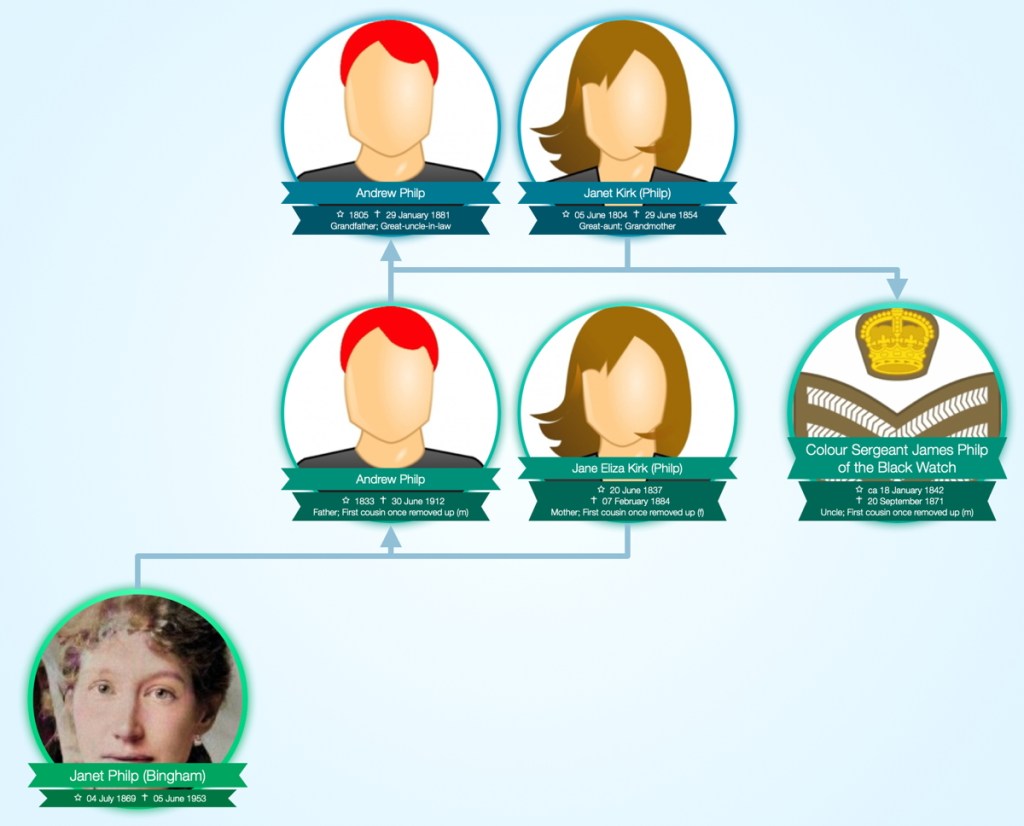
James Philp was the sixth of the seven children of Andrew Philp a baker and his Janet Kirk. None of the births or baptisms of the children appear to have been recorded.
He was named after his maternal grandfather, James Kirk. His birth date of 18 January is based on his being recorded as “under age” in his Black Watch military service record from 18 November 1857 to 17 January 1858.
James Philp had one sister:
- Janet Philp (born 28 June 1835)
and five brothers:
- William Philp (born 1831)
- Andrew Philp (born 1834)
- Robert Philp (born 1837)
- Captain John Philp (born 1839)&
- Thomas Philp (born 1844).
The census of 06 June 1841 makes no mention of James Philp. The census records for Cupar and a number of other Fife parishes are missing.
James Philp first appears in the census of 30 March 1851 where he is described as aged 9 and a scholar living at 53 Bonnygate in the town of Cupar in the parish of Cupar in the county of Fife in Scotland.
James Philp joined the 42nd Regiment of Foot (Black Watch) on 18 November 1857 when he was still under age. His occupation upon enlistment was Saddler.
He does not appear in the Scottish census of 1861 but is listed in the 1861 as a Private in the 42nd Foot (Royal Highland) stationed at Āgra in Uttar Pradesh in India.
He re-engaged at Leith on 26 March 1868 for 10 years and 297 days and served until he was discharged due to invalidity on 7 March 1871. Nine years and nine months of his service was in the East Indies during the Indian Rebellion of 1857 and he was a recipient of the Indian Mutiny Medal – see Military Service below.
At the census of 02 April 1871, James Philp was recorded as being aged 29, a traveller out of employment, and residing at the Temperance Hotel, 114 High Street, Canongate, Edinburgh, Midlothian, Scotland.

On 20 September 1871, James Philp passed away at James Ritchie’s Spirit Shop, 197 High Street, Edinburgh, Midlothian, Scotland. His usual address was 2 Allison Square. He was described as being aged 30, single and a Pensioner, 42nd Royal Highlanders. His parents were described as Andrew Philp, mason’s labourer and Janet Kirk (deceased). The cause of death was Phthisis (Tuberculosis) and Disease of the Heart as certified by Henry D. Littlejohn M.D.. The death was registered on 23 September 1871 at Edinburgh by his elder brother, Robert Philp, Saddler of Lochgelly.


James Philp was buried at Cupar churchyard in Cupar, Fife, Scotland beside his mother Janet Kirk and later his father and the family of his brother Robert.
Military Service
According to his certificate of discharge, the service record of 233 Sergeant James Philp in the 42nd Regiment of Foot (Black Watch) was as follows:
| Promotions, Reductions, &c. | Rank | Period of Service From | Period of Service To | Amount of Service towards G. C. Pay and Pension | Amount of Service towards completion of limited engagement |
|---|---|---|---|---|---|
| Attested | Private | 18 November 1857 | 17 January 1858 | Under age | Under age |
| Private | 18 January 1858 | 24 December 1861 | 3 years 341 days | 3 years 341 days | |
| Promoted | Corporal | 25 December 1861 | 5 January 1863 | 1 year 12 days | 1 year 12 days |
| Promoted | Sergeant | 6 January 1863 | 15 December 1864 | 1 year 344 days | 1 year 344 days |
| Appointed | Colour Sergeant | 16 December 1864 | 25 March 1868 | 3 years 101 days | 3 years 101 days |
| Reengaged at Leith 26 March 1868 for 10 years and 297 days | |||||
| Colour Sergeant | 26 March 1868 | 1 October 1870 | 2 years 190 days | 2 years 190 days | |
| Deprived of Colours | Sergeant | 2 October 1870 | 9 July 1871 | 131 days | 131 days |
| Continued | Sergeant | 10 July 1871 | 11 July 1871 | 1 day | 1 day |
| Good Conduct Pay @ 1st 18 January 1861 | |||||
| Entitled to Two Good Conduct Pay Badges 18 January 1866 | |||||
| Entitled to Three Good Conduct Pay Badges 2 June 1870 |
The exact details of Colour Sergeant James Philp’s service are not known, but he was awarded the Indian Mutiny Medal and it seems likely that he would have been with the Regiment at Cawnpore and the relief of Lucknow. The Black Watch Regimental Museum states: Almost immediately after the Crimean War the Regiment was despatched to India to help quell the Mutiny. There it was first in action at Cawnpore and then, early in 1858, at the relief of Lucknow. It was there that Lieutenant Farquharson won the first of the Regiment’s fourteen Victoria Crosses. After the eventual capture of Lucknow, the Regiment was employed in the flying columns sent out to subdue areas remaining in rebel hands. This involved much fierce fighting and marching large distances.

On 29 January 1871, the G.O.C. (General Officer Commanding) at Aldershot applied for a discharge for Sergeant James Philp from the 42nd Regiment of Foot on grounds of invalidity. His character was Very Good= 3m, and his Amount of Service towards G.C. Pay and pension and Amount of Service towards Completion of Limited Engagement was 13 years and 50 days. The Documents with List were sent to the W.O. or Chelsea on 21 February and he was discharged on 7 March 1871.
His certificate stated that the discharge for 233 Sergeant James Philp was proposed in consequence of his having been found unfit for further Service Under Authority dated Horse Guards 4th February 1871. It also stated that His general character has been very good. He would had he not been promoted have been in possession of three good conduct badges. He has no Certificate of Education. He is in possession of the Indian Mutiny Medal. His name appears once in the Regimental Defaulters Book. He has never been tried. His service at the date of the commission amounted to 13 years and 25 days during which he served abroad for 9 years and 9 months in the East Indies. His service when finally discharged was 13 years and 50 days.
 Vecchio