

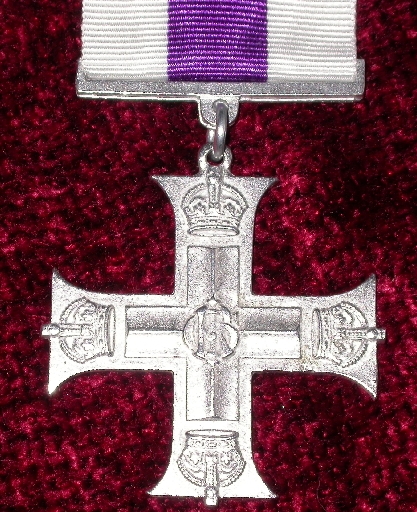
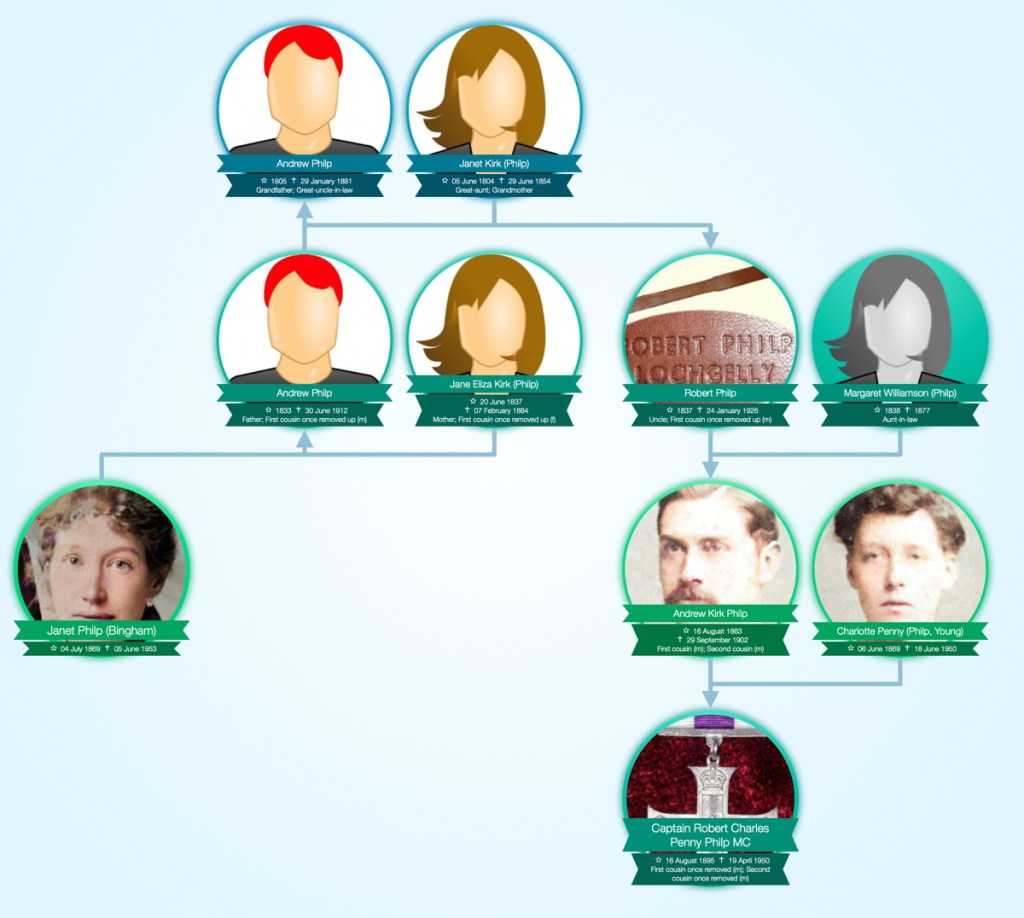
Captain Robert Charles Penny Philp, MC, was born on 16 August 1895 at Kininmonth in the parish of Strichen in Aberdeenshire. He was the elder of the two children of Andrew Kirk Philp, a teacher and mine manager and his wife Charlotte Penny, neice of Andrew Penny, the Silver King of Bolivia.
He was named Robert after paternal grandfather and Charles Penny after his maternal grandfather.
In 1901 Robert’s younger sister, Margaret Williamson Philp was living with her paternal Grandfather, Robert Philp, in Lochgelly in Fife, but Robert and his mother have not been located. His father, Andrew Kirk Philp had travelled to Bolivia to manage a tin mine there, and it seems possible that he was accompanied by his wife and son. His location at the 1911 census is also unknown.
The Origins of the First World War
On 28 June 1914, Gavrilo Princip, a Bosnian Serb Yugoslav nationalist and member of the Serbian Black Hand military society, assassinated the Austro-Hungarian heir Archduke Franz Ferdinand in Sarajevo. In response, Austria-Hungary issued an ultimatum to Serbia on 23 July. Serbia’s reply failed to satisfy the Austrians, and the two moved to a war footing. Russia felt it necessary to back Serbia with full Russian mobilisation being announced on the evening of 30 July; the following day, Austria-Hungary and Germany did the same, while Germany demanded Russia demobilise within twelve hours. When Russia failed to comply, Germany declared war on Russia on 01 August in support of Austria-Hungary, the latter following suit on 06 August; France ordered full mobilisation in support of Russia on 02 August.
German forces invaded Belgium on 03 August and declared war on France the same day; the Belgian government invoked the 1839 Treaty of London and, in compliance with its obligations under this treaty, Britain declared war on Germany on 04 August. On 12 August, Britain and France also declared war on Austria-Hungary; on 23 August, Japan sided with Britain, seizing German possessions in China and the Pacific. In November 1914, the Ottoman Empire entered the war on the side of Austria-Hungary and Germany, opening fronts in the Caucasus, Mesopotamia, and the Sinai Peninsula. The war was fought in (and drew upon) each power’s colonial empire also, spreading the conflict to Africa and across the globe.
Robert Kirk’s military career
Just eight days after Britain’s declaration of war on Germany, on 12 September 1914, Robert Philp enlisted on a Short Service Contract (Three Years With the Colours) as a private soldier. At that time he was a student at the Technical College in Glasgow with his home adress at Bankhound, in the parish of Strichen in Aberdeenshire.
Robert Philp then underwent training at Gailes in Ayrshire starting on 23 September 1914, at Troon in Ayrshire from 13 October 1914, Prees in Shropshire from 14 May 1915, Wensley in Yorkshire from 24 June 1915, Totley in Yorkshire from 27 July 1915, and Codford in Wiltshire from 11 August 1915.
On 01 September 1915 he arrived at Chatham in Kent and was transferred to the Royal Engineers. A day later, on 02 September 1915, he was posted Pioneer and promoted to Corporal.
On 08 September 1915, he was seconded to Kitchener’s New Army and on 12 September 1915, he was discharged as Royal Engineers Depot Chemist Corporal when he was appointed to a Commission (Temporary Second Lieutenancy) in HM Forces (New Army). The New Army, often referred to as Kitchener’s Army or, disparagingly, as Kitchener’s Mob, was an (initially) all-volunteer portion of the British Army formed in the United Kingdom from 1914 onwards following the outbreak of hostilities in the First World War in late July 1914. It originated on the recommendation of Herbert Kitchener, then the Secretary of State for War to obtain 500,000 volunteers for the Army. Kitchener’s original intention was that these men would be formed into units that would be ready to be put into action in mid-1916, but circumstances dictated the use of these troops before then. The first use in a major action of Kitchener’s Army units came at the Battle of Loos (September–October 1915).
On 12 May 1916, Robert Philp began his active service in France as a Lieutenant in the Cameronians (Scottish Rifles), a rifle regiment of the British Army, the only regiment of rifles amongst the Scottish regiments of infantry. It was formed in 1881 under the Childers Reforms by the amalgamation of the 26th Cameronian Regiment and the 90th Perthshire Light Infantry. In 1968, when reductions were required, the regiment chose to be disbanded rather than amalgamated with another regiment, one of only two infantry regiments in the British Army to do so, with the other being the York and Lancaster Regiment. It can trace its roots to that of the Cameronians, later the 26th of Foot, who were raised in 1689. The 1881 amalgamation coincided with the Cameronian’s selection to become the new Scottish Rifles.
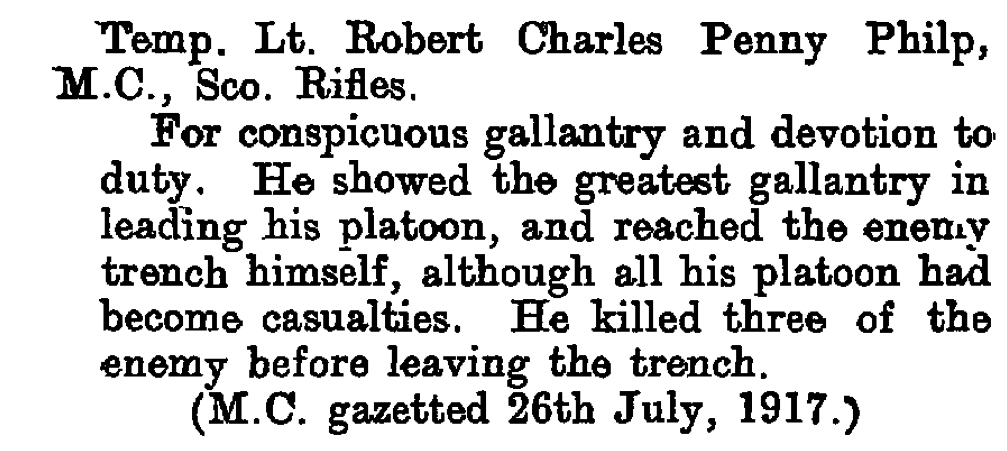
On 26 July 1917 he was gazetted and awarded the Military Cross for leading his platoon and reaching the enemy trench despite all of his platoon becoming casualties. He killed three of then enemy before leaving the enemy trench.
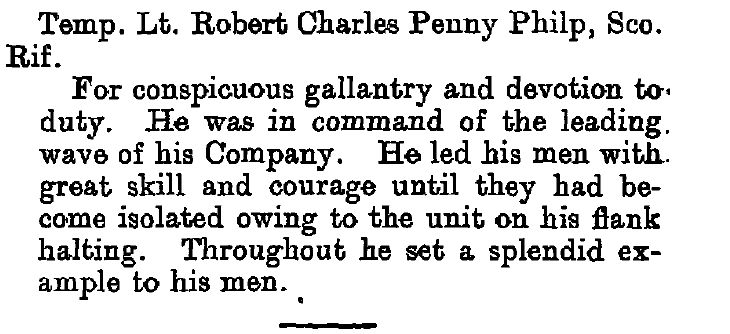
On 25 August 1917 he was awarded a bar to his Military Cross.
Robert Philp’s application for medals on 30 May 1922, reveals that he had been promoted to Captain in the Cameronians.
Civilian Life
In 1922 Robert Philp married Florence Myrtil Campbell at Hammersmith in London. They had two sons, Stephen Philp who was born in September 1923 in Watford in Hertfordshire and Arthur Andrew Philp who was born in 1924 in Oxfordshire.
In 1922 Robert Philp’s home address was given as 9 Rowland Gardens in London with his correspondence address as Clare College in Cambridge. The college was founded in 1326 as University Hall, making it the second-oldest surviving college of the University after Peterhouse. It was refounded in 1338 as Clare Hall by an endowment from Elizabeth de Clare, and took on its current name in 1856.
On 13 March 1929 Robert Philp was working as a Company Director when he left Southampton on RMS Aquitania for New York and returned to Southhampton on 01 May 1929 from New York on a 1st Class ticket on the RMS Berengaria, previously known as SS Imperator (Cunard). His place of residence was given as Northwood in Middlesex.
On 13 October 1937, Robert Philp was working as a Chemical Merchant when he left Southampton on RMS Queen Mary for New York, returning to Southhampton on 09 November 1937 on RMS Aquitania (Cunard White Star Ltd) from Mombasa, Kenya via Dar es Salaam, Beira, Durban and Cape Town. His place of residence was given as Knotty Green in Penn in Buckinghamshire.
Robert Philp died aged 54 on 19 April 1950 at Hammersmith in London.
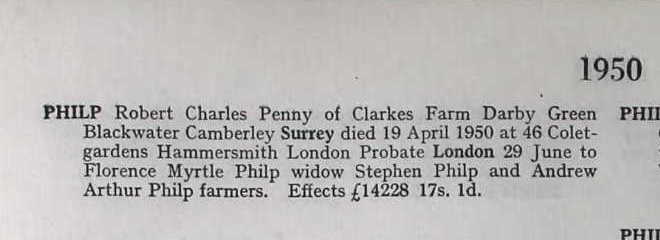
His probate was on 29 June 1950 and he left effects worth £14,228 17s 1d to his widow Florence Myrtle Philp, and sons Stephen Philp and Andrew Arthur Philp, both farmers.
 Vecchio