
Our presumed relative John Oal was born at Halcro in the parish of Bower in Caithness on 12 August 1797 and baptised on 24 August 1797 with witnesses William Oal (presumably his paternal grandfather) and Hugh Manson (possibly his maternal grandfather or uncle.) It is believed that John may have been named after his maternal grandfather, whose identity is unknown.
He was the second of the three sons of William Oal and Mary Manson, whose other children were William (born 09 March 1795 at Halcro), Wemyss (born at Halcro and baptised 24 August 1799) and Andrew, (born 01 April 1802 at Thura).
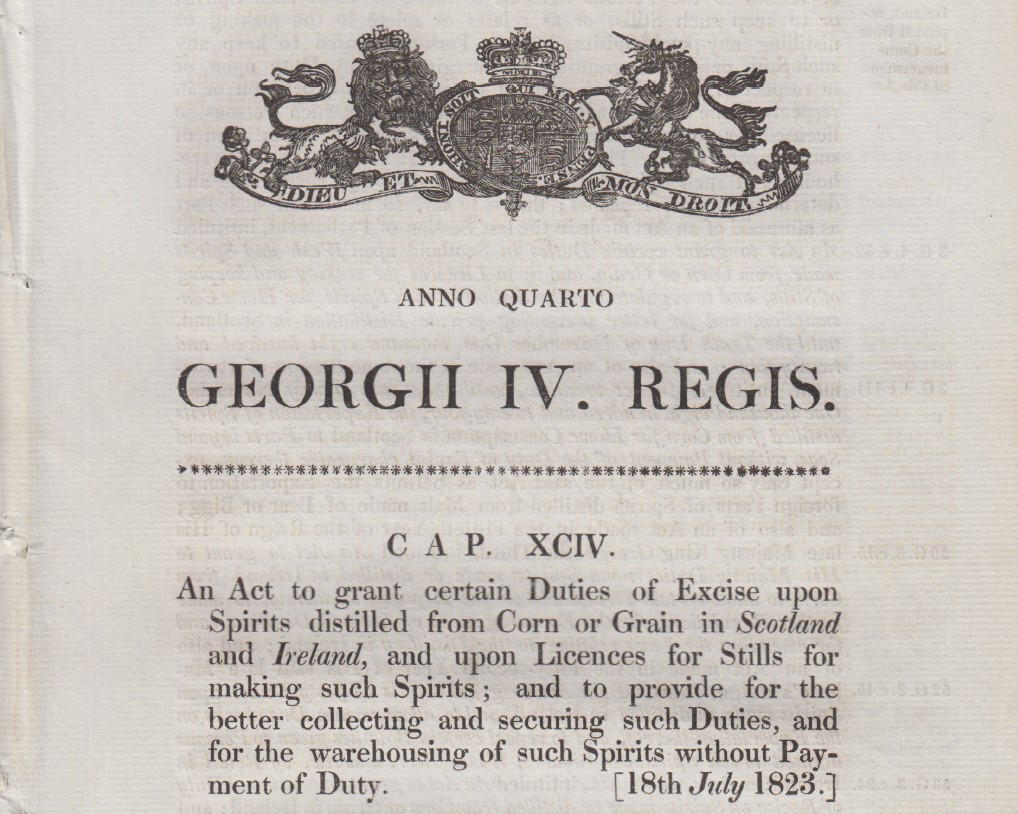
On 18th July 1823, the Excise Act was passed by the Westminster Parliament. This Act fundamentally changed the future of the Scotch Whisky industry, and not only required that £10 be paid for licensing a still, but also set duty levels for distilled spirits, allowed warehousing of distilled spirits before duty needed to be paid, and reduced opportunities for evading tax on distilled spirits.
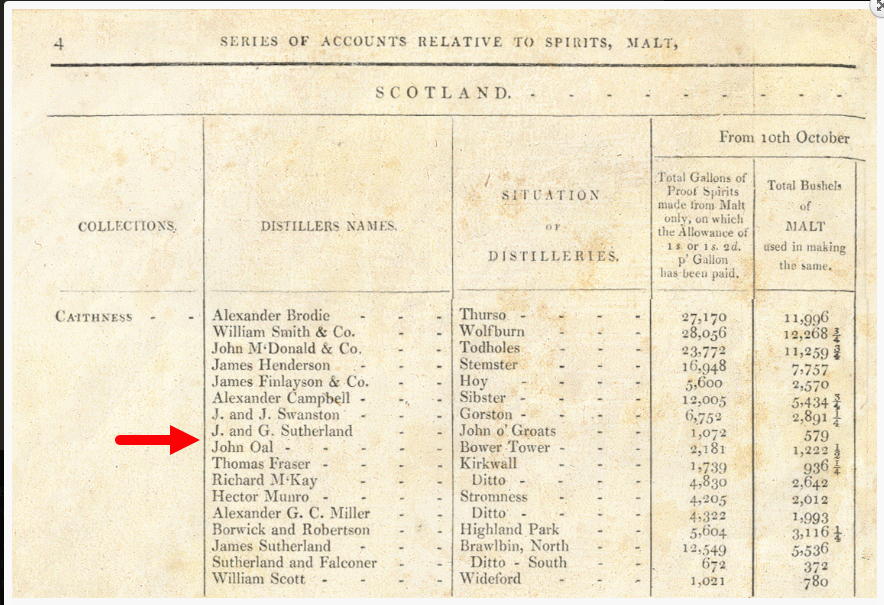
In 1826, John Oal obtained a licence for Bowertower Distillery. However, it seems likely that the distillery may have existed before this date as an illicit still. It is also not impossible that our own ancestors worked as coopers and distillers at this distillery.
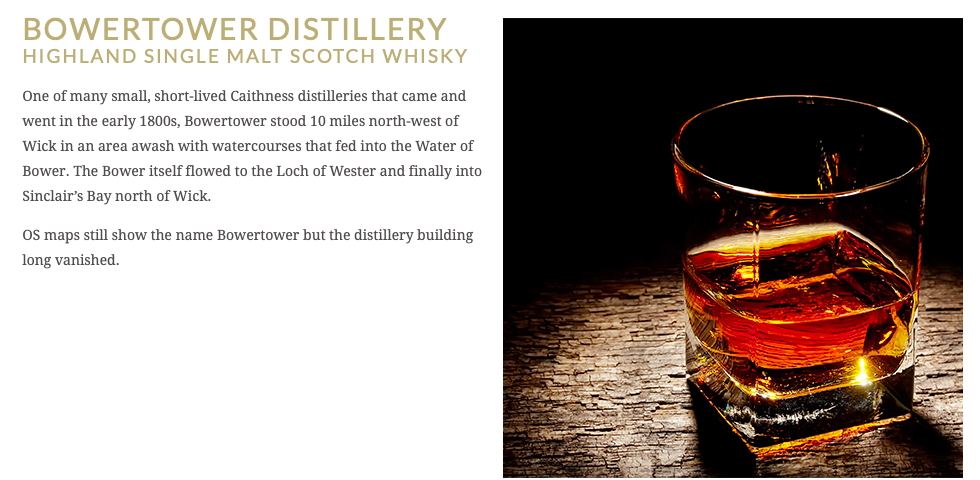
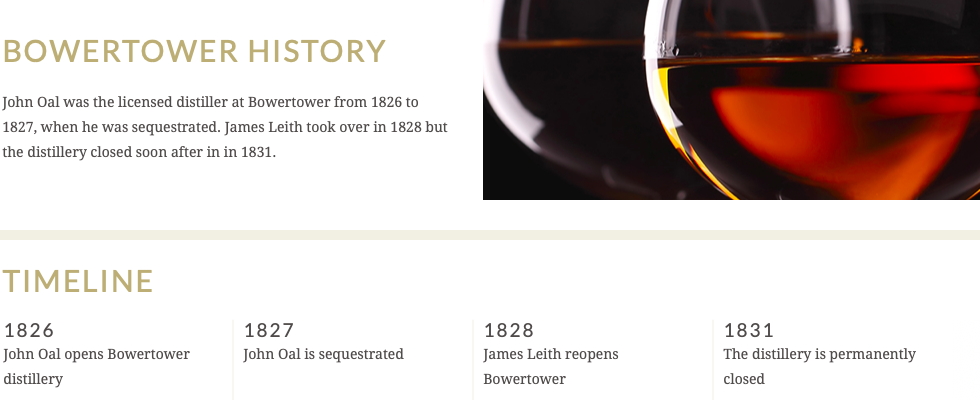
However Bowertower distillery did not prosper and on 17 February 1827, John Oal was sequestered. He was described as “Merchant at Whitegar” and “Distiller at Bowertower” in the London Gazette, in a notice to creditors.

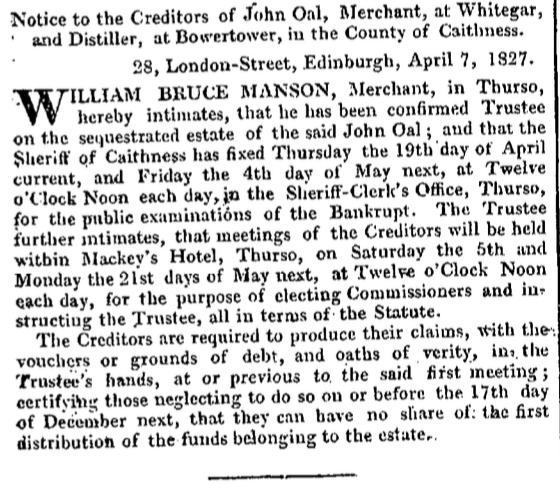
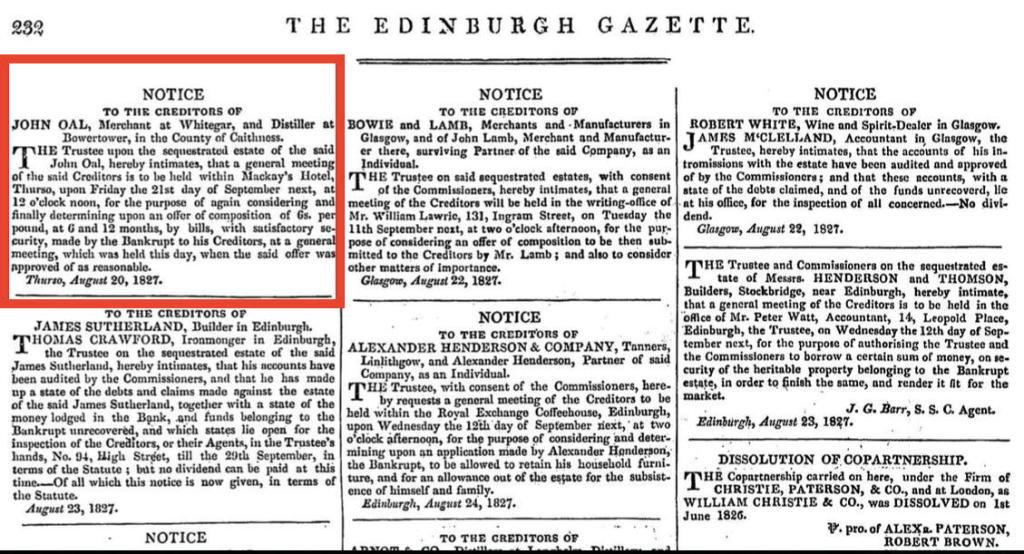
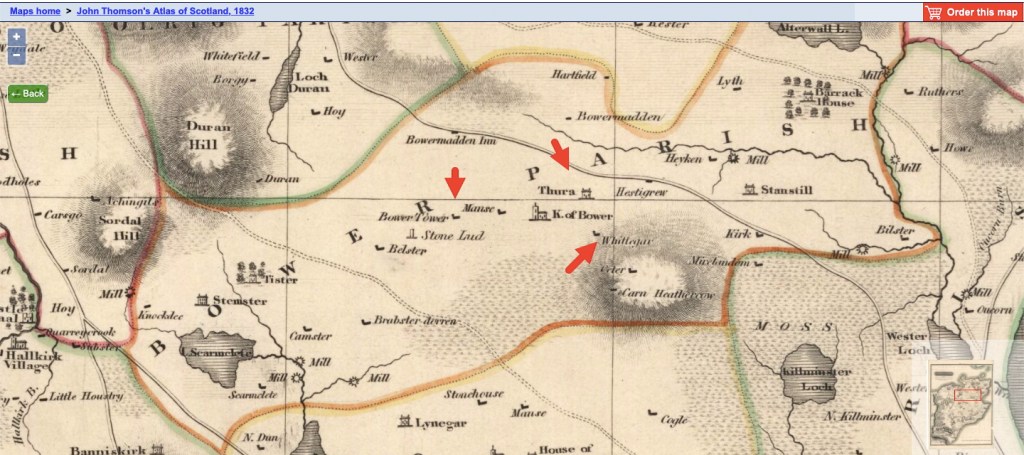
John Oal remained for some time in the area as on 26 April 1831 he was a witness to the baptism of May (later Marjory) Oal, and on 28 August 1833 he was a witness to the baptism of Mary Oal, both daughters of his brother, William Oal.
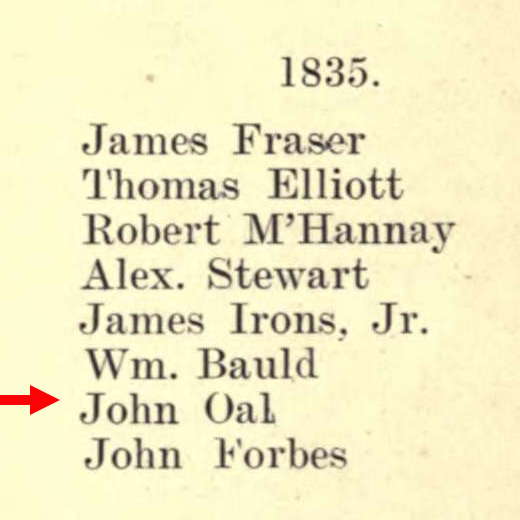
The next mention in the records of John Oal was in 1835 when he was listed amongst the new members of the North British Society in Halifax, Nova Scotia.
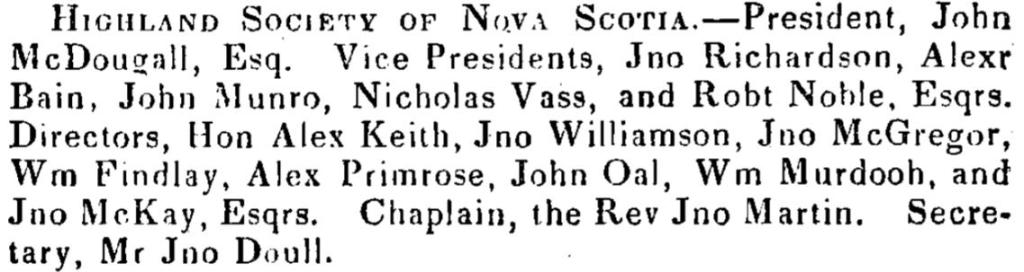
In 1851, John Oal was listed as one of the Directors of the Highland Society of Nova Scotia.
John Oal appears to have prospered in Halifax as the May 1841 entry in the “Diary of brewery heir Jackey Molson, aged 14” notes: “While I was walking one evening on one of the roads heading to the country I passed a brewery and distillery, situated towards the mouth of the harbour, belonging to a Scotsman called John Oal, who very kindly invited us in to see his establishment. He manufactures rum and whiskey, porter, ale, peppermint shrub and ginger beer.“
On 02 October 1846, when he was aged 49, John Oal married Jane Murray, in Halifax. She was a fellow Scot who was the daughter of Benjamin Murray and Jane Murray and she had been baptised on 15 March 1815 in Thurso parish in Caithness.
John Oal and Jane Murray had three daughters, all of whom appear to have died unmarried:
- Jane Elizabeth Wemyss Keith Oal was born on 14 September 1849 in Halifax, Halifax County, Nova Scotia, Canada. She died unmarried around October 1922 to December 1922 in Saint Thomas, Devon England.
- Mary Murray Oal was born around 1851 in Nova Scotia and died unmarried aged 46 on 18 March 1897 at the Lunatic Assylum, Sunnyside, parish of Montrose, in Angus, Scotland. The cause of death was Phthisis Pulmonalis (Tuberculosis) which had afflicted her for 1 year.
- Benjamina, (also known as Jessie) Oal was born around 1852, presumably in Nova Scotia. At the census of 07 April 1861, she appears to be registered as Jessie Oal, born Nova Scotia, aged 7, a scholar, and living at Rotterdam Street in the town of Thurso in Caithness, Scotland. Benjamina died on 29 December 1863, aged 11, at Rotterdam Street in the town of Thurso in Caithness, Scotland. She died of Diptheria, which had afflicted her for four days.
Some time after 1851, John Oal and his family returned to Scotland and he died aged 57 on 16 March 1858 at Georgetown, Thurso, Caithness. The cause of death was paralysis as certified by William Bruce, M.D., Surgeon, Thurso, who last saw the deceased on the 15th day of March 1858 and stated that the disease had continued for years. His occupation was recorded as Distiller and the death registered by Ben Murray, his brother-in-law.
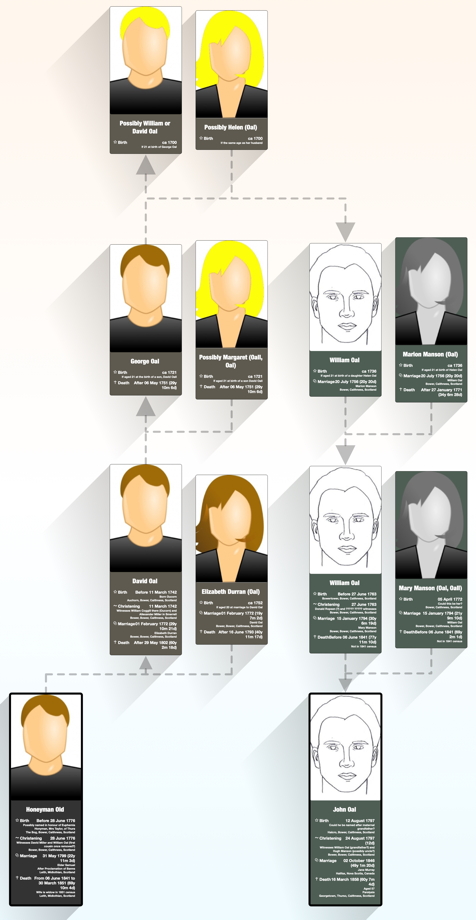
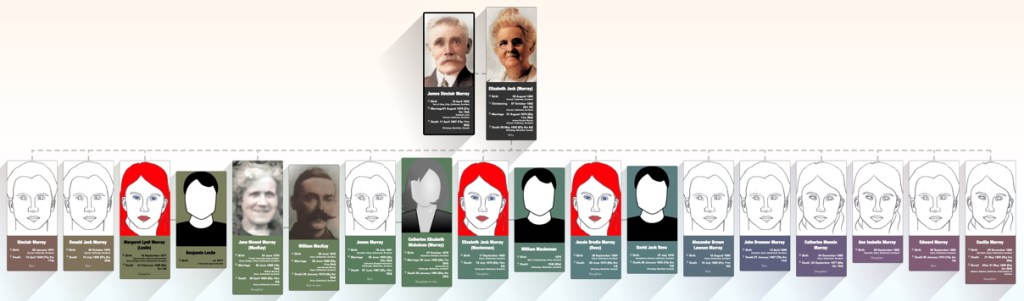
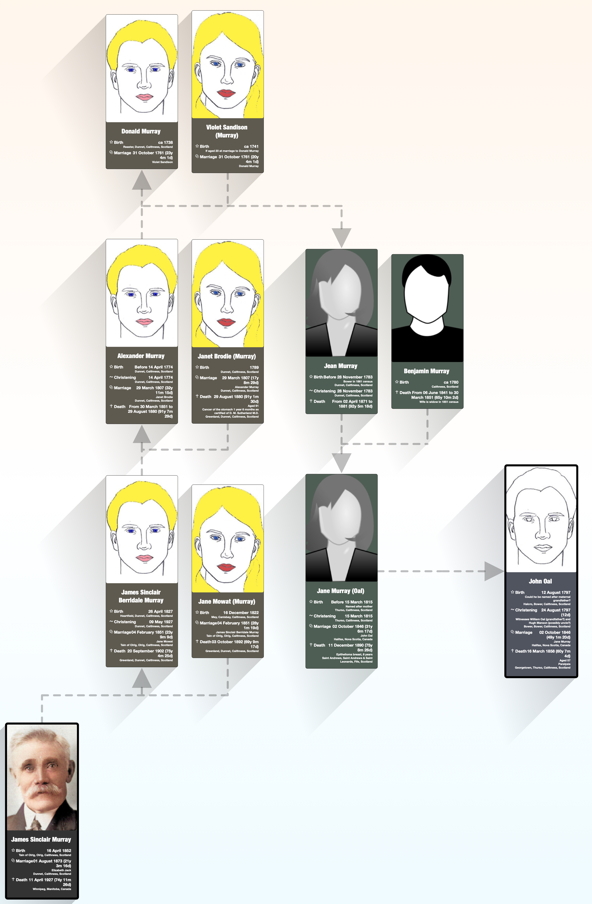
Further DNA studies into these lines are ongoing and will be updated in the future.
How Scotch Whisky is Made – From Grain to Glass.
Whisky Distilling in the Highlands and Islands – missing pieces of our post medieval archaeology. The first of the 2021 UHI Archaeology Institute seminars, featuring PhD student Darroch Bratt. Drawing on historical and archaeological evidence, Darroch demonstrates how his research has attempted to integrate the distilling of whisky into the archaeology of the region and how the historical archaeology of distilling fits into an expanding understanding of rural commercial practice. The variety in the archaeology of illicit distilling is explored and it is shown that early licensed distilling represents an almost untapped archaeological resource in the region.
 Vecchio