
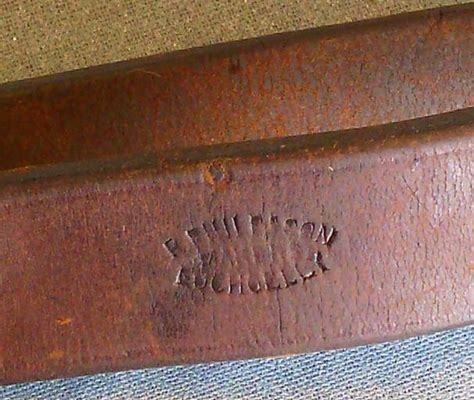

My grandmother would sometimes talk of her grandfather Andrew Philp (not Philip as I originally thought!) and of his younger brother Robert, who, according to family tradition, had gifted a clock to the town of Lochgelly in Fife.
What she did not mention was that Robert Philp was also the creator of the notorious Lochgelly Tawse, which was first made in the town by saddler R. Philp & Son in 1884. The Lochgelly Tawse continued to be used in state schools for over 100 years until 1987, although it continued to be used in private schools until 1998.
Robert Philp was born in 1837 in the parish of Cupar in Fife. No record of his baptism, or that of his siblings, has been found. He was the third son and fourth child of Andrew Kirk, a baker, and his wife Janet Kirk.
His siblings were William (born 1831), Andrew (born 1833), Janet (born 28 June 1835), John (born 1839) James (born around 18 January 1842) and Thomas (born 1844), all in the parish of Cupar. William, Andrew and Thomas followed their father and became bakers, James joined the Black Watch and served in India during the Rebellion of 1857, rising to the rank of Colour Sergeant, while Janet and John emigrated to the United States with their uncle and other members of the extended family, with John serving as a Captain in the Union army in the American Civil war.
Robert appears to have been the most business-minded of the family. he does not appear in the census of 06 June 1841, which is missing for Cupar and several other Fife parishes, but on 30 March 1851 he is recorded as being aged 14 and a scholar, living with the family at 53 Bonnygate in Cupar. By 07 April 1861, Robert was aged 24, living at Main Street in Lochgelly, and is described as a Master Saddler.
On 02 September 1862, Robert Kirk married Margaret Williamson in at the United Presbyterian Church in Lochgelly. The couple went on to have five children, all born in Lochgelly: Andrew Kirk Philp (born 16 August 1863), David Crombie Philp (born 11 July 1865), Catherine Crombie Philp (born 08 October 1867), Jessie Elizabeth Walker Philp (born 01 April 1870) and Robert Walker Philp (born 08 December 1872).
Margaret Williamson died in 1877 in Lochgelly aged 37 and Robert Philp went on to marry Mary Munro Campbell, widow of Donald McIntosh on 20 May 1878 in Cupar, Fife.
In December 1886, Robert Philp acted as factor and commissioner for the children of his great uncle, John Philp, namely William Philp, James Philp, John Philp and Catherine Philp, all of Montrose Township, Lee County, Iowa, USA, in order to sell their property at 15 Well Street, Cupar to Mrs Euphemia Taylor or Smith.
He died on 24 January 1926 aged 88 at 148 Main Street, Lochgelly. The cause of death was Senile changes, Hypostatic congestion, 8 days. He was buried in Cupar churchyard and left his estate to his widow Mary Campbell, his surviving children Catherine Philp, David Crombie Philp, Robert Walker Philp and his step-son William James McIntosh.
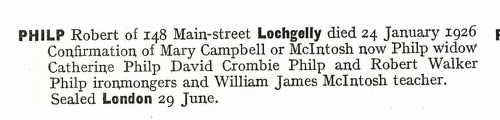

Andrew Kirk Philp and his sister Catherine Crombie Philp both trained as teachers and their father Robert made the original Lochgelly tawses for them in order to maintain discipline in their classes. According to The History of the Lochgelly Tawse:

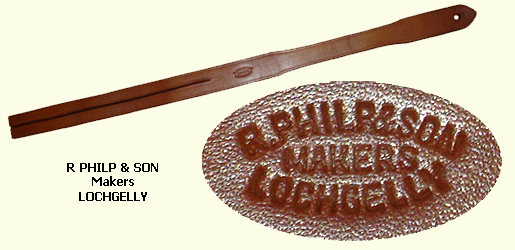
“Although versions of ‘The Tawse’ had been around and used in schools for many years the Lochgelly version which has become so renowned starts with Saddler Robert Philp (born 1837, died 1926) at his Saddlery and Ironmongery shop in Main Street Lochgelly.
“Robert Philp’s eldest son Andrew Kirk Philp and one of his daughters became teachers the Lochgelly Tawse was first made in the town by saddler R.Philp & Son in 1884.
“The teachers liked this new belt it was narrower so easier to wield, firmer so it didn’t wrap around the hand and was well made with no sharp edges to cause serious damage but it didn’t really take the skills of a Master Saddler to make it, so often one of Robert’s three apprentices would get the job.
“As time went on most every saddler and quite a few cobblers would make something similar to this new belt. Approx 30 other maker’s stamps existed but not all manufacturers would have put a name stamp on their belts so it is safe to assume that there was at least double this number making their own version.
“The Lochgelly Tawse is estimated to have held the lion’s share of the market some say as much as 70%. Robert’s youngest son Robert Walker Philp (born 1872, died 1929) joined his father in the family business as an apprentice Saddler when he left school and as the business expanded Robert senior took on another 2 apprentices, James Heggie (born 1876, died 1954) and my Grandfather George Wilson Dick (born 1882, died 1955).
“James Heggie stayed with the firm of Robert Philp & Son all his working life, as a fully qualified Saddler he worked for Robert senior till his death in 1926, then worked on for Robert junior till his early death in 1929 and continued on as manager for Robert senior’s widow Margaret until the business was sold and he retired around 1945.”


See also:
Making the Lochgelly Tawse: An essential part of the teacher’s trade, the tawse was the Scottish education system’s corporal punishment weapon of choice against unruly students. Based in Lochgelly, Fife, John J Dick Leather Goods were teacher’s preferred suppliers of the tawse. Release date: 20 February 2017. Duration 2 minutes.
 Vecchio
My name is Richard Phillips (Philp in Scotland) I have been a genealogist for more than 30 years, I am from Costa Rica, my second great-grandfather Andrew Phillips (his mother’s surname is Hoy) arrived in Costa Rica in 1852, sent by the British crown to collect information that would be used to create the Interoceanic Canal (which was finally built in Panama), he was born in Inverkeithing, Fife in 1824. I was able to continue with my genealogical research until 1700 and with some doubts until the year 1550, my research has allowed me to do believe that I have family living in Stirling, this due to information from a cousin located through the DNA of the Ancestry company that determined that our DNA was identical, we contacted each other and she had done it. . His research and I had done mine and we agreed in just two minutes of conversation, we descend from the same great-grandfather and more than 8,000 thousand kilometers and 172 years of mutual ignorance separate us, until 2 months ago. Her name is Emma Phillips and she lives in Wales. I am looking for and want to find my Phillips cousins in Stirling and other places near Fife, 4 months ago I was in Stirling with my wife but it is not easy to contact people who can see you like a crazy person asking questions about the family’s past. On the other hand, here in Costa Rica we are 1,008 people with the last name Phillips and descendants of my great-grandfather whose name was Andrew Phillips. I have had a page about genealogy for several years and you can check what I tell you:
https://www.facebook.com/familiaphillipsdecostarica
. Thank you so much.
Atte Richard Phillips
LikeLiked by 2 people
Thanks so much for your post and wonderful summary of 30 years of research and the fascinating family history.
Yes, the surname was Philp in Fife, but even in Scotland the name was sometimes recorded as “Philip”.
I am always little cautious regarding Ancestry as their technology is rather outdated and they don’t have basic essentials such as a chromosome browser to allow triangulation. But it is a good start and can be built on by testing on more professional sites such as FamilyTreeDNA and MyHeritage.
LikeLike