

Our first cousin three times removed, Andrew Kirk Philp was born in 1863 in Lochgelly in Fife, but he died in 1902 in Oruro, Bolivia.
Andrew Kirk Philp
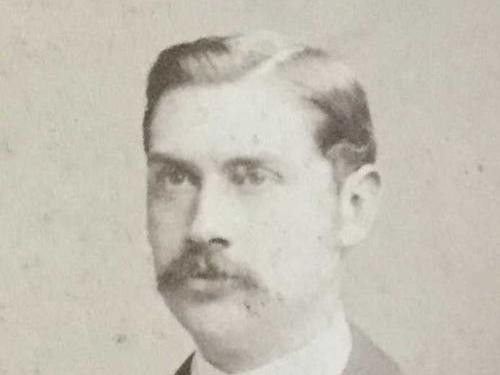
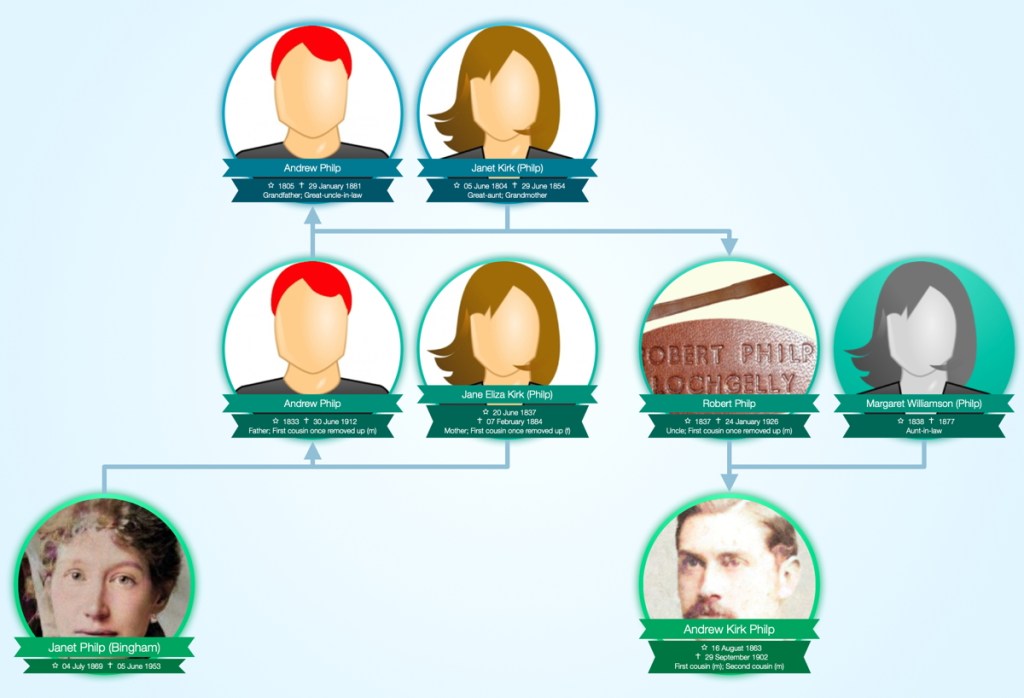
Andrew Kirk Philp was born on 16 August 1863 in the town of Lochgelly in Auchterderran parish in Fife. He was the eldest of the three sons and two daughters of Robert Philp, Master saddler, and his wife Margaret Williamson. He was named Andrew after his paternal grandfather while Kirk was his paternal grandmother’s maiden name.

Andrew Kirk Philp and his sister Catherine both trained as teachers and their father Robert made the original Lochgelly tawses for them in order to maintain discipline in their classes.
At the census of 03 April 1881, Andrew Philp was living at the family home in Lochgelly and worked as a pupil teacher. Ten years later on 05 April 1891, he was a “Schoolteacher at Board School”, living at the schoolhouse at Longside in Aberdeenshire with his housekeeper, Ann Reid.

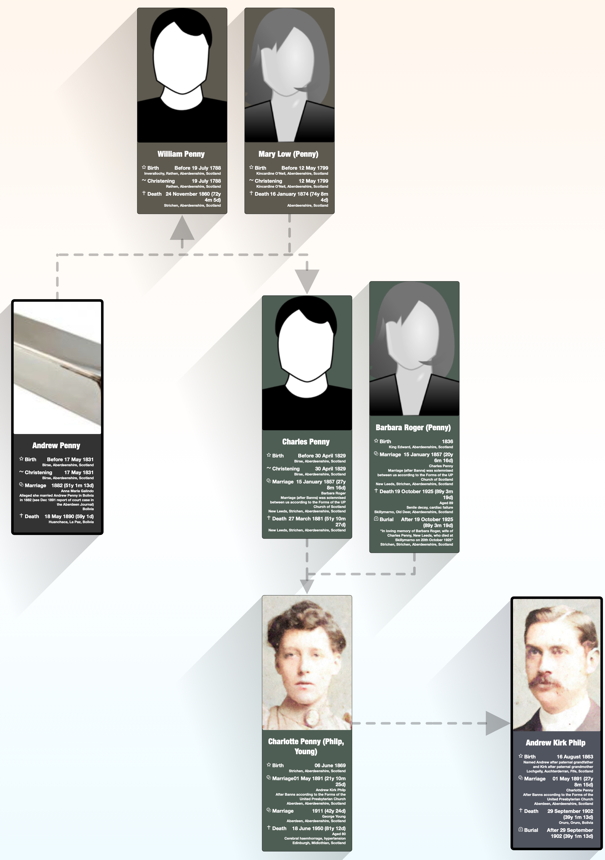
On 01 May 1891, Andrew Kirk Philp married Charlotte Penny, daughter of Charles Penny and Barbara Rodger at the Waverley Hotel, in Guild Street, Aberdeen.
The couple had two children, Margaret Williamson Philp who was born on 01 March 1892 at Kinmundy in Longside parish in Aberdeenshire and Robert Charles Penny Philp who was born at 16 August 1895 at Kininmonth in the parish of Strichen in Aberdeenshire.
Andrew Kirk Philp could not found in the 1901 census, and his daughter, Margaret was living with her paternal grandfather, Robert Philp, in Lochgelly in Fife.
In page 100 of David Dobson’s “Scots in Latin America” published in 2002 in Baltimore, USA, Andrew Kirk Philp is listed as being in Bolivia in 1902.
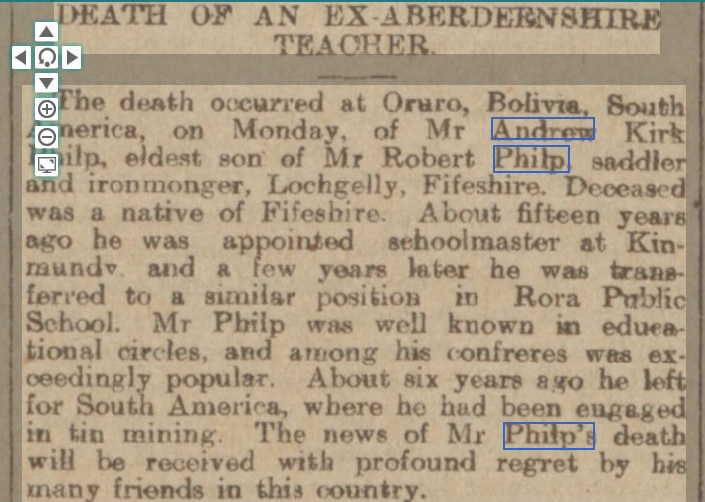
In 1902, Andrew Kirk Philp’s obituary appeared in the Aberdeen Press and Journal stating that he had died on Monday (29 September 1902) in Oruro, Bolivia. It revealed that six years previously (around 1896) he had left for South America where he had been engaged in tin mining. When his wife Charlotte Penny died in 1950, her late husband was described as a “Mine Manager”.
So how did Andrew Kirk Philp the teacher in Scotland become Andrew Kirk Philp the tin miner in Bolivia?
Andrew Penny, the Silver King of Bolivia

Charlotte Penny’s uncle Andrew Penny was baptised on 17 May 1831 in the parish of Birse in Aberdeenshire. He was the fourth of the eight children of William Penny (1788-1860), a mason, and his wife, Mary Low (1799-1874).
According to Aberdeen University:
“Andrew Penny, known as the Silver King, left his home near Aboyne in 1852 to work on a sailing ship from which he made his way to Bolivia where he found work in the Corocoro copper mines. By 1885 he had become sole owner of the San José mine at Oruro – one of the great silver mines of Bolivia.
“Several of Penny’s relatives followed him to Bolivia and today the family name lives on in Oruro through a girls’ orphanage – the Centro Amor de Dios Penny (Penny Centre of the Love of God), built in 1897 and still operates as an orphanage today. In addition there is a Penny hospice in the atrium of the San Miguel Church donated in 1891.
“Penny was followed to Bolivia by James Duncan born at New Leeds, Aberdeenshire, who travelled to South America with Andrew Penny’s nephew in 1882. Duncan made his money by discovering vast reserves of tin in the San Antonio mine in Huanuni in 1896-97.”
Park House, Drumoak, Aberdeenshire

The category A listed Park House is a two storey, eleven bay Neo-Greek house designed by Archibald Simpson and built in 1822. It is stuccoed and painted cream.
In ‘Annals of Lower Deeside’ John Henderson, 1892 notes that William Moir ‘erected on the property a substantial mansion house in the Grecian style of architecture, and had the garden and surrounding policies laid out with much taste and judgement. He further goes on to say that:
‘In 1839 Alexander John Low, afterwards Kinloch, became proprietor under the following circumstances. In the begining of the century, John Kinloch, a native of Kincardineshire, entered the house of Forbes and Company in India, in which he ultimately became a partner. He died a bachelor, leaving a considerable fortune to the family of a sister, Mrs Low, whose husband was a partner in the firm of Forbes, Low and Company, Manufacturers, Aberdeen. It was stipulated that seventy thousand pounds of the residue of his estate should be invested in the purchase of land in Scotland, and also that his heir should assume the name of Kinloch. The heir A J Low, later Kinloch, was a physician. He and his wife, a daughter of the late James Hutcheon, West India Merchant, had a large family.
The estate was purchased from Mr Kinloch’s trustees in July, 1888, for forty seven thousand pounds by Andrew Penny a silver and copper mine owner of Oruro, Bolivia. He was a native of the Parish of Birse and intended to make Park his permanent residence but on route for Scotland died intestate and without issue. He was succeeded by his brother and heir-at-law, James Penny.
At some time around the 1920s or 1930s, Park House was bought by the famous Aberdeenshire personality Sir Robert Williams, who acted as advisor to, and sometime partner of Cecil Rhodes, in the early pioneering days of South Africa. He was a gifted and entrepreunerial Scottish mining engineer and railroad developer who discovered the vast copper deposits in Katanga Province (now incorporated in the Democratic Republic of Congo) and Northern Rhodesia (now Zambia). The house was purchased by the present family in 1947.
The discovery of the lost graves of Andrew Kirk Philp and Andrew Penny Jr.
In 2019, the lost graves of Andrew Kirk Philp and his wife’s cousin, Andrew Penny junior were discovered in Oruro, Bolivia.
Lost graves of Scots miners found in abandoned Bolivian cemetery
The long-forgotten graves of three Scots silver and tin miners have been found in an abandoned foreigner’s cemetery in Bolivia.
By Alison Campsie in The Scotsman, Friday, 28th June 2019, 7:04 pm

Dr. Stewart Redwood, a geologist originally from Stirlingshire but now of La Paz, discovered the graves in the windswept and treeless mining city of Oruro, which sits high on a desert plateau of the Bolivian Andes.
Here lies the graves of several Scots linked to Andrew Penny, from Birse, Aberdeenshire, who left Scotland in 1852 on a whaling boat bound for the southern ocean. He jumped ship at Arica in Peru – now Chile – and made his way to Boliva on foot.
Mr Penny married a Bolivian woman, Anna Maria Galindo, and later bought a share in the San José mine in Oruro and spent seven years draining it of water. He eventually took over the entire business and became known as “The Silver King” given the vast fortune made by the operation with several of his family members also prospering from the precious metals found deep in the Andes.
In the graveyard is the burial spot of Mr Penny’s nephew, also Andrew, originally from New Leeds in Aberdeenshire, which is marked by a Celtic Cross.
Mr Penny’s adopted son, Mariano Mackenzie Penny, who was abandoned by his father, a miner from Perthshire, also lies here.
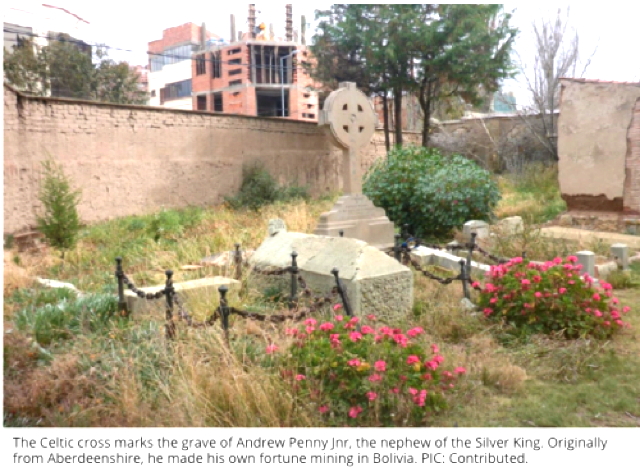
The grave of Mr Penny Snr’s son-in-law, (actually his nephew-in law) Andrew Kirk Philp, a mine manager originally from Lochgelly in Fife, can too be found.
Dr Redwood set about finding the graves given his long-standing interest in the Penny family story.
After several previous attempts, Dr. Redwood was finally given access to the padlocked cemetery in Oruro.

Dr Redwood said: “With the help of friends in Oruro, we were given the key to the padlock by the administrator, and let ourselves in as the church bells rang on a sunny Sunday morning.
“The foreigners’ graveyard is abandoned, overgrown with weeds and unkempt. Most of the adobe-built niches have collapsed exposing coffins, clothing, skulls and bones, and many of the plaques have been stolen and graves vandalised.
“However, I was pleased to find that the grave stones were in good condition.”
Dr Redwood said the search for the gravestone of Andrew Penny Snr continues. He died suddenly in 1890 in town of Huanchaca – now a “ghost town” – with it presumed he was laid to rest somewhere there.
News of Mr Penny’s death was widely reported at the time, with the Aberdeen’s People’s Journal noting that Mr Penny, inherited the “grit” of his father, a stonemason.
He worked at first as a gardener at Ballogie House near Aboyne before joining a couple of whaling voyages to Greenland.
After arriving in Bolivia, it was 30 years before Mr Penny returned home, with those who knew him presuming he was dead.
“He had been given up as dead and his friends and acquaintances did not recognise him – indeed they could scarcely believe that he was the man he had known,” the report said.
Mr Penny was remembered for his generosity, and helped to fund the poor of his native parish as well as local institutions.
“He was called the Silver King but he steadily and carefully avoided ostentatious displays and evinced most happiness and enjoyment in the companionship of those he had known in his early days,” the report added.
At the time of his death, he was preparing to return home to Aberdeenshire, where he had recently bought the Park House and Estate in Drumoak Parish for £48,000 – around £6.1m at today’s value.
His tenants were preparing a big welcome home party, but instead received the news that their landlord and friend had died.
Dr. Redwood has a long connection with mining in Bolivia, having done the fieldwork for his doctorate in geology at the University of Aberdeen in the Bolivian Altiplano.
He said he was always fascinated by the story of the Aberdeenshire miners in Bolivia and has been researching it in recent years.
While the grave of Andrew Penny Senior has yet to be found, there is a lasting memorial to Andrew Penny in Oruro. The “Penny Home for Girls” orphanage was set up by his wife in his memory in 1892 and opened in 1900. It is still going strong today.
The historic links between the North East of Scotland and mining in Bolivia continue to this day with the University of Aberdeen’s backing the headquarters for the Bolivian Geological Society.
One of the founding members of the society, the late Charles ‘Scottie’ Bruce, hailed originally from Fetterangus in Aberdeenshire and after moving to Bolivia in 1960 to work as a miner went on to establish a scholarship scheme with the University.
Dr Redwood was one of the geologists who took part in the scholarship scheme.
 Vecchio