
“You’re feeling sad-hearted, people now
I hope you’ll lend an ear
for sad and dismal is the news
you very soon will hear
about Bob Vickers and William Innes
now in jail to lie
on the 31st. of March
they’re both condemned to die.“
First verse of a poem about the Gorebridge Murders by John Wilson.
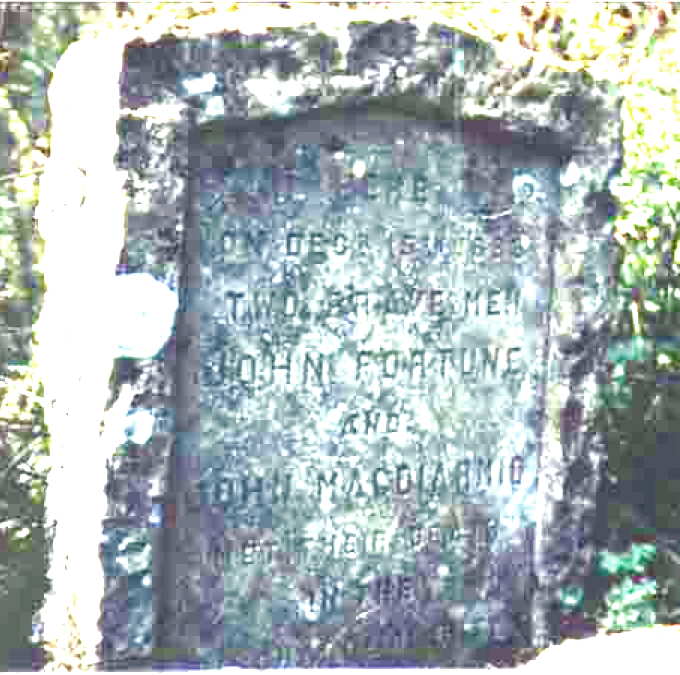
On the 10th March 1884, our fourth cousin twice removed Robert Flockhart Vickers (aka Vickars) and his friend William Innes were tried at the High Court in Edinburgh for the crime of murder and assault by discharging loaded firearms on the night of 15th to 16th December 1883. The victims were John Fortune, assistant gamekeeper, residing at Moorfoot, Temple parish, county of Edinburgh (Midlothian) and his colleague John McDairmid, rabbit catcher. The two men were taken to Edinburgh Royal Infirmary, but John Fortune passed away on the 18th December 1883 and John McDiarmid died on 8th January 1884.
The verdict, by a majority of nine to six, was that Robert Flockhart Vickers and William Innes were Guilty and the Sentence was Death. They were both interned at Calton Prison in Edinburgh where they were executed on 31st March 1884.
However, according to Midlothian Mayhem: Murder, Miners & the Military (2020) by Malcolm Archibald: “Later both Innes and Vickers confessed they were indeed guilty of killing the gamekeepers. Vickers claimed that Innes had had a little too much to drink in the pub in Stobhill and had wanted “to have a shot.” He also said he did not intend to kill Fortune but had aimed at his legs; the angle of the hill deceived him, and he shot the keeper in the stomach. If these statements are true, and there is no reason to doubt them as both men had already been found guilty, then the verdict was flawed. It was not a premeditated murder but the less serious crime of culpable homicide, which did not carry the death penalty.“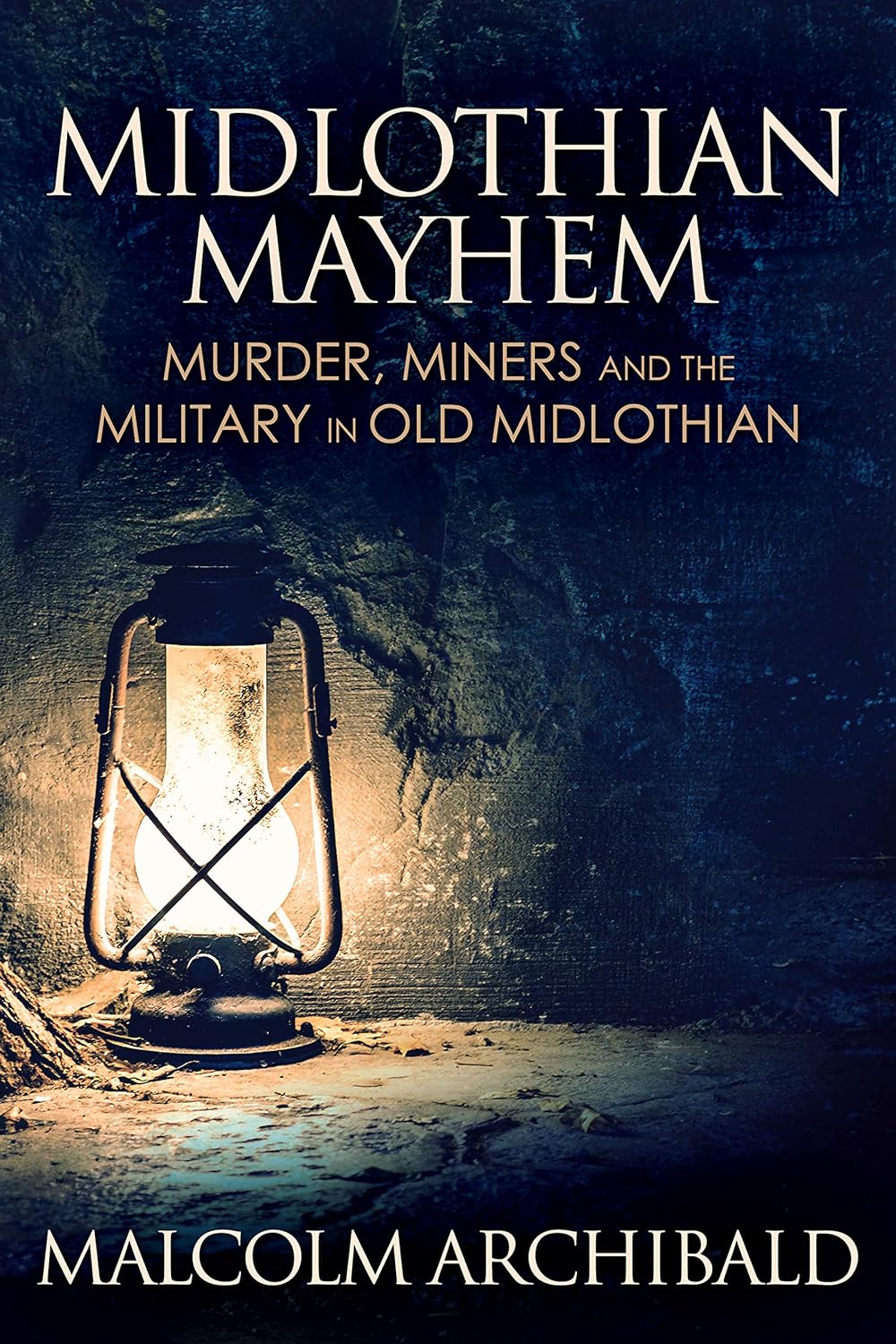
Robert Flockhart Vickers
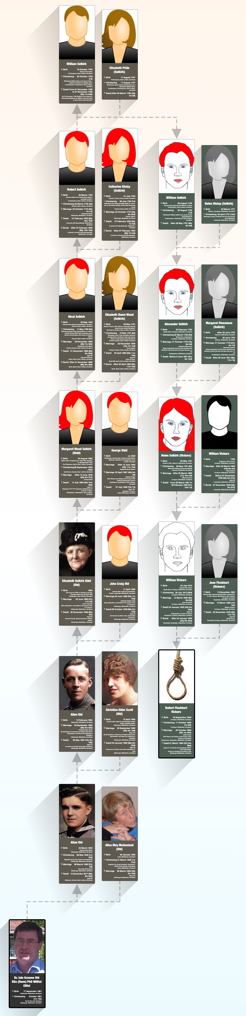
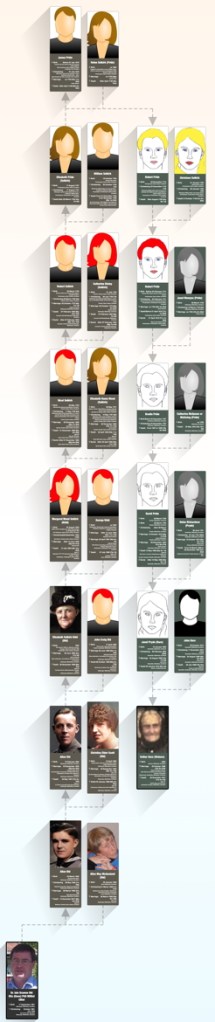
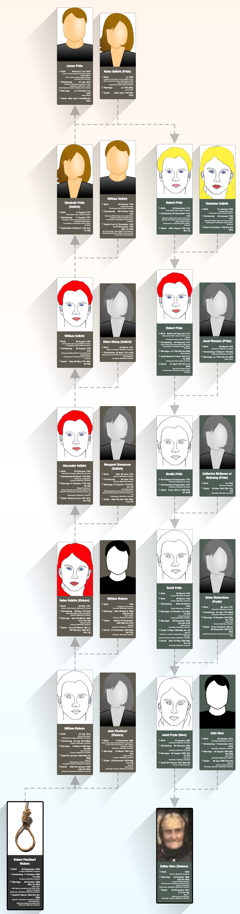
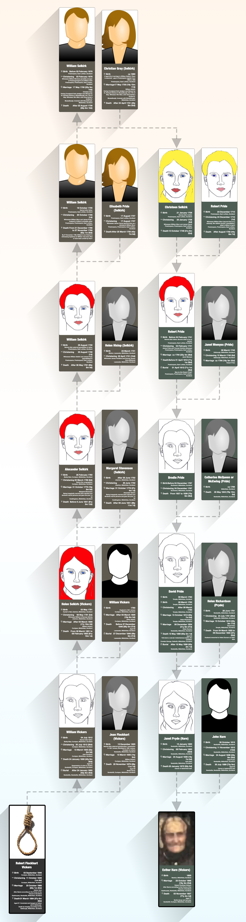
Robert Flockhart Vickers was born on 03 September 1846 in Cockpen parish in Midlothian. He was the fifth child and second son of William Vickers (1812-1855) and Jean Flockhart (1820-1879).
On 23 October 1868 at Easthouses in Newbattle parish in Midlothian, Robert Flockhart Vickers married Esther Hare (1850-1927), his fifth cousin cousin twice over and our fifth cousin twice removed.
The couple had three sons and four daughters: William, Janet, John, Alexander, Robert, Jane, Helen and Esther.
He was executed on 31 March 1884 at Calton Prison in Edinburgh after being found guilty of murder.
The Gorebridge Murders
On the 16th of December, 1883, Robert Flockhart Vickers and his friend and neighbour William Innes, went poaching on the Earl of Rosebery’s estate. John Fortune assistant gamekeeper, and John MacDiarmid, rabbit catcher were shot at and later died as a result of their wounds, while the head gamekeeper, James Grossart survived.
“MURDEROUS ATTACK ON GAMEKEEPERS
“Three men shot near Gorebridge Early on Saturday morning a murderous attack was made by two men on three of Lord Rosebery’s gamekeepers on a field near Rosebery, which is situated about five miles from the village of Gorebridge.
“Each of the three was shot in turn, the injuries inflicted in one case being of a serious character. The persons supposed to have committed the outrage are said to be well known poachers, who have been apprehended.
“The estate of Rosebery comprises of lands situated in several of the parishes in this locality, and the mansion house occupies a sequestrated position in the valley of the South Esk, about six miles southeast of Penicuik and five miles southwest of Gorebridge.
“The head gamekeeper on the estate James Grosset, who resides near Rosebery House; while the house of his assistant, John Fortune, is situated at the base of the Moorfoot Hills.
“For some time past it has been suspected that night poaching was being carried on over certain portions of the estate.
“On Friday night Grosset and Fortune met by arrangement, and accompanied by a rabbit trapper named John McDermid, set out to watch the plantations which afford cover for pheasants, and which extend from the keeper’s house at Rosebery to about a mile in the direction of Edgelaw farm and Carrington.
“About three o’clock on Saturday morning the keepers, who were then near Grosset’s house, heard a shot fired, apparently at a mile’s distance.
“The morning was quite clear, with a touch of frost, while overhead the moon was at its full. Ten minutes after the first shot was fired, and when the keepers had advanced about half a mile, a second report of a gun was heard. The keepers, who were armed only with sticks, and were without dogs seeing two men with guns coming in their direction, lay still to await their arrival.”
From The Evening News – Monday 17th December 1883.
“Early on Saturday morning, three gamekeepers employed on the Rosebery Estate were attacked by two poachers, armed with double-barrelled guns, on a field on the farm of Redside, a few miles southwest of Gorebridge.
“All three men were shot -one on the right arm, one on the left shoulder and the third on the left side, the leads penetrating the lower abdomen.
“The unfortunate men have been confined to bed, suffering considerable pain, and last night the condition of the keeper who was struck in the abdomen was very critical.
“The poachers decamped, but two men said to be well known poachers, who are supposed to have committed the outrage, have been apprehended.
“One of them had to be removed to the Edinburgh Royal Infirmary, being injured in consequence of a gun having, it stated been accidentally discharged in his house, near Gorebridge.”
From The Scotsman – Monday 17th December 1883.
The Trial and Execution
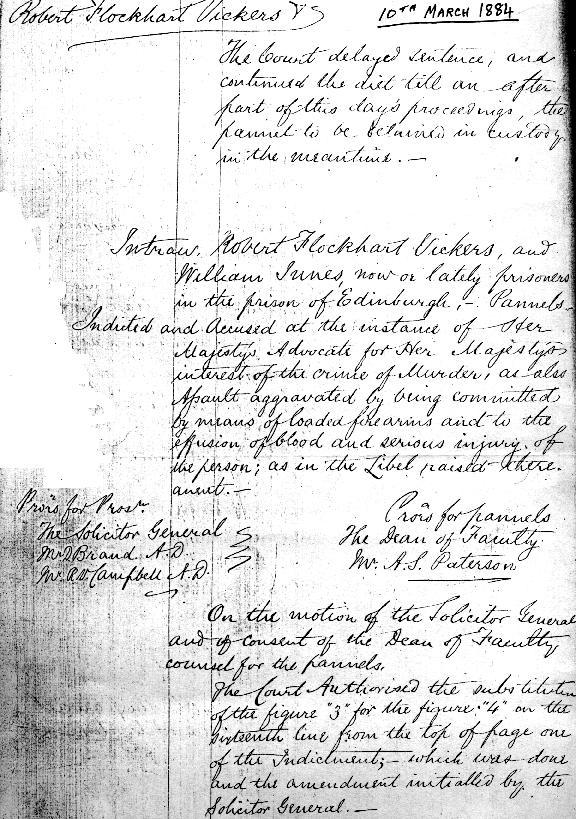
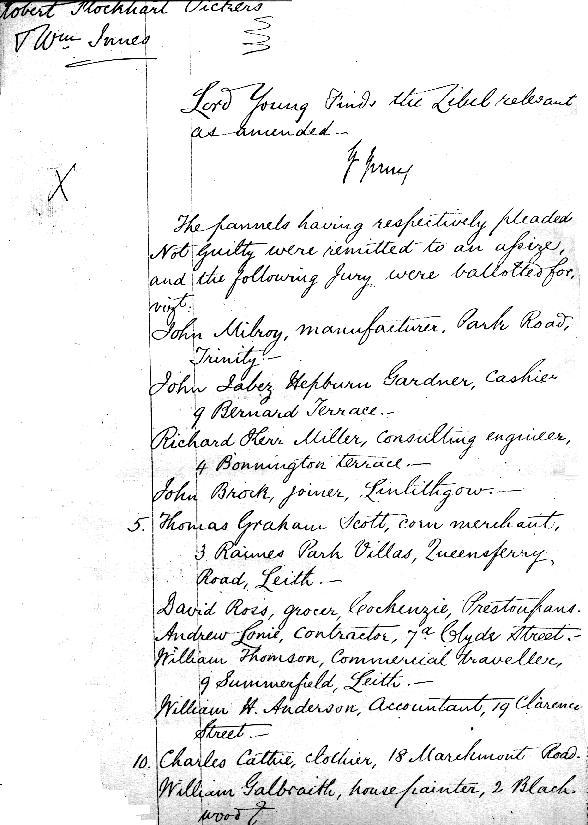
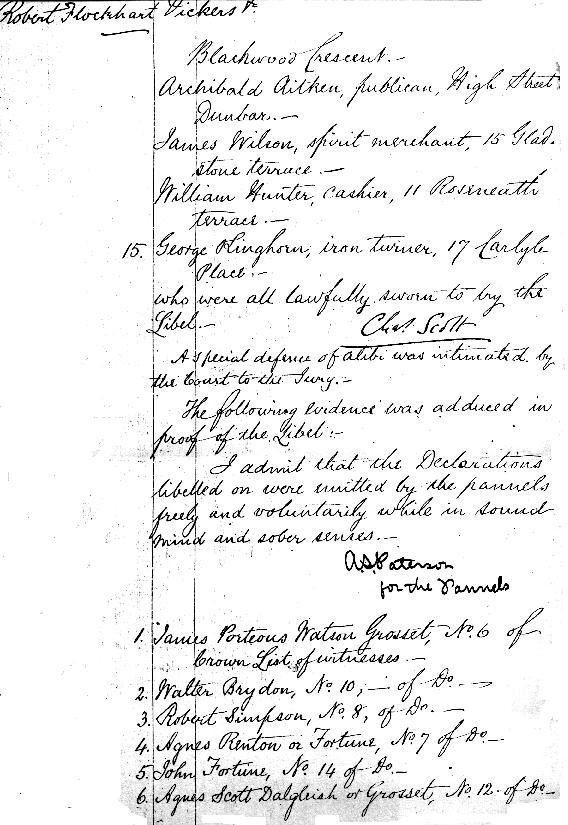
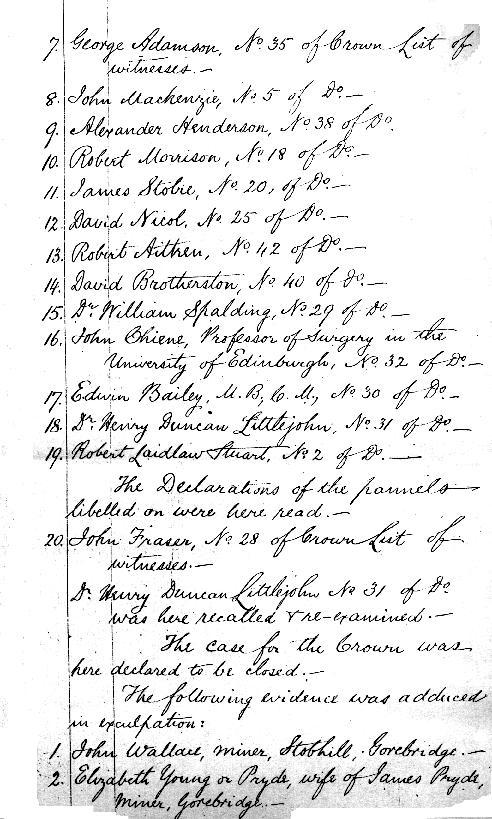
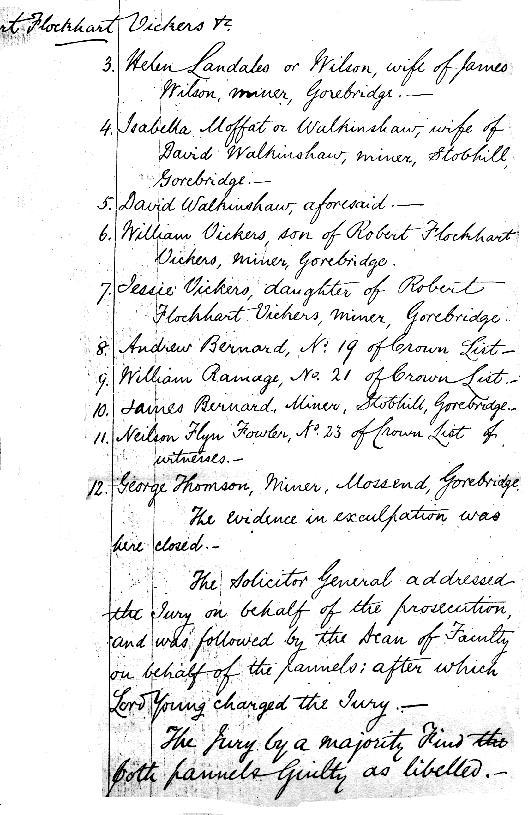
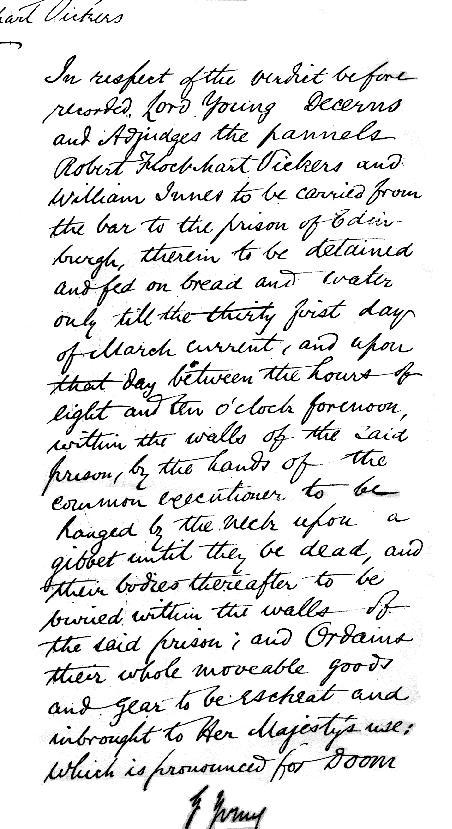
Robert Flockhart Vickers and William Innes were tried on 10th March 1884 at the High Court in Edinburgh and being found guilty by a majority verdict, they were executed by hanging in Calton Prison, Edinburgh on the 31st of March, 1884.
“March 10, Before the High Court of Justiciary at Edinburgh, Lord Young on the bench. Robert Flockhart Vickars and William Innes, miners, residing at Gorebridge, were charged with the murder of two assistant gamekeepers named John Fortune and John McDiarmid. They were also charged with seriously assaulting James Grosset, head gamekeeper, at Rosebery. The gamekeepers, who were employed on Lord Rosebery’s estate, which is situated at the foot of Moorfoot Hills, had gone out to look for poachers. It was a clear frosty morning on the 15th December, while overhead the moon was full. About 8 am., the gamekeepers came upon the men, who were armed with guns.
“On being called to surrender one of the poachers said to the other ” Take that on the left and I will do for that on the right.” A moment later the guns were discharged and the two watchers fell fatally injured. Before the firearms could be reloaded, Grosset made off with the following words ringing in his ears ” quick, don’t let him away; we’ll catch him at the bridge” (meaning the bridge which spans the South Esk), shouted by one of the men to the other, however, by changing his course Grosset arrived safely at Edgelaw Farm, and awakened Mr. Simpson, the farmer, who drove into Gorebridge and informed Sergeant Adamson. Fortune and McDiarmid were at once moved to the Edinburgh Royal Infirmary, but they succumbed to their injuries Fortune on the 18th December and McDiarmid on the 8th January. Grosset was able to furnish such information as led to the arrest of the men, both noted poachers.
“The Solicitor-General (Asher) conducted the prosecution, while the Dean of Faculty (Macdonald) appeared for the prisoners The defence was a complete denial that the men had ever left their own houses at Gorebridge at the time libelled. After an absence of forty-nine minutes the jury, at 7.50 pm., found the charges proved. Lord Young, who expressed his complete concurrence with the verdict, passed sentence of death, to be carried out in the Calton Jail, Edinburgh, on the 31st March. A week after conviction the men admitted shooting the gamekeepers Efforts to obtain a reprieve proved unsuccessful. Both men, particularly Vickars, thought that mercy would be extended to them. Even when he took his place on the drop he was buoyed up with the hope that a last minute reprieve would arrive. A dense crowd assembled outside the prison and on the Calton Hill. Waterloo Place was blocked with a seething mass of people to witness the hoisting of the signal at eight o’clock. Considerable speculation arose as minute after minute passed, but at length, at twelve minutes past the hour the black flag run up on the prison flagstaff to half-mast proclaimed to all who beheld that the Gorebridge poachers had gone to their doom. The execution was carried out by James Berry and an assistant Richard Chester. [In a somewhat rare volume, entitled “Experiences of an Executioner” Berry gives minute detail of the final scene and his four days stay in the Calton Jail. This was the first execution he carried through.“
From “Scottish Crime and Punishment -100 years of Murder & Execution“
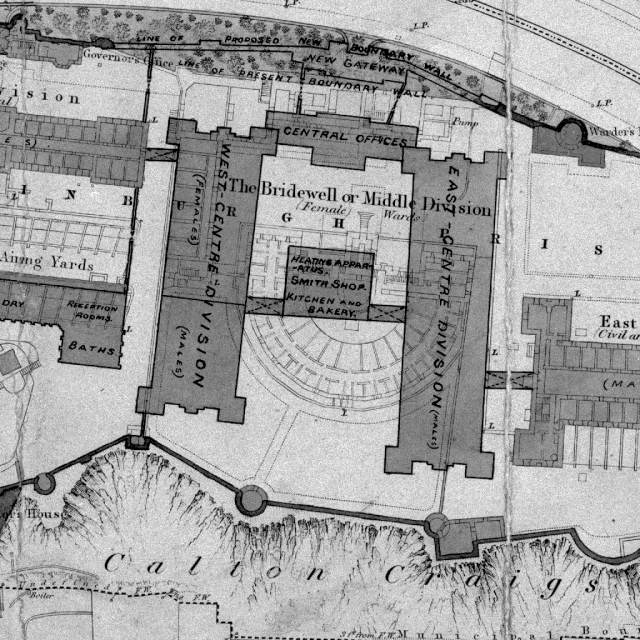
Calton Prison – The Bridewell
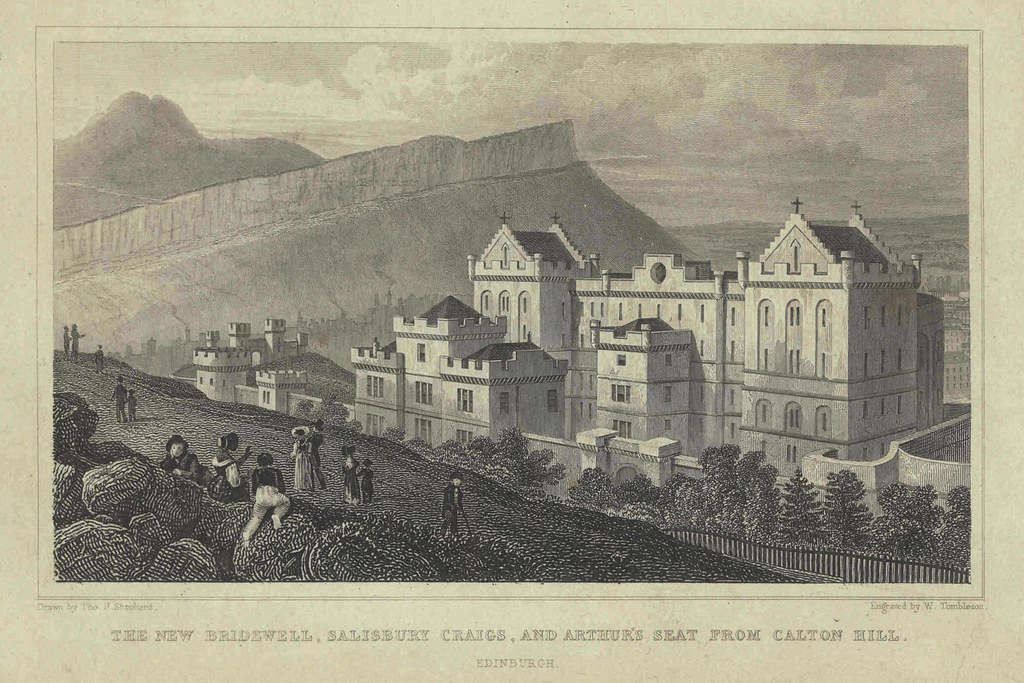
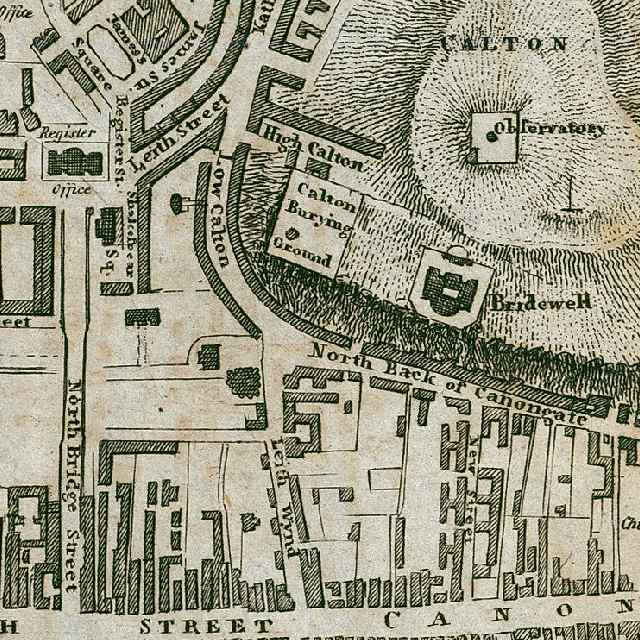
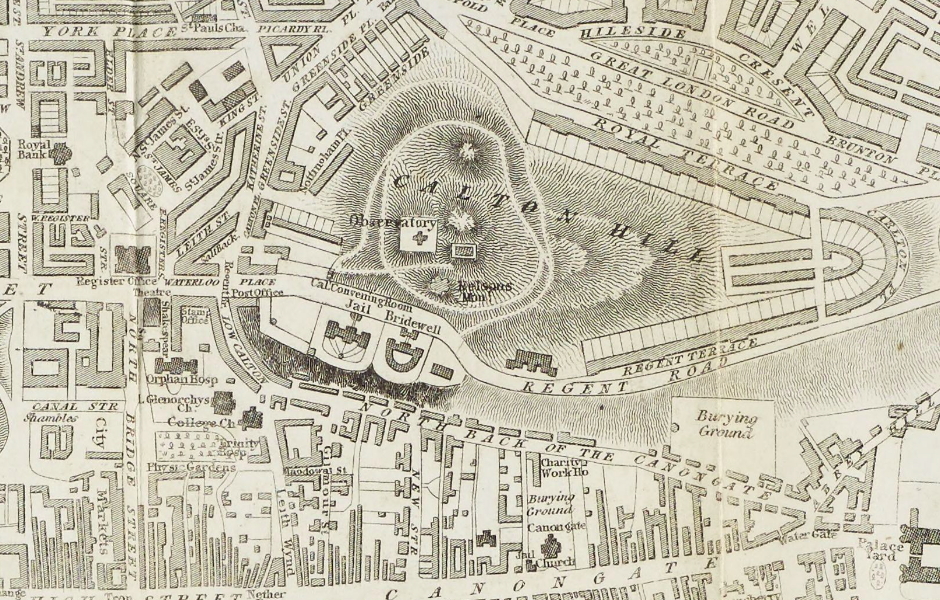
Calton Prison, also known as Calton Jail or The Bridewell was the largest prison in Scotland. This new jail for Edinburgh was designed by the renowned Scottish architect Robert Adam (1728-1792), built between 1791 and 1796 on Calton Hill on a crag overlooking the city, and opened in 1817.
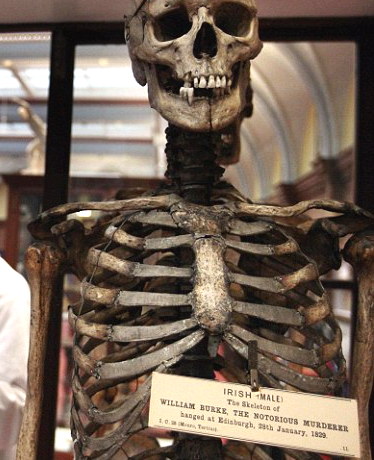
A wide range of convicted criminals were interred in Calton prison including murderers such as the notorious serial killers Burke and Hare, to political prisoners, terrorists, debtors, and those convicted of fraud. From 1914 onward conscientious objectors were also interred here.
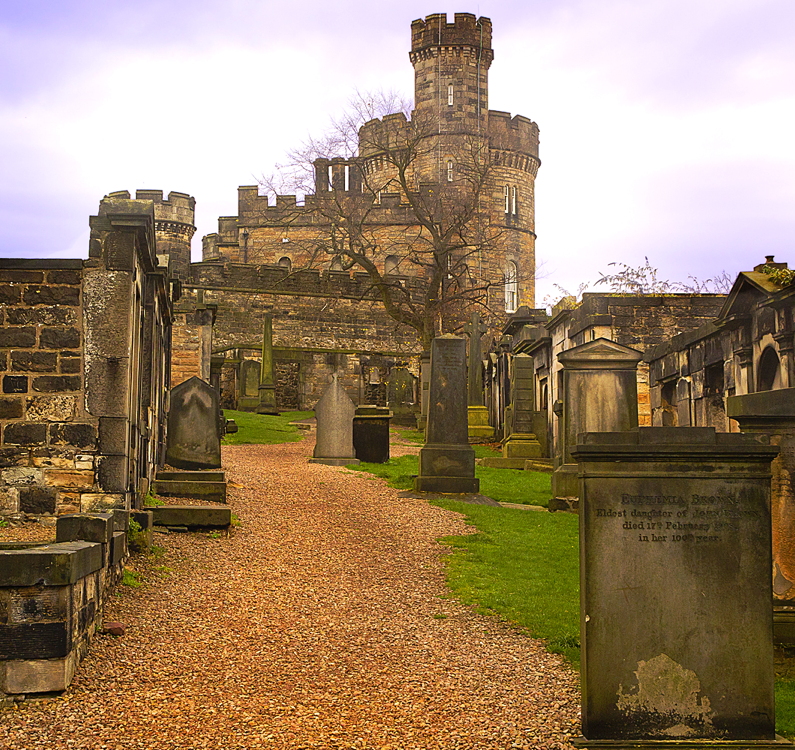
Calton Prison was closed in 1925 with all prisoners being transferred to the new Saughton Prison. Calton Prison was demolished in 1930 and is now the site of Saint Andrew’s House, the headquarters of the Scottish Government. All that is left of the old prison are the southern walls and the Governor’s House.

For more details see:
Robert Flockhart Vickers: A Tale of Double Murder in Old Edinburgh
 Vecchio