

Some older gravestones can be incredibly difficult to decipher, as with this example of a McAusland grave in Luss Kirkyard in Dumbartonshire.
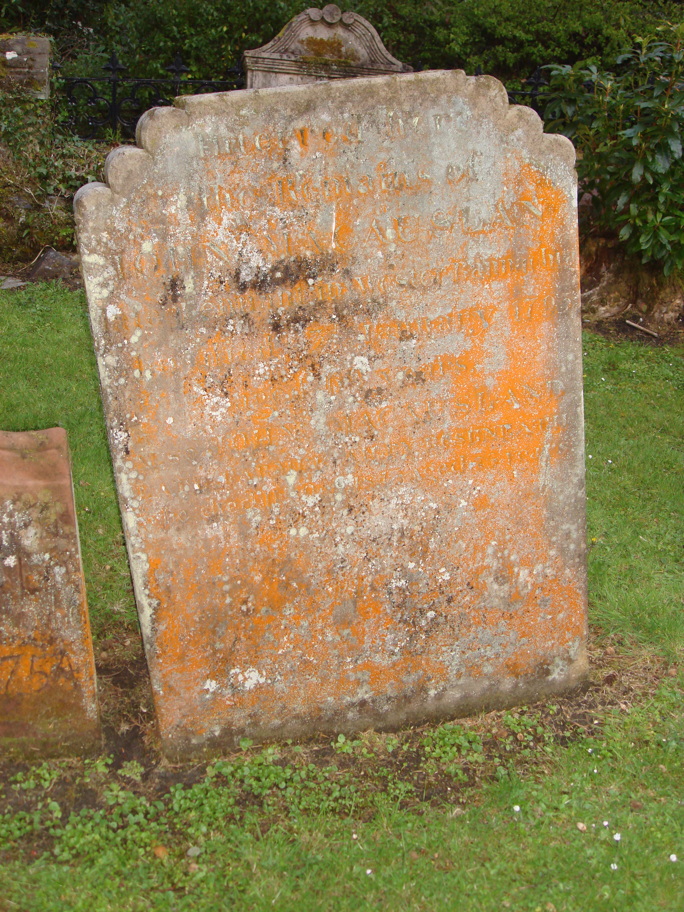
John McAuslan
late Tennant in Western Bannachra who died 3 (?) January 1795
aged 69 years
Also John McAuslan
_________Roseneath
who died ______ aged 76 (?) years.
But with the sun shining, the inscription suddenly became clear:

the Remains of
John MacAuslan
late tenant in Wester Bannachra who died 3 January 1795
aged 69 years.
Also John MacAusland
late farmer Ailey Roseneath
who died 11th Oct 1843 Aged 53 years.
These McAusland men from Luss seem to have married later in life than our East Lothian and Midlothian miners. Generally in the mining community couples would be about 20 when they married, and it can be relatively easily to find the parents as they often used Scottish naming traditions:
- The family’s first son was named after his paternal grandfather
- The second son was named after his maternal grandfather
- The third son was usually named after his father
- The family’s first daughter was named after her maternal grandmother
- The second daughter was named after the paternal grandmother
- The third daughter of the family was named after her mother
But here by the shores of Loch Lomond and in Glen Fruin, the McAuslands didn’t seem to follow the naming traditions very closely, and to work out relationships it is useful to know which farmsteads they lived at.
John McAusland, tennant in Western Bannachra is interesting as when he was married, he was described as “eldest son to John McAuslane of Bannachra“. One tiny word can be crucial as then when someone was described as “at” it meant they lived there, “in”, meant they were a tenant, and “of” meant they were the owner of the property, such as in the example below:
1694 Hearth Tax returns for the Parish of Luss shows that Alexander McCauslane of CALDONAH has 2 hearths, while a John McCauslane in CALDONAH also has 2 hearths. (Hearth Tax returns, 1694).
Bannachra Castle was the seat of Clan Colquhoun, and in in 1592 Sir Humphrey Colquhoun was murdered here by the MacGregors. He was reputedly shot by an arrow through a window on his way to bed, having been betrayed by a treacherous servant and the castle was then sacked. The Colquhouns abandoned Bannachra and relocated to nearby Rossdhu Castle on the banks of Loch Lomand. It transpired that Sir Humhrey’s brother John had been in league with the MacGregors. John Colquhoun was arrested, tried and later beheaded in Edinburgh.
As Bannachra has a castle, which was owned by the Colquhouns in the 1590s, one possibility was that John McAusland had bought the place some time after the Colquhouns retreated to Luss after the Battle of Glen Fruin in 1603. However, it seems clear that the McAuslans were actually in Bannachra, not of Bannachra, and were therefore not owners but tenants.
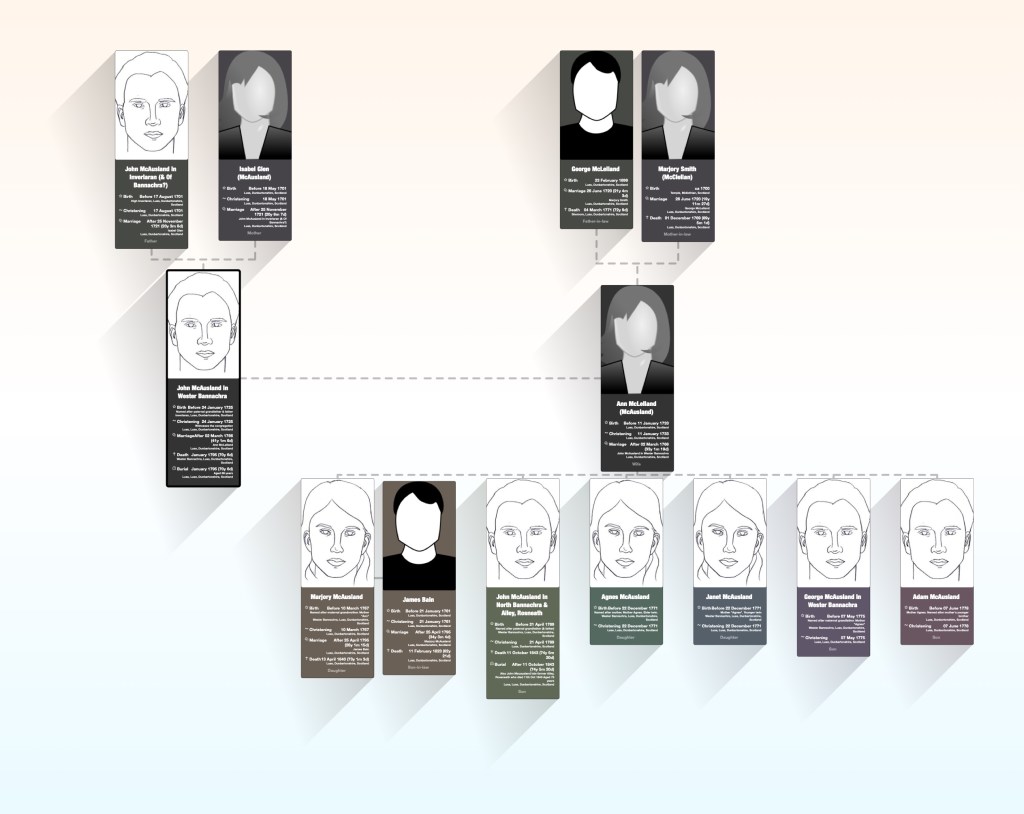
That photo really helps a lot as if John McAusland was 69 when he died, then he was either 41 when he married, or we have missed a generation. It seems likely that he was indeed 41 as the second inscription would correspond to his son John, who was born in 1769 at Wester Bannachra and was taxed on his horse in 1798:

E326:10:8:145 | ScotlandsPlaces
 Vecchio