
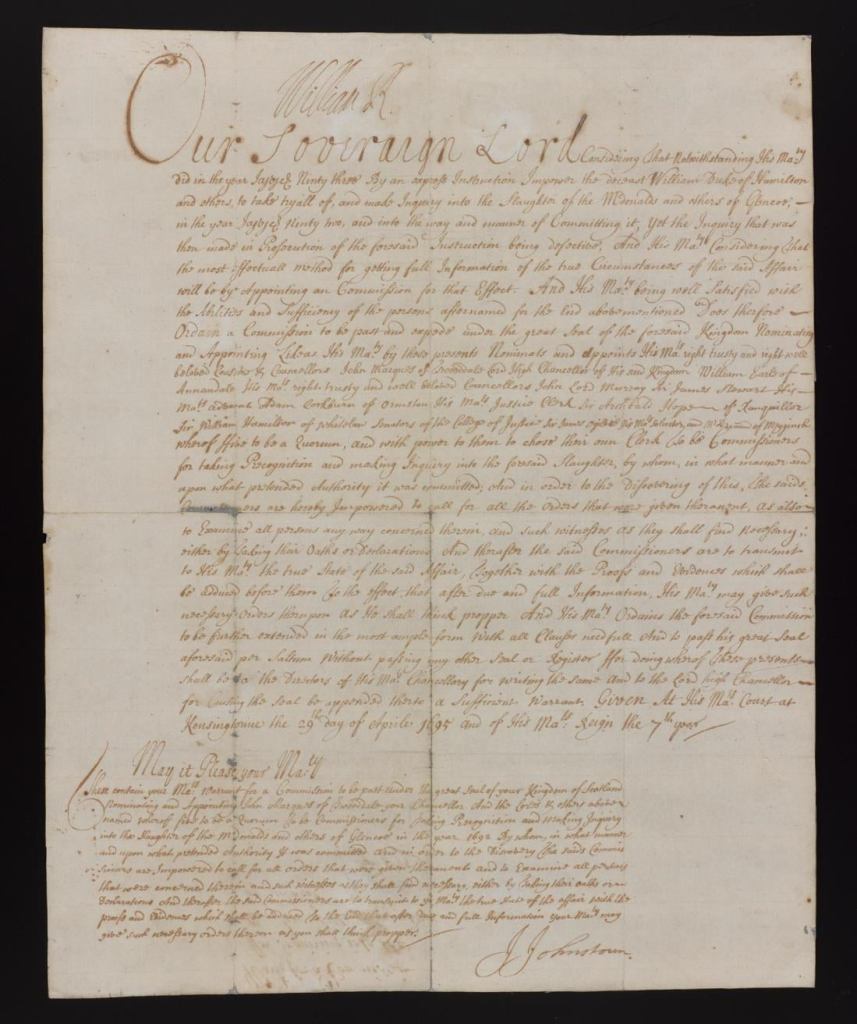
“You are hereby ordered to fall upon the rebells, the McDonalds of Glenco, and to put all to the sword under 70…”
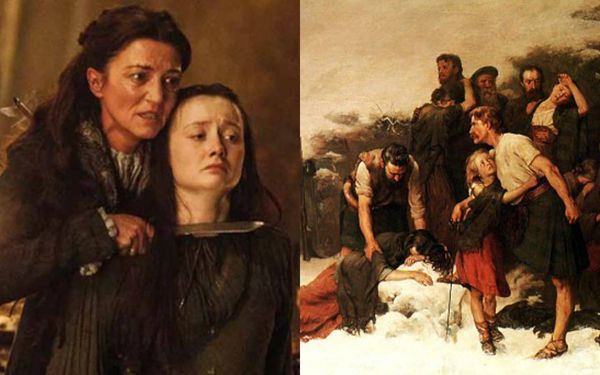
These orders led to the most infamous example of state sanctioned violence in 17th-century Scotland: the Massacre of Glencoe, (Scottish Gaelic: Murt Ghlinne Comhann). The massacre took place in Glen Coe in the Highlands of Scotland on 13 February 1692. An estimated thirty eight members and associates of Clan MacDonald of Glencoe were murdered by government troops, , with others later alleged to have died of exposure, for allegedly failing to pledge allegiance to the new monarchs, William II and III and Mary II who had replaced Mary’s father, James VII & II.
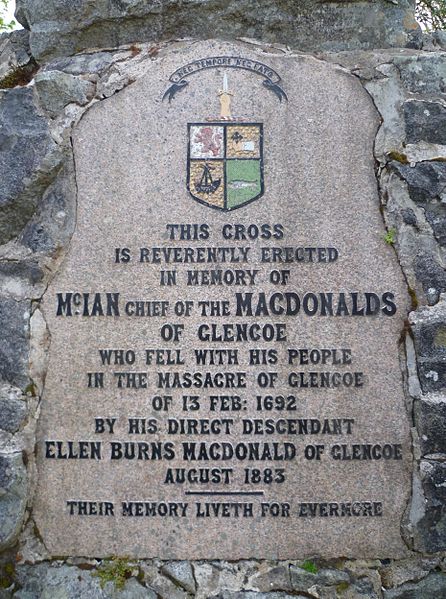
Although the Jacobite rising of 1689 was no longer a serious threat by May 1690, unrest continued in the Highlands especially in areas such as Lochaber. This neutralised military resources that were vital for William of Orange’s Nine Years War in Flanders. By late 1690, the Scottish government had agreed to pay the Jacobite clans a total of £12,000 for swearing loyalty to the new monarchs. However, delays in receiving permission from King James VII to sign the oath meant by December 1691 some had not complied.
Under pressure from William, Secretary of State Lord Stair decided to make an example as a warning of the consequences for further delay. The Glencoe MacDonalds were not the only ones who failed to meet the deadline, while the Keppoch MacDonalds did not swear until early February. The reason for their selection is still debated but appears to have been a combination of internal clan politics, a reputation for lawlessness and perhaps most significant, the fact that they were a small clan, that made them an ideal target.
While there are examples of other similar mass murders in Scottish history, the Glencoe massacre was unusual in the context of late 17th century society and its brutality shocked contemporaries. It became a significant element in the persistence of Jacobitism in the Highlands during the first half of the 18th century, and remains a powerful symbol of Murder under trust.
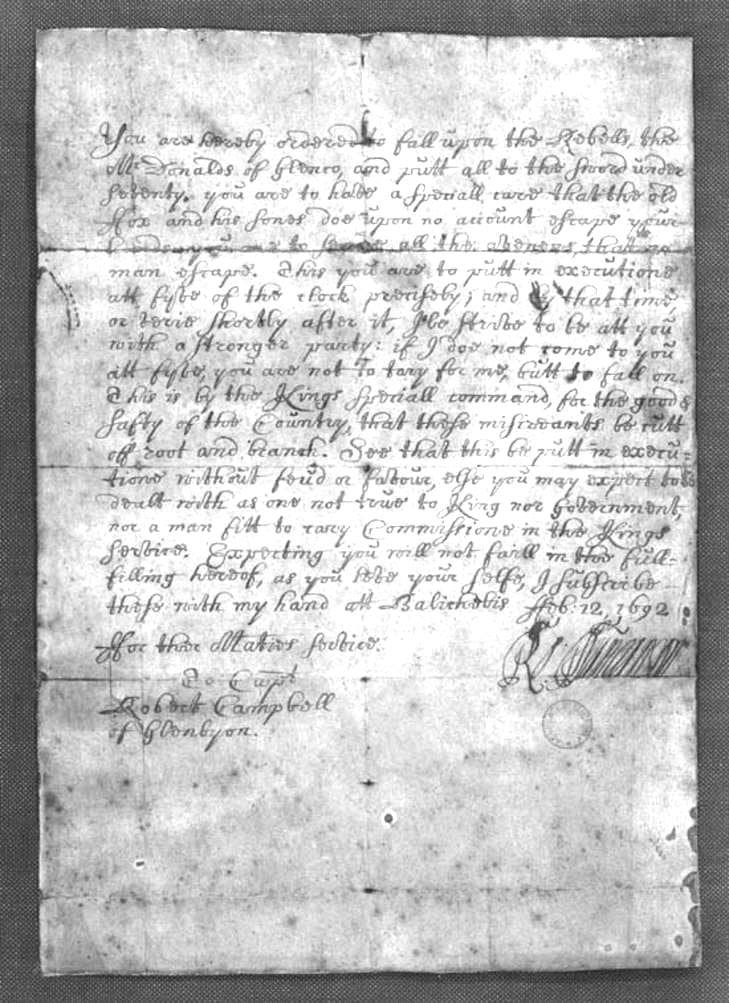
Used with the permission of the National Library of Scotland.
“You are hereby ordered to fall upon the rebells, the McDonalds of Glenco, and put all to the sword under seventy. you are to have a speciall care that the old Fox and his sones doe upon no account escape your hands, you are to secure all the avenues that no man escape. This you are to putt in execution att fyve of the clock precisely; and by that time, or very shortly after it, I’ll strive to be att you with a stronger party: if I doe not come to you att fyve, you are not to tarry for me, but to fall on. This is by the Kings speciall command, for the good & safety of the Country, that these miscreants be cutt off root and branch. See that this be putt in execution without feud or favour, else you may expect to be dealt with as one not true to King nor Government, nor a man fitt to carry Commissione in the Kings service. Expecting you will not faill in the full-filling hereof, as you love your selfe, I subscribe these with my hand att Balicholis Feb: 12, 1692“
The Massacre was commemorated in song:
The Massacre of Glencoe
Chorus:
“Oh cruel is the snow that sweeps Glencoe
And covers the grave o’ Donald
And cruel was the foe that raped Glencoe
And murdered the house o’ MacDonald
“They came in the blizzard, we offered them heat
A roof ower their heads, dry shoes for their feet
We wined them and dined them, they ate o’ our meat
And they slept in the house O’ MacDonald
(Chorus)
“They came from Fort William with murder in mind
The Campbell had orders, King William had signed
Pit all tae the sword, these words underlined
And leave none alive called MacDonald
(Chorus)
“They came in the night when the men were asleep
That band of Argyles, through snow soft and deep.
Like murdering foxes, among helpless sheep
They slaughtered the house o’ MacDonald
(Chorus)
“They came from Fort William with murder in mind
The Campbell had orders, King William had signed
Pit all tae the sword, these words underlined
And leave none alive called MacDonald
(Chorus)
“Some died in their beds at the hands of the foe
Some fled in the night, were lost in the snow.
Some lived to accuse him, what struck the first blow
But gone was the house of MacDonald
(Chorus)
(Repeat Chorus)
Under Scottish law there was a special category of murder, known as “murder under trust“. Although the massacre order was signed by the king, Scottish law did not accept that as an excuse for murder, and the clan Campbell was blamed for the crime.
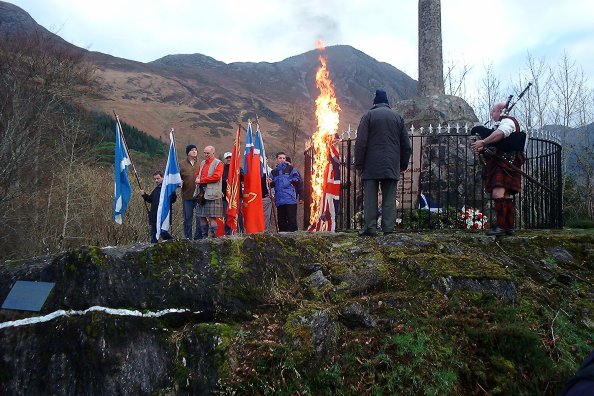
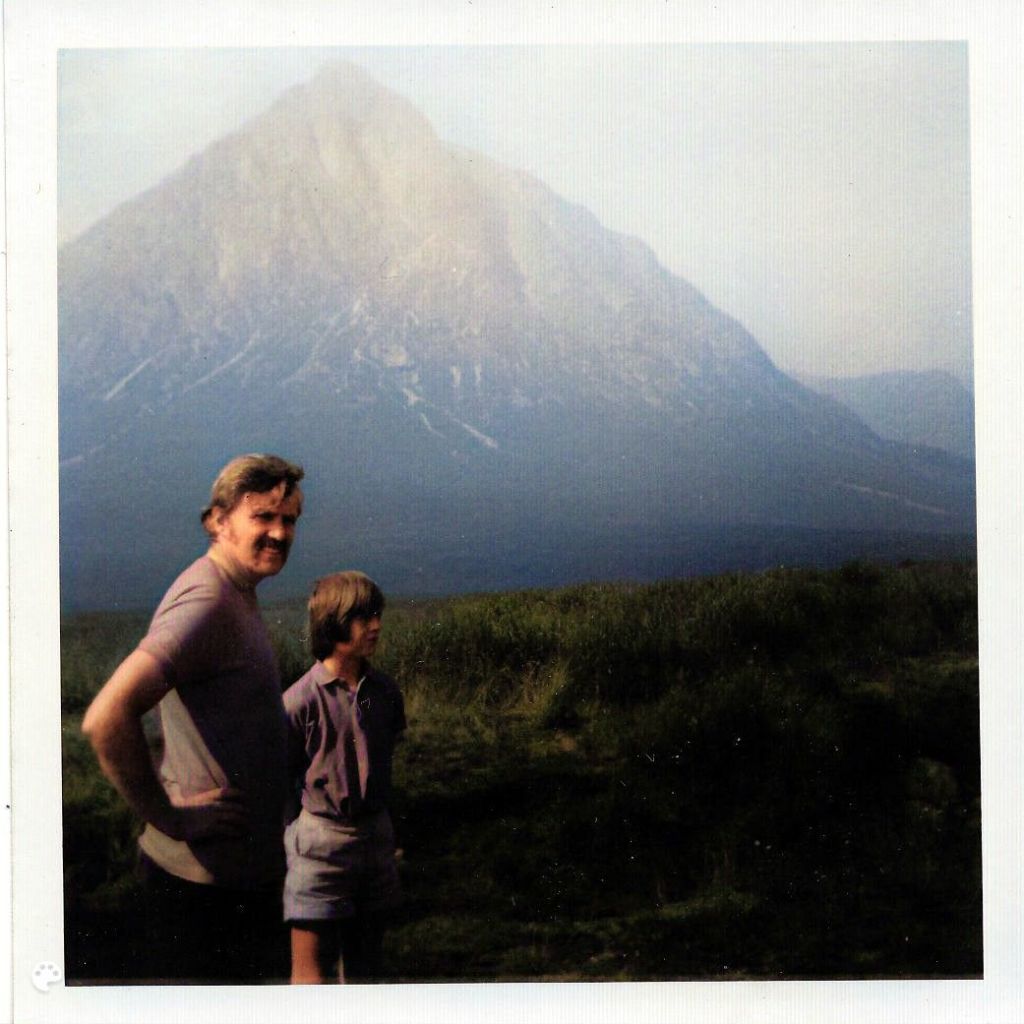
The Massacre of Glencoe commemorated in 2005. Photo credit Donald Anderson.
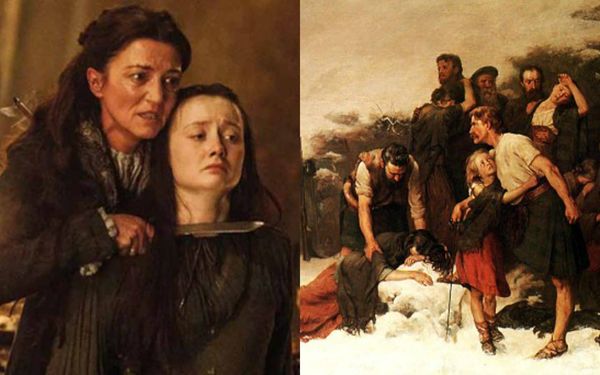
The Connection between the 1692 Massacre of Glencoe and the Appin Murder of 1752.
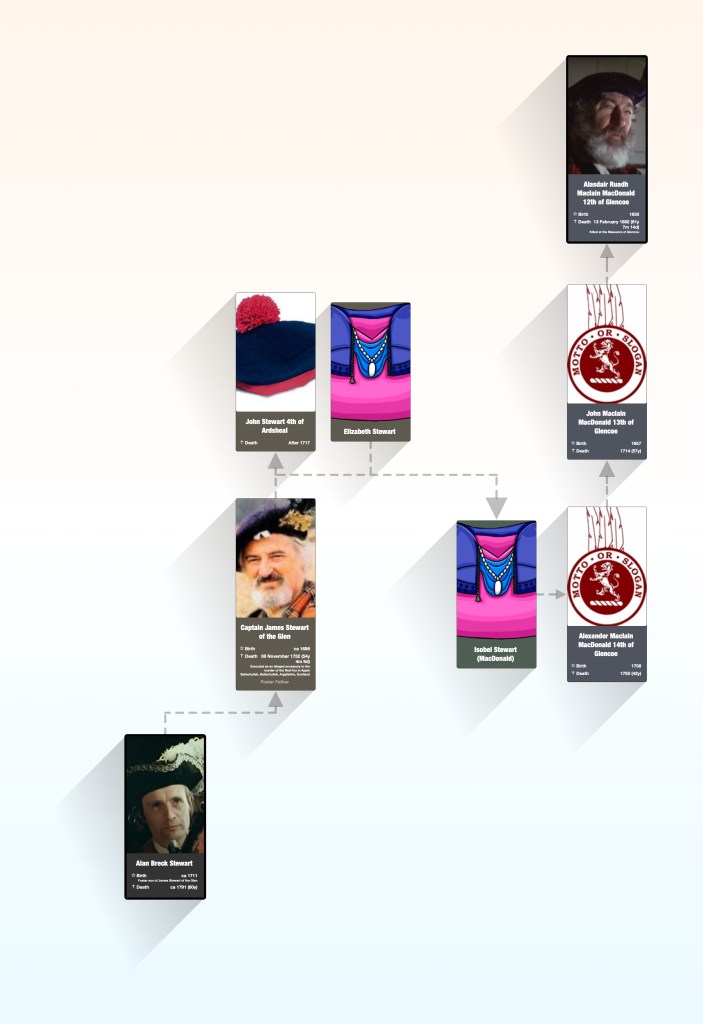
Colin Roy Campbell of Glenure (1708-1752), nicknamed “The Red Fox“, was the government-appointed factor to the forfeited lands of the Clan Stewart of Appin in north Argyllshire. During the Highland Clearances, a series of reprisals against Jacobite sympathizers in the aftermath of the rising of 1745, Campbell had ordered several evictions of members of Clan Stewart. On 14 May 1752, Campbell was shot in the back by a marksman in the wood of Lettermore near Duror.
The search for the killer targeted the Stewarts of Appin. The chief suspect, Alan Breck Stewart having fled, James Stewart of the Glens, the tanist of the Stewarts of Appin, was arrested for the crime and tried for the murder in a trial dominated by the pro-Hanoverian Clan Campbell: chief Archibald Campbell, 3rd Duke of Argyll was the presiding judge and the 15-man jury contained Campbell clansmen. Although the trial showed that James was not directly involved in the assassination (he had a solid alibi), he was found guilty “in airts and pairts” (as an accessory; an aider and abetter).[5]
James Stewart of the Glens was hanged on 8 November 1752 on a specially commissioned gibbet above the narrows at Ballachulish, now near the south entrance to the Ballachulish Bridge. He died protesting his innocence, lamenting that people of the ages may think him capable of a horrid and barbarous murder.
In 2001 a descendant of the Stewarts of Appin, 89-year-old Anda Penman, identified young Donald Stewart of Ballachulish as the real killer, having allegedly kept a secret that was passed on by word of mouth through generations of her family.
 Vecchio