

Edwardum occidere nolite timere bonum est
It may come as a surprise to modern readers that even celebrated authors such as Sir Walter Scott often omitted punctuation when writing and left it to the publisher to insert punctuation where they felt it was necessary. Generally, even without punctuation, the meaning of most writing was clear, but not always.
The importance of punctuation is demonstrated in the celebrated amphibolic letter in Christopher Marlowe’s 1594 play Edward II (Full title: The Troublesome Reign and Lamentable Death of Edward the Second, King of England, with the Tragical Fall of Proud Mortimer), which results in the King being executed. Deliberately left “unpointed”, or unpunctuated, it both saves and kills the King:
“This letter written by a friend of ours,
Containes his death, yet bids them save his life.
Edwardum occidere nolite timere, bonum est.
Feare not to kill the king tis good he die.
But read it thus, and thats an other sence:
Edwardum occidere nolite, timere bonum est.
Kill not the king tis good to feare the worst.
Unpointed as it is, thus shall it goe,
That being dead, if it chaunce to be found,
Matrevis and the rest may beare the blame,
And we be quit that causde it to be done.“
Christopher Marlowe, Edward II. Act Five, Scene Four.
We are faced with a similar problem in the interpretation of the signatories of the “Pryde Petition” of ca 1746. This was signed by a number of coal miners in the employment of William Grant, Baron of Prestoun Grange, regarding their working conditions. The mine at Prestongrange in Prestonpans parish in East Lothian had flooded and several of William Grant’s tied miners had been sent to work at the Duke of Hamilton’s pit at Pinkey (Pinkie) in Inveresk with Musselburgh parish in Midlothian, where they had serious concerns regarding their treatment. It is an important document as it is surely one of the earliest recorded examples of what later became trades unionism and in its field it is the equivalent of the 1320 letter to the Pope from the Community of the Realm of Scotland that is now known as the “Declaration of Arbroath“.
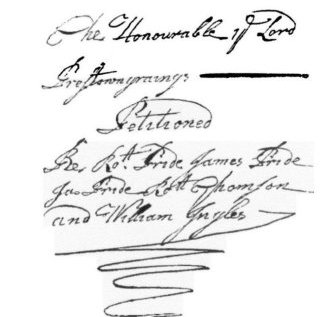
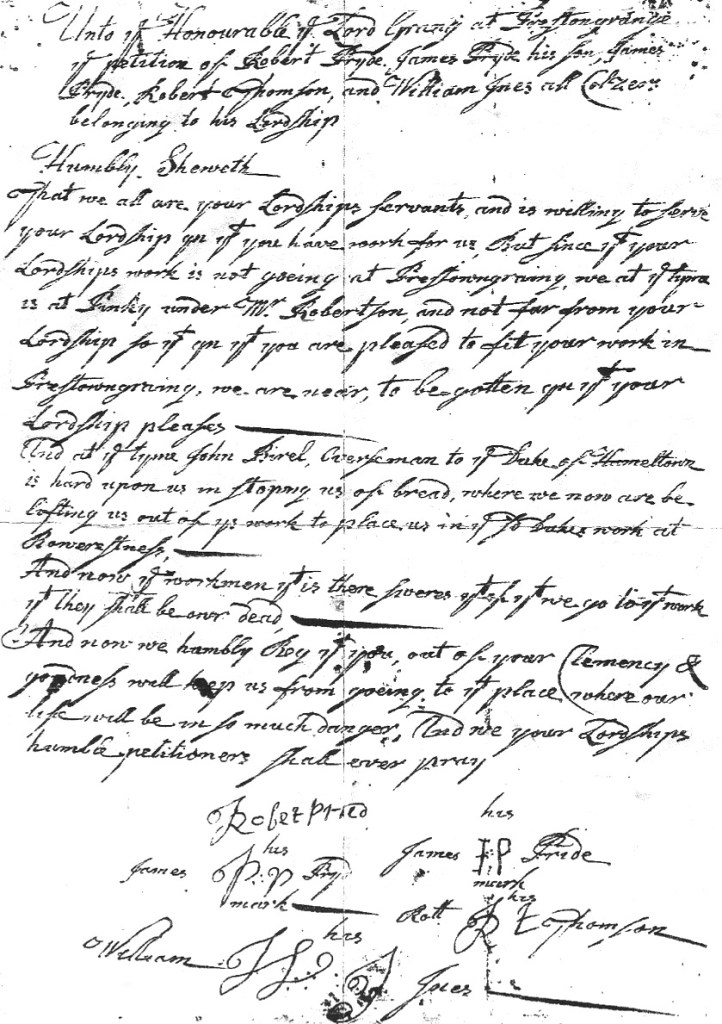
PETITION WORDING
Front
The Honourable ye Lord Prestongraings
Petitioned
Be Rott. Pride, James Pride,
Ja. Pride, Rott. Thomson
And William Ingles
Petition
Unto ye Honourable ye Lord Grang at Prestongrange
Ye petition of Robert Pryde. James Pryde his son, James
Pryde. Robert Thomson, and William Ines all Colzers (Colliers)
belonging to his Lordship
Humbly Sheweth
That we all are your Lordships Servants, and is willing to serve
your Lordship qn yt (when that) you have work for us, But since yt (that) your
Lordships work is not goeing at Prestongraing, we at ye tyme
is at Pinky under Mr Robertson, and not far from your
Lordship so yt qn yt (that when yet) you are pleased to fit your work in Prestongraing we are near to be gotten qn yt (when that) your
Lordship pleases
And at ye time John Birel, Oversman to ye Duke of Hameltown (Hamilton)
is hard upon us in stoping us of bread, where we now are be (by)
lifting us out of ys (this) work to place us in ye Lo (Lord) Dukes work at
Bowersstness (Borrowstouness).
And now ye workmen yt (that) is there sweres yt (that) if yt (that) we go to yt (that) work
yt (that) they shall be our dead.
And now we humbly Prey yt (that) you, out of your Clemency &
goodness will keep us from going to yt (that) place where our
life will be in so much danger, And we your Lordships
humble petitioners shall ever pray
SIGNED
Robet Pried
James Pryd (his initials mark)
James Pride (his initials mark)
Rott. Thomson (his initials mark)
William Ingles (his initials mark)
So, which Prides actually signed the petition?
The problem, as in the letter that determined the fate of Edward II, lies in the fact that the text is ambiguous. Does “his son” mean that the first James Pride is the son of the previously named Robert Pride, or does it refer to “his son”, the second named James Pryde?
Robert Pride’s son, James was born on 27 March 1732 at Prestonpans, so he would only have been aged about 14 at the time of the petition. While this was young, in Scotland in was legal, albeit rare, for boys to marry at 14 without parental consent until 1928. Robert’s younger brother James also had a son named James, but he was not baptised until 12 November 1740 in Prestonpans, so he would have been too young to be a signatory.
But what of James Pride, senior, the father of Robert and James Pride? In A Pride of Prydes by Eve Pryde-Roberts she states:
“Although there is some ambiguity caused by the way the names are listed it would appear that the Petition was instigated by James’ son Robert, signed by him and his brother James and by James the Elder together with the other men named. “
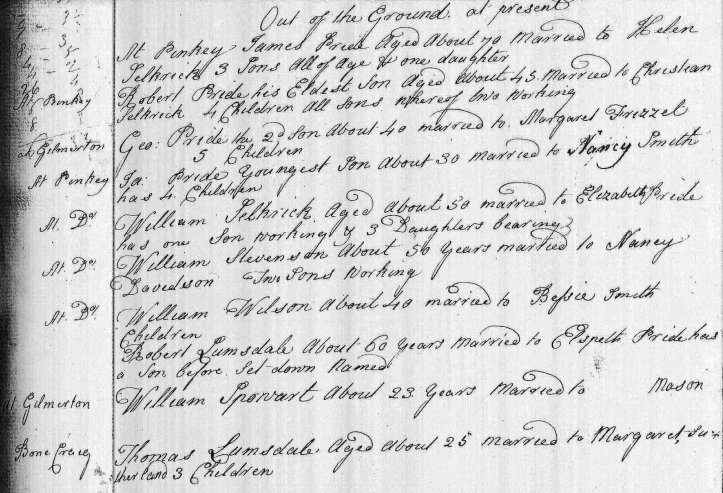
If we look at the people who were actually at Pinkey (modern Pinkie near Musselburgh) they included James Pride senior and his sons Robert and James. So despite the ambiguous mention of “his son” it would make sense that Eve’s conclusion is likely to be correct and that these were probably the people who instigated the petition.
King Edward II of England was forced to abdicate and was imprisoned at Berkeley Castle. Whilst here he was brutally murdered, and today the circumstances of the event still remain a mystery.
Prestongrange Museum – East Lothian – Scotland.
 Vecchio