
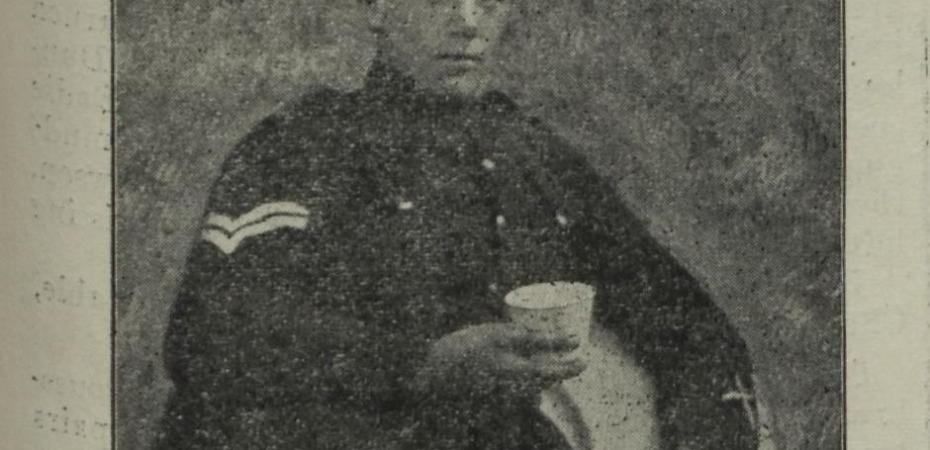
George Archer-Shee, the inspiration for The Winslow Boy
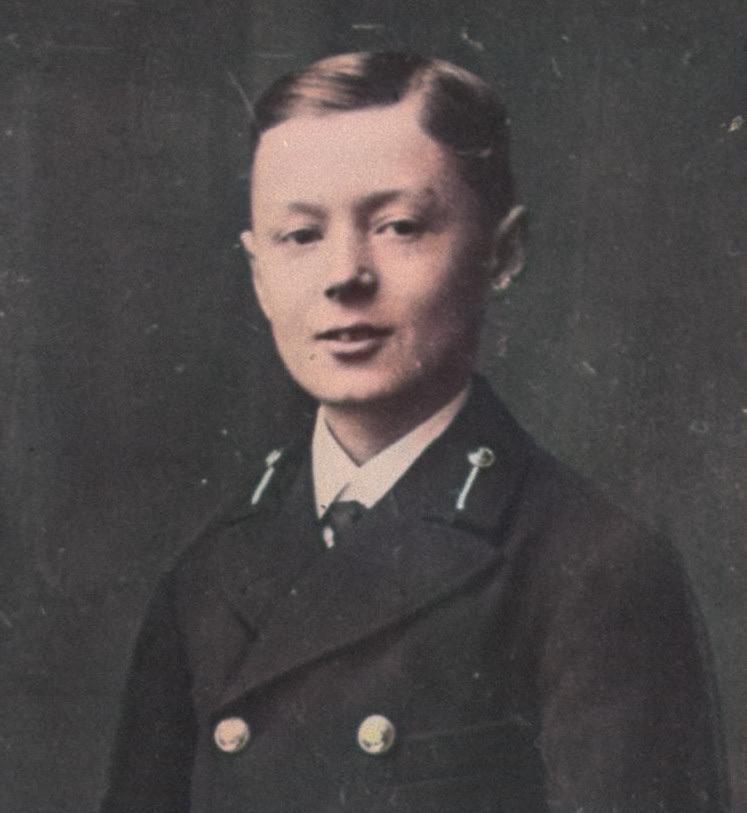
George Archer-Shee (6th May 1895 – 31st October 1914) was a Royal Navy cadet whose case of whether he stole a five shilling postal order was decided in the English High Court of Justice in 1910. George Archer-Shee was successfully defended by Sir Edward Carson, a barrister and politician.

The trial became a British cause célèbre, and was the inspiration for the 1946 play The Winslow Boy by Terence Rattigan , which has been the basis of two films. Following George Archer-Shee’s acquittal, his family were paid compensation in July 1911. George Archer-Shee obtained a commission in the British Army in 1913, and was killed aged just 19, on 31st October 1914, at the First Battle of Ypres.
James Stuart Colquhoun McAuslane
Around the same time as the incident that inspired Terence Rattigan to write The Winslow Boy, there was a similar incident involving a member of the McAuslane family. However unlike the well-documented affair involving George Archer-Shee, we know little about the circumstances regarding James Stuart Colquhoun McAuslane’s accusation and how the events ended.

James Stuart Colquhoun McAuslane was born on 3rd January 1889 in Battersea. This is a large district in southwest London, south of the river Thames, and is part of the London Borough of Wandsworth. It is perhaps best known for its eponymous power station and cat & dog home.
James was the only son of James McAuslane, esquire, who had been born in 1854 at Dunfermline in the county of Fife in Scotland and his wife Victoria Albertina Lyons. She had been born in 1854 at Patras, Greece’s third-largest city and the regional capital and largest city of Western Greece, in the northern Peloponnese. Although born abroad, Victoria’s parents were British and therefore she was a British subject by parentage.
James had three elder sisters: Margaret Ethel, born 1881 in South Hornsey, Middlesex, England; Gladys Victoria, born 1884 in Battersea; Edith Jessica, born 1885 also in Battersea; and a younger sister, Alesta Alexandra, born 1893 in Bexley in Kent.

James’ father had moved to London some time before his marriage in 1879, and in 1889, he became member 502 of The Buchanan Society. The Society was founded in 1725 and is celebrating its 300th anniversary this year. The society does not research the clan’s history but rather aims to provide support, to those eligible, in the form of educational and financial hardship grants.
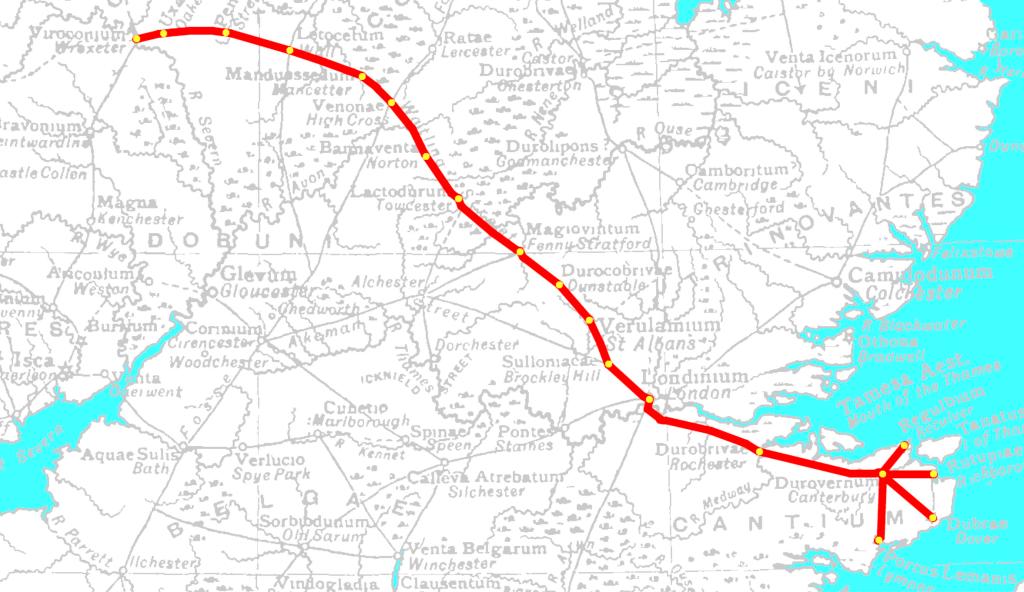
In 1889, James McAuslane senior’s address was 60 Watling Street, London. Watling Street is a historic route in England, running from Dover in the southeast, via Saint Albans to Wroxeter. The road crosses the River Thames at London and was used in Classical Antiquity, Late Antiquity, and throughout the Middle Ages. Created by the ancient Britons, Watling Street was later paved by the Romans and was perhaps the best known road in Roman Britannia and medieval England. The line of Watling Street became the border between Danelaw and the Anglo-Saxon kingdoms of Wessex and Mercia.
At the census of 5th April 1891, the family was living at “Glen Rose”, Ballham Park Road, Battersea and James McAuslane senior was working as an “Australian Merchant”.
At the census of 31th March 1901, the family was living at 1 Darnley Road in Kensington, and he was working as a “Granite Quarry owner & financier (Employer)“.

At the census of 2nd April 1911, James McAusane senior and his wife were boarders at 10 Cornwall Road in Harrogate and he was employed as the Secretary of the Primrose League. The Primrose League was founded in 1883 and was “an organisation for spreading Conservative principles amongst the British democracy.” In 1910, the League’s membership had reached 2,053,019, however, by 1912 the membership had fallen to just over 650,000 as other similar organisations emerged. In 2004, after 121 years, the Primrose League was wound up, but it was resurrected in 2023.
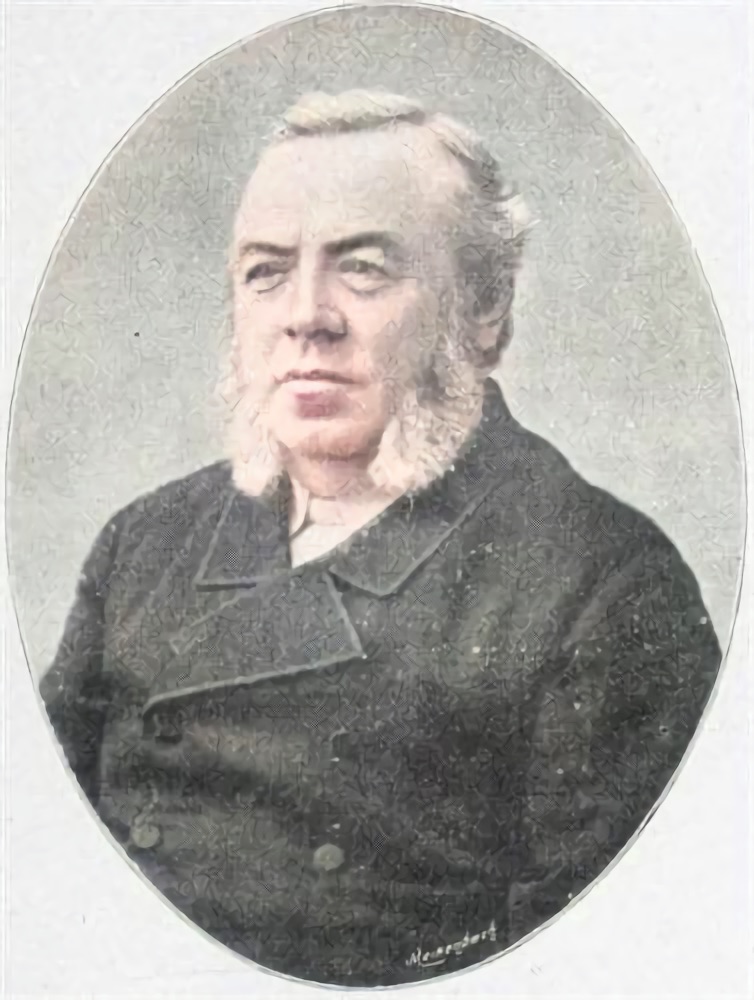
James’ grandfather, Alexander McAuslane (1825 – 25th June 1886) was a Doctor of Divinity. He had studied at Washington and Lee University, a private liberal arts college in Lexington, Virginia, United States of America. It was established in 1749, as Augusta Academy, in what was then the Colony of Virginia and is one of the oldest institutions of higher learning in the USA.
John McCaslan of Newlandmuir (20th March 1767 – 20th July 1862) had researched the McAusland family history and his son, Robert McCasland of Newlandmuir referenced this research when he matriculated arms on 10th February 1863. Alexander McAuslane was also a family historian and established that via the maternal line his Prestilloch McAuslands were descended from Alexander Stewart, 4th of Ballachulish, and via him from the Stewart Kings of Scots.
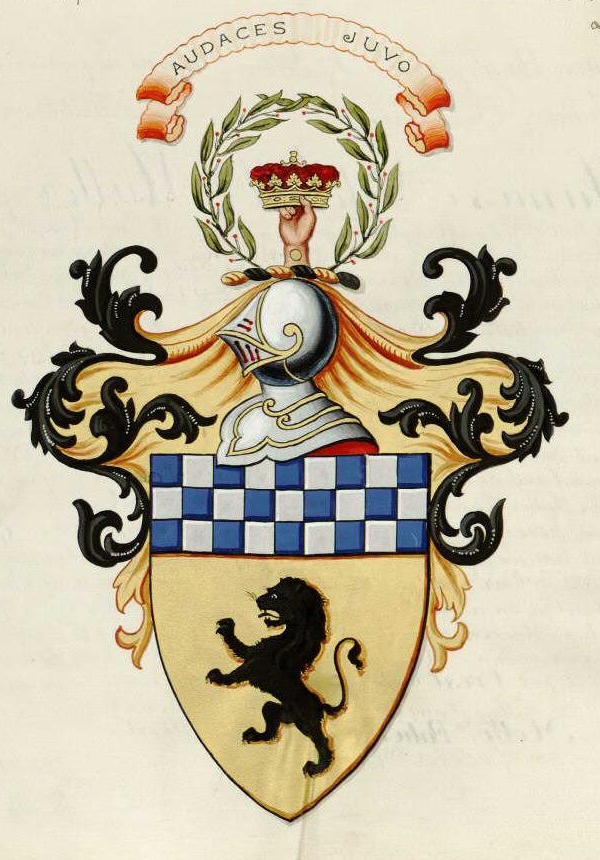
When James’ father James McAuslane senior matriculated arms in 1891, these consisted of the black Buchanan lion rampant on a yellow field with an addition of a blue and white chequey to highlight their descent from the Stewarts/Stuarts. James’ second christian name of “Stuart” was clearly another illusion to their illustrious ancestry.
In some internet trees such as Family Search, James’s third christian name of “Colquhoun” would appear to be in honour of his apparent great grandmother, Catherine Colquhoun, (19th October 1796 – 15th June 1843), a granddaughter of Walter Colquhoun in Meikle Balernaig, who may have been a descendant of the Colquhoun Barons of Luss & Colquhoun. However this is an error as, Catherine Colquhoun actually married not James Stuart Colquhoun McAuslane’s great grandfather, Peter McAuslane (1796 – 21st July 1876), but his possible first cousin once removed, Peter McAuslane (1797 – 7th December 1849). Instead, we believe that, as with James second christian name of “Stuart”, his third christian name of “Colquhoun” was a reference to deep McAuslane ancestry back to the 1500s when Agnes Colquhoun, daughter of Humphrey Colquhoun of Tullichintaull married Patrick McCauslane, 21st Baron of Caldenoch in our reckoning, and Marjory Colquhoun, daughter of Sir John Colquhoun, 13th Baron of Luss, 11th Baron of Colquhoun, married Patrick McCauslen, 18th Baron of Caldenoch in our reckoning.
The Lyons Family

In Arthur Charles Fox-Davies’ “Armorial families; a directory of gentlemen of coat-armour” (1905), the father of Victoria Albertina Lyons is described as “Andrew Lyons, Knight Commander of the Hanoverian Guelphic Order of Patras“.
It is interesting to note that there was another British diplomat who served in Greece named Captain Sir Edmund Lyons (21st November 1790 – 23rd November 1858). He later became Admiral Edmund Lyons, 1st Baron Lyons. In August 1832, Edmund Lyons transported the new King Otto of Greece, and the Bavarian Regency, from Brindisi to Nauplia, and then, in 1833, from Trieste to Athens. Sir Edmund left the navy in January 1835, and was knighted in the Royal Guelphic Order. He was appointed by Lord Palmerston as the British diplomat at Athens, as which he remained for almost fifteen years. On 29 July 1840 he was created a baronet, in July 1844 he was made a Knight Grand Cross in the Civil Division of the Order of the Bath and in 1856 he was raised to the Peerage of United Kingdom as Baron Lyons, of Christchurch, Hampshire, (United Kingdom).
Given the Patras connection it seems possible that Andrew Lyons was related in some, as yet unknown way to the 1st Baron Lyons.

Wanted for Fraudulent Conversion of £45
Being a member of such a privileged family, it might be considered that James Stuart Colquhoun McAuslane had been “born with a silver spoon in his mouth“. However, in 1911, as with George Arthur-Shee, the inspiration for The Winslow Boy, James Stuart Colquhoun McAuslane became embroiled in a scandal. In the Police Gazette of 13th October 1911, James Stuart Colquhon (sic) McAuslane appeared in the City of London section of the Police Gazette, wanted “for fraudulent conversion of £45.”
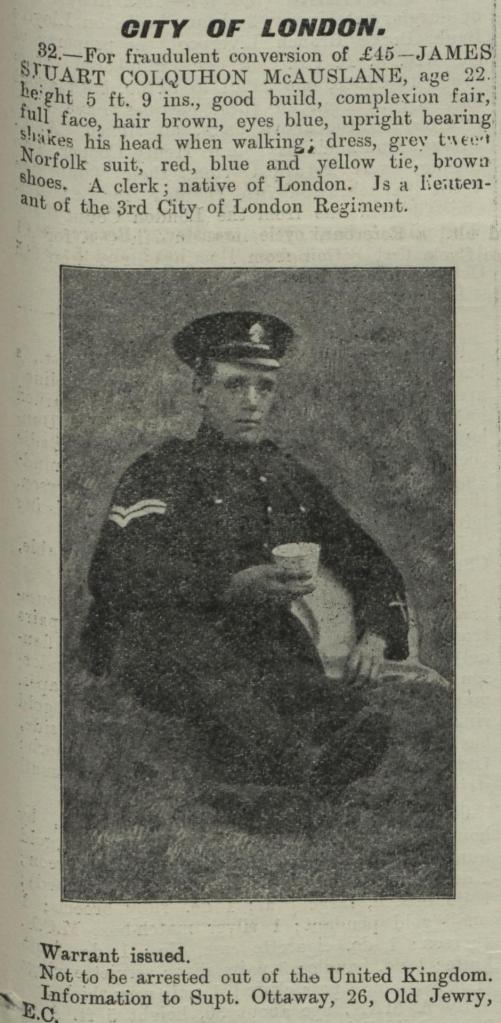
A detailed physical description of James was given, and he was described as “a Lieutenant of the 3rd City of London Regiment” – although the accompanying photo appears to be of someone in a corporal’s uniform.
The same information appeared a week later in the Police Gazette of 20th October 1911.
At the moment, we do not know how this affair began or ended and whether James was arrested and tried, or whether he evaded capture.
While we have found him in the 1891 and 1901 censuses, we could not find him in 1911. Neither do we know when he died and whether he succeeded his father as an armiger of Clan Buchanan.
Update
Thanks to the members of the Scottish Indexes group on Facebook, we now have some more information concerning James Stuart Colquhoun McAuslane.
Residence
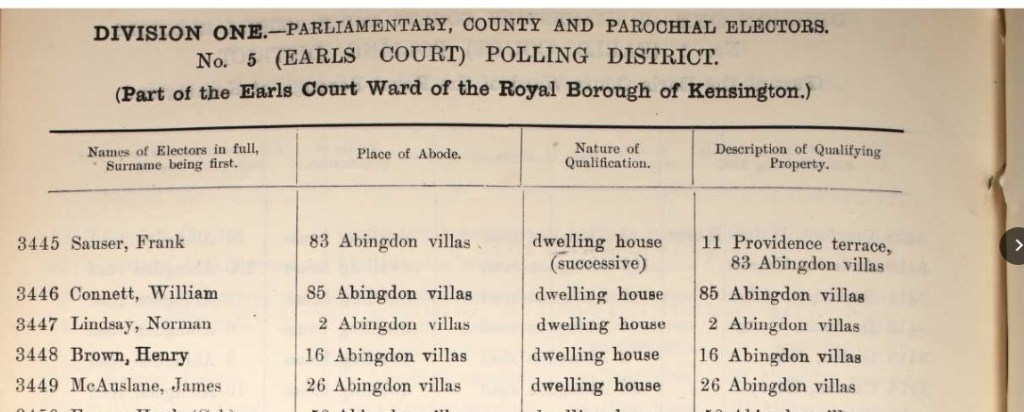
In 1905, a James McAuslane living at 26 Abingdon Villas was registered as a voter in the Royal Borough of Kensington.

26 Abingdon Villas is estimated current value is over £5 million pounds.

In 1911, there is a Stuart McAuslane, aged 22 and single, who was born in Wandsworth. Battersea, where James Stuart Colquhoun McAuslane was born is part of the London Borough of Wandsworth. Stuart McAuslane was working as a Commercial Clerk – an employment that might potentially have provided an opportunity for an alleged “fraudulent conversion of £45.”
Entries in the London Gazette

London Gazette, 6th May 1910.
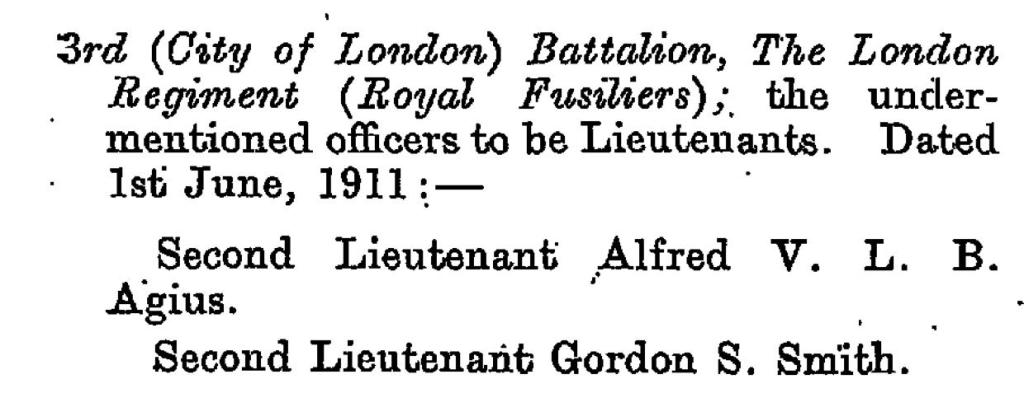

London Gazette, 25th July 1911.

The London Gazette confirmed that James Stuart Colquhoun McAuslane served in the 3rd (City of London) Battalion, The London Regiment (Royal Fusiliers). This infantry regiment was created in 1908 to encompass the 26 Volunteer Force battalions in the newly formed County of London. It was part of the Territorial Force (which became the Territorial Army in 1921). The regiment saw service in the First World War and was disbanded in 1938, shortly before the Second World War, when most of its battalions were converted to other roles or transferred elsewhere.
James Stuart Colquhoun McAuslane was promoted from Lance Sergeant to Second Lieutenant on 7th May 1910, then promoted further to Lieutenant on 25th July 1911.
On 3rd April 1912, he was removed from the Territorial Force, presumably as a result of his alleged “fraudulent conversion of £45.
Cap Badge

Stephen Barr has pointed out that the Cap Badge in the photo of the Corporal with the dog in the Police Gazette certainly looks very much like the City of London Regiment Cap Badge. Whether James Stuart Colquhoun McAuslane was initially a corporal who was promoted to lieutenant or the photo is of another member of the regiment was originally unclear. Certainly, a few years later, at the start of World War I, young gentlemen who enlisted as private soldiers were promoted as temporary officers. This happened with our relative Robert Philp MC & Bar, who was promoted to corporal on 2nd September 1915 and then ten days later commissioned as a Temporary Second Lieutenant in Kitchener’s New Army.
The entries in the London Gazette indicate that James Stuart Colquhoun McAuslane was a Lance-sergeant, Second Lieutenant, and then Lieutenant in The London Regiment.
Lance-sergeant was an appointment given to a corporal so they could fill a post usually held by a sergeant. Lance-sergeants wear three rank chevrons, the same insignia as a sergeant, whereas the police photograph is of a corporal. It seems likely that this is indeed of James Stuart Colquhoun McAuslane, prior to his subsequent promotions.
Acknowledgements
Thanks to Stephen Barr, Craig Miller and Doreen Cuthbert for information and suggestions.
If you have any additional information about James Stuart Colquhoun McAuslane, please do get in touch.
The Winslow Boy 1948 (and 1999) Movie Review + Comparison.
 Vecchio